
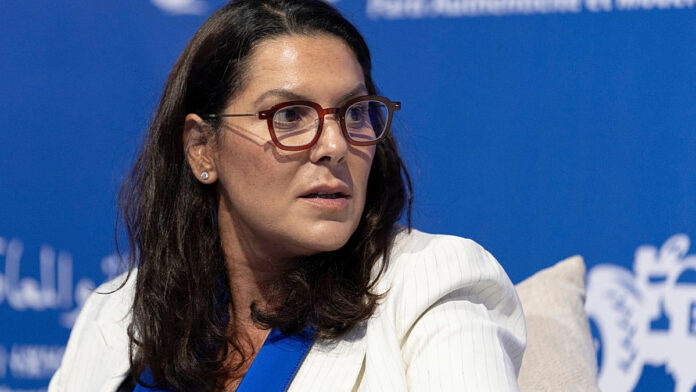
RABAT – Morocco’s King Mohammed VI has appointed Fatima Ezzahra El Mansouri as the country’s first woman prime minister, marking a historic change in political leadership after an election that also exposed declining voter participation and growing pressure to deliver jobs and economic opportunities.
El Mansouri’s appointment on Tuesday follows the victory of her liberal-centrist Authenticity and Modernity Party, known as PAM, in the 23 September parliamentary election. PAM secured 97 seats in Morocco’s 395-seat parliament, increasing its representation from 87 seats in 2021 and overtaking the National Rally of Independents.
The appointment gives Morocco its first female head of government at a significant moment for the North African economy. The incoming administration will oversee the final stages of a roughly $20 billion investment programme linked to preparations for the 2030 FIFA World Cup, which Morocco will co-host with Spain and Portugal.
El Mansouri brings considerable political experience to the role. She has previously served as mayor of Marrakech and held government responsibility for housing and urban policy. Her elevation to prime minister adds another milestone to a political career that has placed her among Morocco’s most prominent female public figures.
Her party’s election victory came after a campaign dominated by employment, public services, healthcare, wages and the cost of living. PAM promised an ambitious programme that included creating one million jobs and increasing investment in healthcare, education and social protection.
Delivering those promises will be difficult in an economy where impressive infrastructure development exists alongside frustration among younger Moroccans over employment and economic opportunity. Those tensions became particularly visible during youth-led protests last year and a mass attempt by migrants to cross into the Spanish enclave of Ceuta.
Voter participation provides another indication of public dissatisfaction. Turnout fell to 38.02% from about 50% in the 2021 parliamentary election, according to Morocco’s Interior Ministry. Around 27 million Moroccans were eligible to vote, but only 15.8 million had registered, about 12% fewer than in the previous election.
Turnout does not provide a complete measure of public confidence, but the decline leaves Morocco’s new government confronting an important question about political participation. El Mansouri takes office after a historic personal appointment, yet a substantial majority of eligible citizens did not participate in choosing the parliament from which her government emerges.
Morocco’s political system also places limits on how parliamentary elections reshape national policy. Under the 2011 constitution, the king appoints the prime minister from the party that wins the largest share of parliamentary seats. The monarch retains substantial authority over strategic policy, defence and foreign affairs, while the elected government manages significant areas of domestic and economic policy.
PAM’s victory changed the balance within parliament without fundamentally altering that constitutional structure. The National Rally of Independents, which led the previous government under Aziz Akhannouch, fell into second place after five years in power.
Akhannouch had already stepped down as RNI leader and did not seek another term as prime minister. His government faced criticism over food prices and other economic pressures, while tensions emerged between coalition partners during the election campaign.
The Islamist Justice and Development Party also staged a significant parliamentary recovery. PJD won 54 seats after securing only 13 in the 2021 election, when voters removed it from government after a decade in power. Former prime minister Abdelilah Benkirane returned to lead the party’s campaign, although PJD has said it will remain in opposition.
Istiqlal, the conservative nationalist party that also participated in the outgoing government, secured 65 seats. PAM will therefore need coalition partners because its 97 seats fall well short of the parliamentary majority required to govern alone.
Coalition negotiations will determine the composition of El Mansouri’s government, but economic delivery is likely to define its term. Morocco is investing heavily in transport, stadiums and other infrastructure as it prepares for the 2030 World Cup, while pursuing a broader ambition to double economic output per person by 2035.
The International Monetary Fund has estimated planned World Cup-related and associated development spending at around 190 billion dirhams, approximately $20 billion. That is equivalent to nearly 12% of Morocco’s 2024 gross domestic product.
Such spending has the potential to leave infrastructure that extends well beyond football. Rail networks, airports, roads, stadiums, tourism facilities and urban development can strengthen Morocco’s long-term economic capacity if investment is integrated into wider national development.
However, major infrastructure spending also creates pressure to demonstrate that economic gains reach households beyond the construction and tourism sectors. Employment, wages, housing, healthcare and education remain central concerns for many Moroccans, particularly younger people entering the labour market.
Morocco has already built a strong position in several African industries. Its automotive manufacturing sector has attracted major international companies, while aerospace, renewable energy, fertiliser production, tourism and logistics have become important parts of the economy. The country has also used ports such as Tanger Med to strengthen its role in trade between Africa, Europe and international markets.
The World Cup provides another opportunity to accelerate that investment model, but the scale of public spending will place the new government under scrutiny over priorities and economic returns. Infrastructure built for a global sporting event will ultimately be judged by how effectively it serves businesses and communities after the tournament ends.
El Mansouri’s appointment adds another dimension to that political transition. Morocco has increased women’s representation across parts of public life over recent decades, but the country’s highest elected government office had remained exclusively male.
Having a woman as prime minister carries considerable symbolic importance, particularly in North Africa and the wider continent. The political significance of the appointment, however, will increasingly depend on the government’s performance rather than the historic nature of the appointment alone.
Morocco enters this new political term with major infrastructure projects under construction, international attention building ahead of 2030 and considerable economic ambition. It also enters the term with fewer than four in ten registered voters participating in the parliamentary election and continued frustration among young people seeking a greater share of economic progress.
El Mansouri will therefore inherit both opportunity and pressure. Her appointment has already made Moroccan political history, but the larger test for the new government will be whether the investment transforming the country’s physical infrastructure can translate into employment, stronger public services and broader economic participation for the people expected to live with its legacy.