


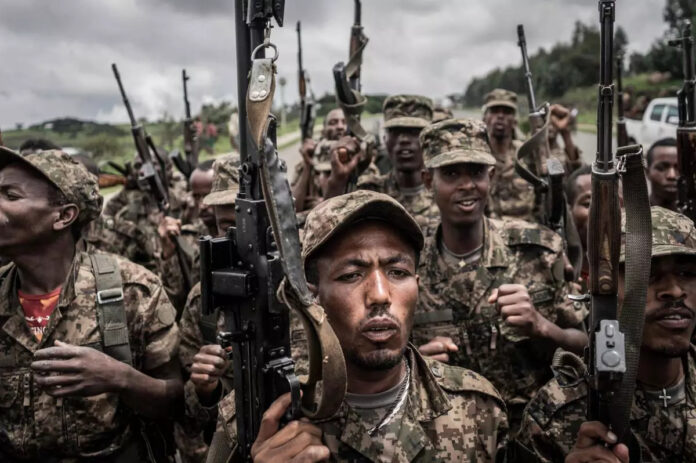
ADDIS ABABA – The Ethiopia Tigray conflict has entered a dangerous new phase as renewed fighting places the peace agreement that ended the devastating 2020–2022 war under its greatest pressure in nearly four years. Federal-aligned forces have taken the strategic town of Alamata after days of escalating hostilities across northern Ethiopia.
Ethiopian government forces and allied fighters entered Alamata, about 120 kilometres south of Tigray’s regional capital Mekelle. Their advance followed an offensive by Tigrayan forces into neighbouring areas last week. Video verified by Reuters showed soldiers carrying Ethiopian flags through the streets of Alamata. The town sits on an important transport corridor between Tigray and the neighbouring Amhara region, making control of it strategically significant.
The latest escalation follows a rapid deterioration in the security situation across northern Ethiopia. Tigrayan forces seized airports in Mekelle, Axum and Shire last week and detained federal personnel. Authorities subsequently suspended civilian flights into the region, cutting an important transport connection between Tigray and the rest of Ethiopia.
The African Union said the seizure of the airports was inconsistent with commitments made under the 2022 Pretoria Agreement. It warned that the latest developments risk reversing progress made since the previous war ended. The continental body has called for immediate de-escalation and urged the parties to return to direct negotiations.
Both sides have blamed each other for the renewed confrontation, making independent verification particularly important. Ethiopia’s federal government accuses the Tigray People’s Liberation Front of attacking federal forces and expanding military operations beyond Tigray. Tigrayan leaders accuse Addis Ababa of failing to implement important parts of the Pretoria Agreement and taking actions that threaten the region.
Communications disruptions have made it increasingly difficult to establish a complete picture of events on the ground. Mobile and internet services have faced major disruption, while travel restrictions and suspended civilian flights have further limited access to affected areas. Reports from medical organisations nevertheless indicate that the latest fighting is already producing significant casualties.
Médecins Sans Frontières treated more than 420 wounded people at hospitals in Korem and Alamata within 48 hours, according to figures reported by the Associated Press. Other facilities have also received casualties as fighting has spread. Around 150,000 people have been displaced during the latest violence, according to figures cited by AP.
The scale of the humanitarian concern reflects what northern Ethiopia experienced during the previous war. Fighting between federal forces and the TPLF from 2020 to 2022 caused enormous loss of life and displaced millions of people. Conflict also destroyed infrastructure and severely disrupted food supplies, healthcare and essential services. Estimates of the total death toll vary considerably because they include both direct violence and deaths linked to hunger, disease and the collapse of basic services.
South Africa became central to ending that conflict when the two sides signed the Pretoria Agreement on 2 November 2022. The African Union brokered the agreement, with former Nigerian president Olusegun Obasanjo playing a leading mediation role. Former Kenyan president Uhuru Kenyatta and former South African deputy president Phumzile Mlambo-Ngcuka also participated in the peace process.
The agreement established a permanent cessation of hostilities and created a framework for disarmament, humanitarian access and the restoration of federal authority. It also allowed essential services to return gradually to Tigray and opened a political process after two years of destructive warfare.
However, the agreement did not resolve several disputes that continued to strain relations between Addis Ababa and Tigrayan authorities. Territorial control remains one of the most difficult issues, particularly in western Tigray. Tigrayan and Amhara communities maintain competing claims over territory there, while Tigrayan leaders have continued to demand the return of areas seized by Amhara forces during the previous war.
Disarmament, the return of displaced communities and the political position of the TPLF have created further disagreements over implementation. Those unresolved questions now form part of the background to the renewed Ethiopia Tigray conflict, increasing pressure on a peace process that had already shown signs of strain.
Ethiopia’s wider political and security environment has also changed since the Pretoria Agreement. Armed groups continue to operate in different parts of the country, while political disputes have created additional pressure on Prime Minister Abiy Ahmed’s government. Renewed fighting in Tigray therefore carries the risk of becoming entangled with other conflicts rather than remaining geographically contained.
Regional tensions add another layer of complexity. Ethiopia’s military leadership has accused Eritrea, Sudan and Egypt of supporting forces opposed to the federal government. Those governments have denied involvement, and independent evidence has not established the allegations.
Relations between Ethiopia and Eritrea have deteriorated significantly despite Eritrean forces having fought alongside Ethiopia’s federal military during the previous Tigray war. Disputes involving regional security and Ethiopia’s ambitions for access to the Red Sea have further complicated relations across the Horn of Africa.
The African Union is now trying to prevent those wider tensions from overwhelming the peace process it helped negotiate. AU Commission Chairperson Mahmoud Ali Youssouf has asked Obasanjo to engage urgently with the parties and support renewed diplomatic efforts. The continental body maintains that the Pretoria Agreement remains the foundation for sustainable peace and reconciliation in Ethiopia.
United Nations Secretary-General António Guterres has also expressed concern about the deteriorating security situation. He called on the parties to de-escalate, protect civilians and allow humanitarian organisations safe access to affected communities.
The capture of Alamata gives federal-aligned forces an important position south of Mekelle, but further military advances could significantly raise the stakes. Continued fighting could deepen displacement and disrupt humanitarian assistance to communities that remain vulnerable after the previous conflict.
The consequences also extend beyond security and humanitarian concerns. Ethiopia has been working to rebuild infrastructure, attract foreign investment and advance major economic reforms. Another prolonged conflict could divert government resources, disrupt regional trade and weaken investor confidence in one of Africa’s largest economies.
Much now depends on whether the federal government and Tigrayan leadership continue to regard the Pretoria Agreement as the framework for resolving their disputes. The agreement stopped full-scale warfare in 2022, but it did not eliminate the political, territorial and security disagreements behind the conflict.
Nearly four years later, those unresolved issues are again colliding with military force. Control of Alamata is important, but the larger question reaches far beyond one strategic town. Continued escalation risks dismantling years of difficult peace-building and returning northern Ethiopia to a conflict whose human and economic costs the country is still struggling to overcome.