
ACCRA, Ghana – Ghana has signed a US$28 billion agreement to develop a major petroleum refining and petrochemical complex in the country’s Western Region, advancing plans to become one of West Africa’s leading energy processing centres. The proposed investment could transform Ghana’s industrial capacity, create employment and strengthen regional fuel supplies. However, the project must still overcome financing and land acquisition challenges before construction can begin.
The agreement, signed in Accra on 19 October, covers the second phase of Ghana’s Petroleum Hub project in Jomoro. The Petroleum Hub Development Corporation (PHDC) entered into the partnership with an international consortium led by Global Sphere, a United Arab Emirates-based company. The consortium also includes investors and technical partners from South Korea and Mali.
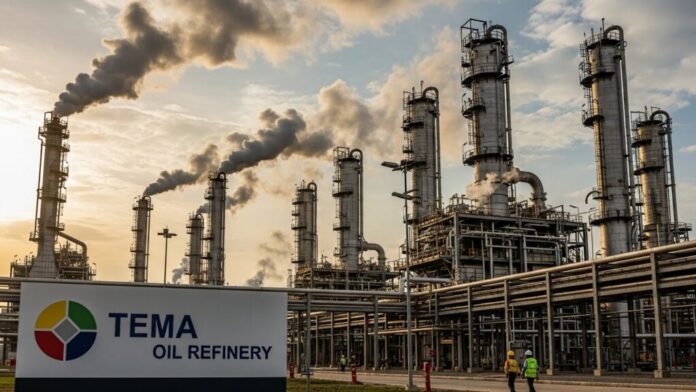
Under the proposed development, the investors plan to construct a refinery capable of processing 300,000 barrels of crude oil per stream day. The complex will also include two petrochemical plants, petroleum storage facilities with a combined capacity of four million cubic metres and a multi-berth jetty for maritime operations.
Construction is expected to begin in the first quarter of 2027, subject to the completion of preparatory requirements. The developers have outlined a five-year implementation period, with completion targeted for 2031.
The scale of the investment reflects Ghana’s ambition to move beyond exporting crude oil and importing large quantities of finished petroleum products. Successive governments have sought to expand domestic processing, create industrial jobs and capture more value from the country’s natural resources.
Ghana began commercial oil production in 2010, establishing itself as a petroleum producer in West Africa. However, developing a domestic refining industry capable of meeting national demand and serving neighbouring markets has proved more difficult.
The latest agreement represents another attempt to turn those ambitions into large-scale industrial infrastructure.
Speaking at the signing ceremony, Minister for Energy and Green Transition John Abdulai Jinapor said Ghana needed to increase the economic value generated from its petroleum resources.
“We cannot increase oil production without adding value to that oil resource,” Jinapor said, describing the Petroleum Hub as an important part of the country’s industrial strategy.
He also acknowledged that the planned refinery would produce more fuel than Ghana’s domestic market could absorb, making regional exports central to the project’s commercial prospects.
The government expects the complex to supply petroleum products to other West African countries, many of which continue to rely on imported refined fuels. If completed and operated competitively, the facilities could strengthen Ghana’s position in regional energy trade and create opportunities in transport, storage, distribution and related industries.
Petrochemical production could provide another source of industrial growth. Petrochemical plants convert petroleum-derived materials into products used in plastics, packaging, textiles and other manufacturing processes. These industries can support wider supply chains, although their development depends on reliable infrastructure, competitive production costs and sustained demand.
PHDC Chief Executive Officer Toni Aubynn described the agreement as a major step towards implementing the government’s long-standing plans.
“This commitment ranks among the largest industrial investment ever mobilized in Ghana and stands as a powerful vote of confidence in our country’s stability, leadership and long-term economic prospect,” Aubynn said.
The corporation has linked the project to opportunities for Ghanaian engineers, technicians, contractors and small businesses. It also expects the development to support technical training, technology transfer and local industrial participation.
However, the agreement does not mean that US$28 billion has already been invested or secured.
Boubacar Belco Bah, representing the investment consortium, confirmed that the partners were still working on financing arrangements. These include equity investment, long-term borrowing and measures designed to reduce financial risks.
The distinction is significant for a project of this size. Large petroleum developments require substantial capital, reliable crude supplies, long-term customers and confidence that facilities can operate profitably over several decades.
Investors must also assess the future of petroleum demand as governments and businesses increasingly pursue cleaner energy technologies.
Ghana’s earlier experience with the Petroleum Hub illustrates the challenges ahead.
In 2024, the country launched the first phase of the project under a separate agreement valued at approximately US$12 billion. That development also included plans for a refinery capable of processing 300,000 barrels daily.
Former President Nana Akufo-Addo attended a groundbreaking ceremony in August 2024. However, substantial construction has yet to begin, with land acquisition and compensation disputes among the obstacles affecting implementation.
The latest agreement therefore adds another proposed phase to a development programme that has struggled to move from planning into physical construction.
The wider Petroleum Hub initiative has previously been estimated at approximately US$60 billion across three phases. Its long-term vision includes three refineries with combined processing capacity of 900,000 barrels per stream day, five petrochemical plants and extensive petroleum storage infrastructure.
Achieving that scale would require investment far beyond the latest agreement, alongside substantial improvements in supporting infrastructure.
Land remains one of the most sensitive issues.
The proposed development occupies an area in Jomoro where communities depend on land for farming and other livelihoods. Earlier plans faced objections over the amount of land required and concerns about compensation for affected residents.
In March 2026, PHDC confirmed that the project’s proposed land requirement had been reduced from 20,000 acres to approximately 12,300 acres following objections from communities.
The reduction addressed part of the dispute, but questions surrounding land rights, compensation and community participation remain important to the project’s progress.
Jinapor has pledged to work with the ministries responsible for finance and lands, alongside the Attorney-General’s Office, to resolve outstanding issues.
The government’s ability to reach agreements with affected communities will be critical. Delays in compensation or uncertainty over land ownership could disrupt construction schedules and increase project costs.
Beyond Ghana, the investment comes as competition in West Africa’s refining industry intensifies.
Nigeria’s Dangote refinery has already changed the region’s petroleum market by introducing substantial new refining capacity. Its emergence has raised expectations that African countries can process more crude oil domestically rather than depend heavily on fuel imports.
Ghana’s proposed complex would enter a market where established and emerging refiners compete on production costs, logistics, reliability and access to customers.
This creates both an opportunity and a commercial challenge. West Africa’s large population and expanding economies provide a substantial market for petroleum products. However, Ghana would need to demonstrate that its proposed facilities can supply those markets at competitive prices while covering the costs of construction, crude oil purchases and operations.
The availability of feedstock presents another consideration. Ghana produced approximately 37.3 million barrels of crude oil in 2025, equivalent to an average of about 102,000 barrels daily. That was considerably below the proposed refinery’s capacity of 300,000 barrels per stream day.
Although the two measures are not directly identical, the difference suggests that a refinery operating near its planned capacity would need substantial imported crude unless Ghana significantly increases domestic production.
Such arrangements are common in international refining, but they require dependable supply contracts and efficient transport infrastructure.
The proposed jetty and storage facilities could help address those needs by supporting crude imports and petroleum product exports. Their effectiveness would depend on how well the complex connects to shipping networks and regional distribution markets.
Ghana’s investment strategy also reflects a broader question facing resource-rich African economies: how much economic value should remain on the continent?
Countries across Africa export crude oil, minerals and agricultural commodities while importing processed products that often command higher prices. Governments increasingly view local manufacturing and processing as essential to industrial development, employment creation and economic diversification.
Large industrial projects can contribute to those goals, but their economic benefits are not automatic.
Employment opportunities depend on the skills available locally and the extent to which developers use domestic contractors and suppliers. Technology transfer requires deliberate investment in training and institutional partnerships. Meanwhile, environmental management and community engagement must remain part of project planning throughout construction and operation.
The proposed Jomoro complex could also influence trade under the African Continental Free Trade Area, which seeks to strengthen commercial links between African economies. A competitive Ghanaian refining industry could supply neighbouring markets and support regional manufacturing through petrochemical production.
Yet the project’s long-term success will depend on commercial viability as much as government ambition.
The US$28 billion agreement signals renewed interest in Ghana’s petroleum processing sector and provides a framework for further negotiations. It does not resolve the financing, land and operational questions that have delayed earlier developments.
Attention will now turn to whether the consortium can secure investment commitments, settle outstanding land issues and begin construction within the proposed timetable.
Ghana has set out an ambitious vision for becoming a major West African energy and petrochemical centre. Turning that vision into an operating industrial complex will require more than investment announcements. Its real significance will emerge through the infrastructure built, the industries developed and the economic opportunities created for Ghana and the wider region.