


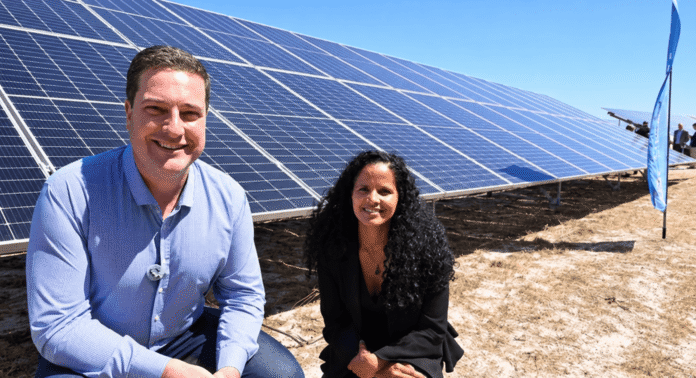
CAPE TOWN, South Africa – Cape Town has unveiled a R220 million solar and battery storage power plant in Atlantis, marking a significant step towards reducing the city’s dependence on Eskom and developing its own electricity supply.
The Helderhoop Solar and Storage Power Plant, officially launched on 8 October, is South Africa’s first hybrid power facility built by a metropolitan municipality. City authorities estimate that the project could save at least R400 million in electricity costs over the next 20 years.
Cape Town Mayor Geordin Hill-Lewis said the investment forms part of the municipality’s strategy to secure more affordable electricity and reduce its exposure to rising power costs.
“The key benefit of this new power plant is that the power it generates is much cheaper than Eskom -saving Cape Town residents at least R400m over the coming 20 years,” Hill-Lewis said.
The facility occupies 15 hectares and contains 12,850 solar panels alongside two utility-scale batteries. Earlier project specifications indicated a solar generation capacity of approximately seven megawatts, with battery storage designed to support electricity supply beyond daylight hours.
Construction is complete, although the plant has not yet entered full commercial operation. Municipal officials confirmed that it is undergoing controlled testing as part of the commissioning process.
The project created approximately 305 jobs during construction, providing employment and opportunities to develop skills in renewable energy infrastructure.
Cape Town’s investment reflects a broader shift in South Africa’s electricity sector as municipalities seek greater control over energy procurement and generation.
Historically, municipal electricity distributors have depended heavily on Eskom for bulk electricity purchases. However, rising costs, infrastructure pressures and previous periods of severe load-shedding have encouraged cities and businesses to explore alternative sources.
Helderhoop forms part of Cape Town’s wider programme to diversify electricity supply through municipal generation, independent power producers and battery storage.
The municipality has also begun purchasing electricity from independent producers. It recently reported securing power through an initial procurement programme at prices below Eskom’s comparable supply rates.
These developments could have implications beyond Cape Town. Municipalities across South Africa face the challenge of balancing reliable electricity provision with affordability, ageing infrastructure and financial constraints.
Greater investment in locally developed energy projects could help cities manage some of these pressures while creating opportunities for construction companies, engineering firms and renewable energy suppliers.
However, the projected R400 million saving remains a long-term estimate. The city has not announced an immediate reduction in household electricity tariffs resulting from the Helderhoop project.
The plant’s performance will depend on successful commissioning, reliable operation and the actual cost of generating and storing electricity over time.
The project also carries local significance for Atlantis, which marks its 50th anniversary this year. Its name, Helderhoop, meaning Bright Hope, was proposed by local learner Vinolio Cloete through a public naming competition.
Cape Town’s latest investment demonstrates how municipal governments can participate directly in developing electricity infrastructure rather than relying exclusively on established suppliers.
The next test will be whether the project delivers its anticipated savings and provides a model that other South African municipalities can adapt to their own energy needs.