
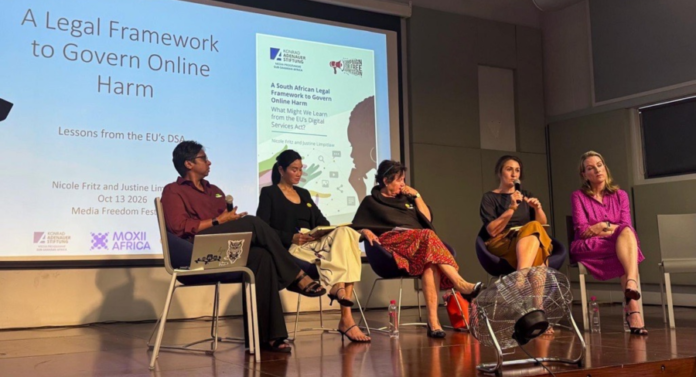
Three weeks before South Africa’s local government elections, journalists, researchers, regulators and civil society representatives gathered in Johannesburg to confront a difficult question: who should be held accountable when harmful content spreads on social media?
The discussion took place at the Media Freedom Festival, held from 14 to 16 October 2026 under the theme Elections and Accountability: News, Digital Media and Information Integrity. During a session on 15 October, legal experts Nicole Fritz and Justine Limpitlaw launched a 92-page report examining how South Africa could regulate online harm without undermining freedom of expression.
Their report, A South African Legal Framework to Govern Online Harm: What Might We Learn from the EU’s Digital Services Act?, examines the responsibilities of major technology companies. It considers how social media platforms influence the information people see, share and discuss, particularly during elections and periods of political tension.
South Africans are scheduled to vote in local government elections on 4 November, making the debate especially relevant to the country’s democratic processes. Konrad-Adenauer-Stiftung gov.za
The report argues that digital platforms should take greater responsibility for how their services operate. This includes the systems they use to recommend, rank, promote and moderate information. However, the authors caution against making companies automatically liable for everything users publish or giving the government sweeping powers to determine what people can say online.
Their central recommendation is that South Africa should develop a regulatory framework suited to its own circumstances rather than simply adopt European legislation.
“South Africa does not need its own Digital Services Act,” the report states.
The European Union’s Digital Services Act (DSA) establishes responsibilities for online platforms and search engines. Its strongest requirements apply to the largest services, which must assess risks linked to their operations and take steps to address them. These risks include potential harm to elections, public debate and children’s safety.
Fritz and Limpitlaw believe South Africa can draw lessons from the European approach while developing rules that reflect its legal system, regulatory institutions and social conditions.
Under their proposed framework, platforms would need accessible systems for reporting harmful content and appealing moderation decisions. Companies would also have to explain significant decisions affecting users and provide greater transparency about how their services operate.
This could include publishing information about content moderation in South Africa, disclosing political advertising practices and allowing qualified independent researchers to examine relevant platform data under appropriate safeguards.
Larger platforms would face additional responsibilities. They would need to assess how their systems contribute to serious risks, introduce reasonable measures to reduce those risks and submit to independent scrutiny.
The authors also recommend stronger protections for children and improved moderation capacity in South African languages. Significant foreign platforms serving South African users would need local legal representatives who could respond to regulatory and legal processes.
The distinction between individual content and platform systems is central to the proposal. Rather than asking regulators to assess millions of social media posts, the framework would examine how companies design and manage services that influence the spread of information.
“No one can seriously maintain any longer that digital platforms simply provide places in which people speak,” the authors argue.
They explain that platforms influence what users encounter through systems that determine which content gets “recommended, repeated, ranked and made visible”.
The report uses anti-migrant mobilisation in South Africa to illustrate these concerns. It examines online activity surrounding the so-called 30 June deadline announced by the vigilante group March and March.
The authors do not argue that social media platforms caused xenophobia. Instead, they examine how online services can help groups organise campaigns, circulate messages and make particular viewpoints appear more widespread through repeated exposure.
Their analysis also refers to an August 2026 decision by the United Nations Committee on the Elimination of Racial Discrimination. The committee expressed concern about violence and hate speech directed at migrants in South Africa.
The report highlights another challenge: enforcing South African law against multinational technology companies.
It examines a 2025 High Court dispute involving social media accounts that distributed intimate images of South African schoolchildren. The case exposed difficulties that can arise when a platform operates through foreign corporate structures and local representatives lack authority to accept legal documents.
“The effectiveness of South African law should not depend upon litigants first navigating the faraway corporate architecture of a multinational technology company,” the authors write.
Such cases raise questions about whether South African courts, regulators and citizens have practical ways to hold major platforms accountable. However, the report also acknowledges that stronger regulation carries risks. Complex rules could increase compliance costs, while poorly defined legal obligations might give regulators excessive discretion. Platforms could also remove lawful content to avoid penalties, potentially restricting legitimate public debate.
Privacy presents another concern. Allowing researchers access to platform data could improve public understanding of online harm, but it would require safeguards to protect personal information. Measures intended to protect children would need similar protections.
These competing interests make the design of any future legislation particularly important. Parliament would need to establish which platforms face additional responsibilities, what constitutes a serious risk and how regulators can enforce the rules without encouraging censorship.
The report does not propose a specific user threshold, regulatory levy or maximum penalty. Those decisions would affect which companies fall within the framework and how much compliance would cost.
Instead of creating a single authority to decide what people may say online, Fritz and Limpitlaw recommend a network of oversight institutions. They propose that the Independent Communications Authority of South Africa (ICASA) supervise platform compliance with requirements such as complaints procedures, transparency reporting and local-language moderation capacity.
Courts and existing institutions would retain their responsibilities for privacy, equality, elections and other legal matters. Expanding ICASA’s role would nevertheless require new legislation, adequate funding and specialist expertise.
The authors also support a system of co-regulation. Under this approach, industry bodies and trusted organisations could contribute to standards and reporting procedures, while ICASA would retain regulatory oversight and enforcement powers.
“Co-regulation must not, however, become another name for industry self-regulation,” they warn.
Trusted organisations could help identify potentially harmful content and request faster reviews. However, the report argues that they should not receive independent powers to censor information.
Although the framework focuses on South Africa, its implications extend across the continent. Major technology companies operate across national borders, often using similar systems to distribute information in different African countries.
This creates opportunities for governments to cooperate on platform accountability, particularly where individual national markets have limited influence over multinational companies.
Speaking to Fence Africa 24, Fritz said “there is definitely scope for a continental approach”.
She argued that Africa’s market size and its young population could give governments greater influence when engaging major digital platforms.
Limpitlaw agreed that treating Africa as an integrated digital market “would certainly help”. However, she cautioned that the African Continental Free Trade Area (AfCFTA) remains at an early stage and currently focuses on expanding trade between African countries.
The African Union adopted the AfCFTA Protocol on Digital Trade in February 2024. The agreement aims to support digital trade and encourage greater alignment between national regulatory systems.
Although the protocol could support cooperation, it does not establish a comprehensive legal framework for social media accountability. Countries would still need domestic laws and institutions capable of enforcing relevant requirements.
Other continental initiatives may provide more direct guidance. The African Commission on Human and Peoples’ Rights has published draft guidelines addressing information integrity and the responsibilities of technology companies operating in Africa.
The commission has invited public comments, with consultation deadlines extending to December 2026 and January 2027. It expects to present final versions for adoption in early 2027.
These guidelines could help African governments develop common standards for protecting rights online. However, they would not automatically provide the enforcement powers or financial resources needed to regulate technology companies.
The proposed South African framework also considers how regulation could affect smaller businesses and emerging African technology companies.
Fritz told Fence Africa 24 that the strongest obligations should generally apply to “billion-dollar/sometimes trillion-dollar enterprises”, rather than newly established businesses.
The report recommends a tiered approach. Basic responsibilities could apply broadly, while costly requirements such as independent audits, detailed risk assessments and regulatory levies would primarily affect platforms with substantial reach or influence.
This distinction matters because excessive compliance costs could make it harder for African start-ups to compete. Poorly designed regulation might unintentionally strengthen the largest technology companies by creating barriers that smaller competitors cannot afford to overcome.
The report therefore calls for a balance between accountability, innovation and the protection of fundamental rights. Importantly, the framework remains a research proposal rather than legislation before South Africa’s Parliament. The government has not adopted its recommendations, and the report does not establish new legal obligations for technology companies.
Its significance lies in the questions it raises about the future of digital governance. Policymakers would need to determine which companies should face stricter oversight, how regulators could exercise their powers independently and what protections would prevent lawful expression from being suppressed.
The debate is especially relevant as African countries confront the growing influence of social media on elections, public discourse and political participation.
Digital platforms have become important spaces for journalism, business, civic engagement and public debate. Yet their decisions about what users see and how information spreads often remain difficult for the public to examine.
Fritz and Limpitlaw argue that protecting freedom of expression does not mean allowing powerful technology companies to operate without meaningful scrutiny.
As the authors conclude, freedom of expression “does not require that the private infrastructures through which an ever-greater share of public communication takes place remain opaque, inaccessible or effectively beyond the reach of public law.”
The challenge facing South Africa, and potentially other African countries, is to establish accountability without giving governments or private companies excessive control over public expression. Whether the proposals eventually influence legislation will depend on political decisions, institutional capacity and the ability to protect both public safety and democratic freedoms.