
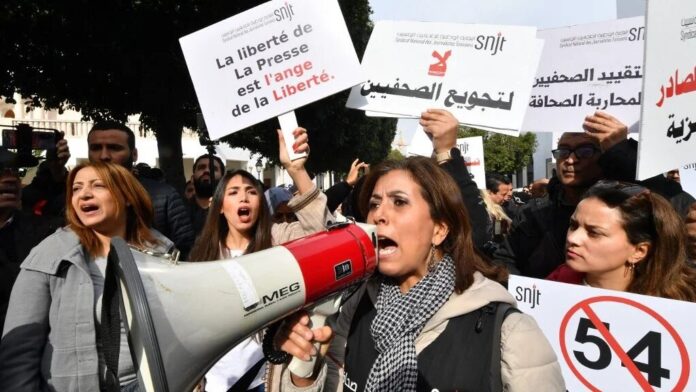
TUNIS, Tunisia – Tunisia’s press freedom crisis is drawing renewed scrutiny as around 20 journalists face criminal charges and four remain in prison, according to the country’s journalists’ union. The prosecutions have intensified concerns about the future of independent journalism in a country once regarded as a leading example of democratic change in North Africa.
The National Syndicate of Tunisian Journalists says reporters face growing legal pressure over their investigations, published articles and social media comments. Some have left the country to avoid imprisonment, while others report threats, restrictions on their work and increasing difficulties obtaining information from government institutions.
Tunisia has fallen more than 50 places in the past five years to 137th in the World Press Freedom Index compiled by Reporters Without Borders. The decline reflects growing concern among media organisations and human rights groups about restrictions introduced since President Kais Saied consolidated power in 2021.
Zied Dabbar, head of the journalists’ union, described the number of prosecutions as unprecedented. He said approximately 20 journalists currently face criminal charges, while four are serving prison sentences or remain in detention.
The situation marks a significant change from the period following Tunisia’s 2011 revolution, which ended the 23-year rule of President Zine El Abidine Ben Ali. The uprising helped trigger the Arab Spring protests across North Africa and the Middle East, while opening space for independent media and public criticism of government.
Tunisia subsequently introduced constitutional protections for freedom of expression and developed a more diverse media environment. Independent newspapers, broadcasters and online platforms expanded their reporting on politics, corruption and public affairs.
However, the country’s political direction changed in July 2021 when Saied suspended parliament and assumed sweeping executive powers. He later dissolved the legislature and introduced a new constitution that strengthened the presidency.
Critics argue that these changes weakened institutions responsible for holding the government accountable. The authorities reject accusations of authoritarianism and maintain that their actions are lawful.
Saied has repeatedly denied restricting freedom of expression. He says journalists remain free to criticise the government, while Tunisian authorities insist that criminal prosecutions are impartial judicial matters and that nobody stands above the law.
Press freedom organisations dispute that position. They argue that the growing number of criminal cases, arrests and restrictions has created an environment in which journalists risk punishment for reporting on matters of public interest.
Among those detained is Mohamed Yousfi, editor-in-chief of the independent investigative website Al-Qatiba. Police arrested him in September while he was travelling to participate in a radio programme.
Authorities charged Yousfi with illicit enrichment, an allegation he denies. His arrest prompted demonstrations by journalists and activists who demanded his release and criticised what they described as increasing pressure on independent media.
Prominent broadcasters Mourad Zeghidi and Borhen Bsaies have also faced imprisonment. They were initially convicted on charges involving false information and insults directed at the president, before later facing tax-related convictions. Both deny wrongdoing.
Journalist Zied Heni received a one-year prison sentence earlier this year after criticising a judicial ruling. His detention has placed considerable pressure on his family, who have continued campaigning for his release.
The consequences extend beyond those currently in prison. Journalists say the possibility of prosecution has changed how newsrooms approach investigations, particularly those involving government institutions, public spending and the judiciary.
Aymen Rezgui, editor-in-chief of the independent news organisation Nawaat, told Reuters that journalists face an increasingly unpredictable environment.
“We are living in a grey area, as if we were in a shifting minefield, and we pay the price every day,” he said.
Nawaat has reported receiving threats over its investigations into prison conditions, public services and other domestic issues. The outlet also faced a temporary suspension of its activities last year.
Other journalists have chosen to leave Tunisia. Khaoula Boukrim, founder of the independent news website Tumedia, moved to France in December 2025 after expressing fears that authorities would arrest her.
She later received a four-year prison sentence in absentia over writings critical of the judiciary and the country’s political system. Journalist Haythem Mekki also left Tunisia after receiving a prison sentence following public comments about conditions at a hospital morgue.
The pressure on journalists has raised broader concerns about access to reliable information. According to the journalists’ union, reporters frequently encounter police restrictions while covering public events. Some international correspondents have also struggled to obtain official accreditation.
Several government ministries no longer maintain functioning press offices, making it harder for journalists to obtain responses or scrutinise official decisions. Media organisations also report a decline in political debate on private radio stations and reduced space for opposition voices in state broadcasting.
These restrictions have implications beyond the media industry. Independent journalism allows citizens to examine government spending, question public decisions and understand how political developments affect their lives.
When journalists struggle to investigate public institutions or report criticism without fear of prosecution, the public may receive less information about matters ranging from healthcare and employment to corruption and economic policy.
Tunisia’s experience carries wider significance for Africa, where press freedom remains closely linked to debates about democratic governance and public accountability. The ability of journalists to work independently can influence how governments respond to criticism and how citizens participate in political life.
In September, Saied amended parts of Tunisia’s controversial 2022 cybercrime legislation, reducing some penalties following criticism from rights organisations. The changes represented a limited concession, although campaigners continued to question the law’s impact on freedom of expression.
The government maintains that its legal measures protect public order and address unlawful conduct. Journalists’ organisations, however, argue that the wider pattern of prosecutions and restrictions continues to discourage independent reporting.
Tunisia’s next challenge will be to reconcile the government’s stated commitment to the rule of law with demands for stronger protection of journalists and freedom of expression.
Fifteen years after the revolution that transformed its political landscape, the country faces renewed questions about the freedoms that emerged from that period. The outcome will matter not only to journalists facing prosecution, but also to citizens who depend on independent reporting to understand and scrutinise the decisions made in their name.