


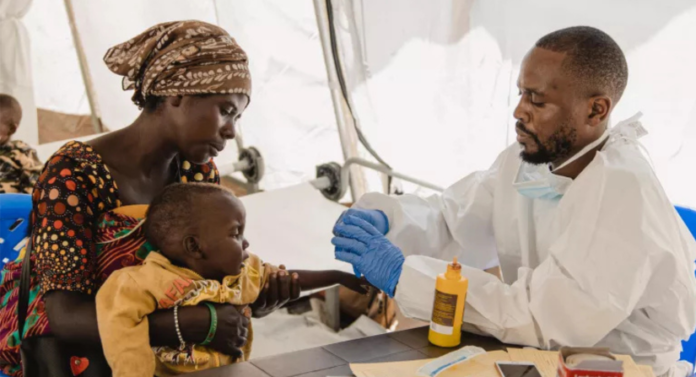
More than 2,000 people have died from Ebola in the Democratic Republic of the Congo as health authorities struggle to contain one of the country’s most serious outbreaks.
Confirmed deaths reached 2,011 from 4,381 cases, according to government figures reported on Tuesday. The outbreak has spread across several provinces in eastern DR Congo, placing further pressure on communities already affected by conflict and displacement.
Health authorities are dealing with the Bundibugyo strain of the virus, which differs from the Zaire Ebola strain responsible for several previous outbreaks in the country.
Unlike Zaire Ebola, there is currently no approved vaccine specifically designed for Bundibugyo virus disease. Scientists and health authorities are assessing possible vaccine options while treatment centres focus on supportive care and experimental interventions.
WHO says the outbreak remains in a period of intense transmission, with cases reported across dozens of health zones. It has become the second-largest Ebola outbreak recorded globally, behind the 2013-2016 West Africa epidemic.
Eastern DR Congo presents particularly difficult conditions for controlling the disease.
Years of armed conflict have displaced communities and weakened access to healthcare in parts of the region. Population movement can make contact tracing more difficult, while insecurity can restrict health workers from reaching affected areas.
Containing Ebola depends heavily on identifying infected people quickly, isolating cases and tracing those who may have come into contact with the virus.
Delays can allow infections to spread within households and communities before health teams know where transmission has occurred.
WHO has also found evidence that the outbreak may have started earlier than initially recognised. Some early infections were reportedly mistaken for illnesses including malaria and typhoid before authorities identified Ebola.
Such delays may have allowed the virus to circulate undetected before the outbreak was officially recognised.
Health workers now face the challenge of slowing transmission while maintaining public confidence in affected communities. Previous Ebola responses have shown that cooperation between medical teams, local leaders and families can be critical to containing outbreaks.
DR Congo has extensive experience dealing with Ebola, having recorded multiple outbreaks since the virus was first identified in 1976.
Experience alone, however, cannot remove the challenges created by the current strain, the scale of transmission and insecurity in affected areas.
Regional authorities are also watching developments closely because movement across borders creates the possibility of cases appearing in neighbouring countries. Uganda has previously recorded cases connected to the wider Bundibugyo outbreak.
International health agencies are calling for stronger surveillance, faster identification of infections and additional resources for frontline teams.
With more than 4,300 confirmed cases and the death toll now above 2,000, controlling transmission has become increasingly urgent.
DR Congo’s immediate challenge is to find infections faster than the virus can spread, while protecting health workers and communities already facing severe humanitarian pressures.