


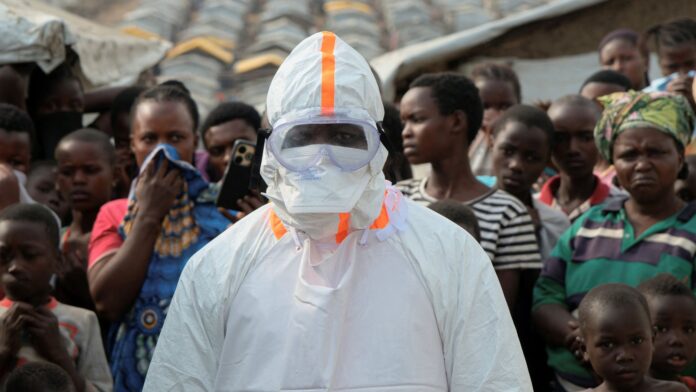
Health authorities in the Democratic Republic of Congo are racing to contain one of the country’s most severe Ebola outbreaks as infections continue to spread across the east of the country.
The latest figures released by the National Institute for Biomedical Research show 2,473 confirmed cases and 999 deaths, with new infections being reported mainly in Ituri and North Kivu provinces. The outbreak has become one of the fastest-growing Ebola epidemics ever recorded in Africa.
Public health officials warn that the virus is spreading faster than response teams can trace it, making containment increasingly difficult.
Health Workers Face an Uphill Battle
Medical teams are working around the clock to identify new cases, isolate patients and monitor people who may have come into contact with infected individuals. However, many of the newest infections have no clear link to previously confirmed cases. That means the virus is spreading silently through communities before health officials can intervene.
The situation has raised concerns among experts, who say hidden chains of transmission remain one of the biggest obstacles to ending the outbreak. In some affected areas, treatment centres are struggling to cope with the growing number of patients.
Containing Ebola in eastern DRC has always presented unique challenges. Several of the worst-affected communities lie in regions where armed groups continue to operate. Insecurity has disrupted medical operations, delayed contact tracing and limited access to some villages.
Violence against health workers and attacks on healthcare facilities have also slowed the emergency response, forcing medical teams to suspend operations in certain locations until security improves.
These interruptions allow the virus to spread further before infected people receive treatment.
A Different Ebola Strain
The Bundibugyo strain of the Ebola virus causes the current outbreak. Unlike the Zaire strain responsible for several previous outbreaks, there is currently no widely approved vaccine specifically designed to protect against the Bundibugyo variant.
Scientists are continuing clinical trials to identify effective treatments while researchers accelerate the development of new diagnostic tools. The World Health Organisation has also expanded laboratory support to improve testing capacity.
Although neighbouring Uganda has reported imported cases linked to the outbreak, no new infections have been detected there since late June.
Health officials have begun the mandatory 42-day enhanced surveillance period required before an outbreak can officially be declared over. Cross-border screening remains in place as authorities work closely with regional partners to prevent further international spread.
Other countries in East and Central Africa continue to strengthen preparedness measures, particularly at airports and border crossings. Public health experts say community trust remains essential. Rapid reporting of symptoms, cooperation with contact tracers and safe burial practices are among the most effective ways to reduce transmission.
Health workers have also intensified public awareness campaigns to counter misinformation and encourage people to seek treatment early.
Previous Ebola outbreaks have shown that early isolation significantly improves survival rates while reducing further infections.
The World Health Organisation, Africa Centres for Disease Control and Prevention (Africa CDC), and humanitarian organisations continue supporting the Congolese government through funding, surveillance, laboratory testing, and medical supplies.
Despite these efforts, officials say additional resources will be needed if the outbreak continues to expand. The coming weeks are expected to be critical as response teams attempt to interrupt transmission chains before the virus reaches more densely populated areas.
For millions of people living in eastern DRC, the priority remains clear: stopping the outbreak before more lives are lost.