
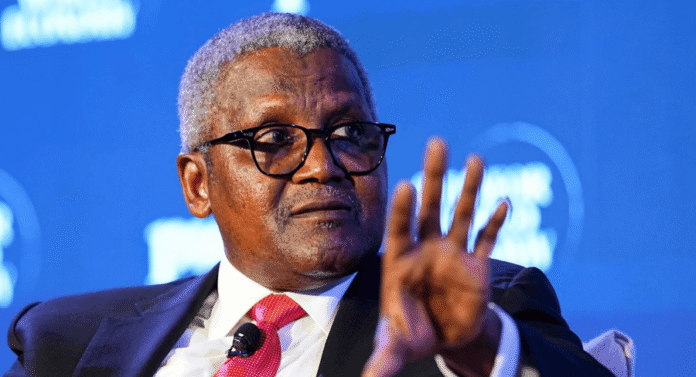
NAIROBI, Kenya – Nigerian industrialist Aliko Dangote has acquired a 25% stake in Kenya Pipeline Company for approximately US$335 million, marking a major expansion of his energy business into East Africa. The investment places one of Africa’s largest industrial groups inside a strategic fuel transportation network serving Kenya and neighbouring countries, with a further US$1.5 billion expansion under consideration.
Dangote confirmed the acquisition on 21 October during the Financial Times Africa Summit in London. His company purchased approximately 4.5 billion shares, representing a 24.76% interest in Kenya Pipeline Company (KPC), the operator of Kenya’s petroleum pipeline network.
The transaction is part of a broader strategy to expand Dangote’s presence across Africa’s refining, storage and fuel distribution industries. It also comes as his group advances plans to develop a major oil refinery in Kenya’s coastal county of Lamu.
Kenya Pipeline operates a network of approximately 1,300 kilometres, transporting petroleum products from the port of Mombasa to inland markets. Its infrastructure supports fuel distribution within Kenya and supplies neighbouring countries, including Uganda, Rwanda, Burundi, South Sudan and the eastern Democratic Republic of Congo.
The network plays an important role in East Africa’s energy security. Landlocked countries depend on regional transport corridors to access imported petroleum products, making pipeline capacity and reliability important to businesses, households and public services.
Dangote said the acquisition would support the distribution of petroleum products across the region.
“We bought 25 percent of their pipeline network for their distribution of petroleum products,” he said during the London summit.
The Nigerian businessman also outlined plans to invest a further US$1.5 billion in expanding Kenya’s pipeline infrastructure. The proposed investment could increase transportation capacity and strengthen fuel distribution across East Africa, although detailed project timelines and financing arrangements have not been announced.
The acquisition follows Kenya’s decision to open Kenya Pipeline Company to private investors. Earlier this year, the government sold 65% of the company through an initial public offering on the Nairobi Securities Exchange, retaining a 35% stake.
The privatisation formed part of wider economic reforms aimed at attracting investment, improving state-owned enterprises and raising government revenue. Kenya has faced pressure to strengthen public finances while maintaining investment in infrastructure and essential services.
Dangote’s acquisition makes his interests one of the largest shareholders in the pipeline operator. However, a stake of approximately 25% does not give his group outright control of the company.
The transaction has nevertheless attracted political scrutiny in Kenya. Several state-backed institutions that participated in the initial public offering subsequently sold shares through a large block transaction, raising questions about the commercial rationale and transparency of the process.
Kenyan lawmaker Ndindi Nyoro questioned the circumstances surrounding the sale, including the role of public institutions in purchasing and disposing of shares within a relatively short period.
Treasury Cabinet Secretary John Mbadi defended the transaction, describing it as a commercial decision between willing sellers and a willing buyer. He rejected suggestions that the sale demonstrated improper political interference.
The competing accounts highlight the importance of transparency in transactions involving strategic public infrastructure. Kenya must balance its need for private investment with public confidence in the management of assets that influence national and regional fuel supplies.
Beyond the ownership debate, Dangote’s entry could reshape competition in East Africa’s petroleum industry.
His group operates a large refinery near Lagos, Nigeria, with a stated processing capacity of approximately 700,000 barrels per day. The facility has become central to the company’s ambition to reduce Africa’s dependence on imported refined petroleum products.
Dangote is also pursuing a second refinery in Lamu, Kenya, with a proposed capacity of 700,000 barrels per day. The project, estimated at approximately US$16 billion, could establish another major refining centre on Africa’s eastern coast if financing, construction and regulatory requirements are successfully completed.
The planned refinery and the Kenya Pipeline investment could eventually create a more integrated business linking fuel production, storage and transportation.
Such an arrangement could improve distribution efficiency and provide access to a wider regional market. However, the Lamu refinery remains under development, and its future connection to existing pipeline infrastructure has not been fully established.
The potential benefits extend beyond Kenya. Uganda, Rwanda, Burundi and South Sudan rely heavily on imported fuel transported through regional corridors. Improvements in pipeline capacity could reduce logistical constraints and support more reliable deliveries.
Transport costs remain an important component of fuel prices in landlocked African economies. Businesses in agriculture, manufacturing, mining and transport depend on petroleum products to operate machinery, move goods and maintain production.
Greater infrastructure capacity could support these industries, although lower consumer fuel prices would depend on several factors, including international oil prices, taxes, exchange rates and market competition.
The expansion also reflects changing patterns of investment across Africa. African-owned industrial groups are increasingly pursuing major infrastructure and manufacturing opportunities beyond their home countries.
Dangote’s investments in cement, fertiliser and petroleum have already established his group across multiple African markets. The Kenya Pipeline acquisition extends that strategy into energy logistics, where control of storage and transportation networks can influence the movement of essential commodities.
However, expanding private ownership of strategic infrastructure raises questions about competition and market access. Regulators will need to ensure that pipeline services remain available on fair terms to other fuel suppliers and distributors.
Access to reliable energy infrastructure is especially important as African economies seek to expand manufacturing and regional trade. Efficient transport networks can support investment, but their benefits depend on transparent regulation and competitive markets.
The African Continental Free Trade Area has increased attention on the infrastructure needed to connect African economies. While the agreement focuses on reducing trade barriers, its wider ambitions depend on transport, energy and logistics systems capable of supporting cross-border commerce.
Kenya’s pipeline network illustrates this connection. Although it transports petroleum rather than manufactured goods, its reliability affects businesses operating throughout East and Central Africa.
Dangote has also outlined broader plans to invest in energy infrastructure across the continent, including storage facilities and distribution networks in other African markets.
These ambitions could strengthen links between African producers and consumers. Yet their success will depend on financing, regulatory approvals, infrastructure development and cooperation between governments.
The Kenya Pipeline acquisition represents a significant step in Dangote’s expansion from refining into regional fuel distribution. It also places Kenya at the centre of a wider strategy to develop integrated petroleum infrastructure across Africa.
Whether the investment delivers lasting economic benefits will depend on how effectively the proposed expansion improves fuel transportation, supports fair competition and strengthens regional energy security.
As African countries seek to reduce infrastructure bottlenecks and deepen economic integration, the transaction demonstrates the growing role of African private capital in strategic industries. Its wider significance will be measured not only by the scale of investment, but also by the benefits delivered to businesses, consumers and economies across the region.