


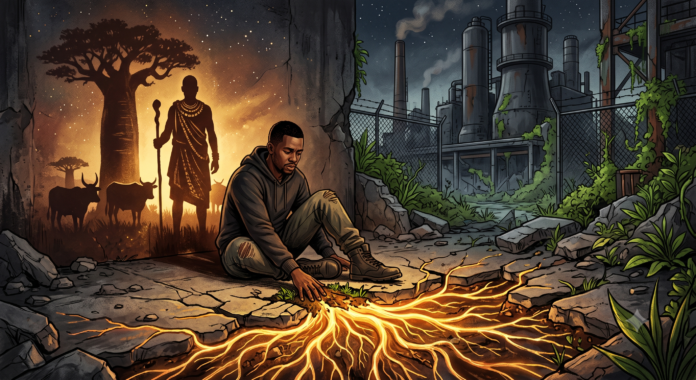
Across the world, countless men carry psychological wounds they struggle to confront, let alone speak about. On the African continent, however, understanding those wounds requires looking beyond the individual and examining the historical forces that helped shape generations of men.
The psychological reality of the modern African man cannot be understood solely through Western clinical frameworks. His experiences are intertwined with a distinctive historical trajectory involving colonialism, economic dispossession, disrupted family structures and the erosion of indigenous systems of identity and belonging.
For generations, millions of Africans lived under foreign occupation. Colonial structures disrupted indigenous ways of living and imposed political, economic, educational and religious systems that transformed communities.
One of the most profound changes was economic. Collective ways of living rooted in land, family and community increasingly gave way to commercial systems in which labour, money and economic status became central measures of individual value.
Before colonial rule, many African communities depended heavily on extended families, agriculture, livestock and communal relationships. Regional conflicts, inequality and hardship certainly existed, but land, family and community formed an important part of social and economic security.
Colonialism fundamentally altered those relationships. Foreign legal and administrative systems were introduced. Racial classifications reshaped social structures. Land ownership changed. Formal education increasingly replaced traditional systems through which children learned practical skills, cultural knowledge and responsibilities from parents and elders.
For boys, this also changed how masculinity was learned and passed between generations. Young boys who might previously have spent significant periods alongside fathers, relatives and community elders increasingly entered formal institutions designed around colonial economic and administrative requirements. This historical disruption matters when examining the mental health of African men today.
Deconstructing trauma beyond Western frameworks
Contemporary psychology frequently uses the Adverse Childhood Experiences, or ACEs, framework to understand how childhood adversity can influence later emotional, physical and social outcomes.
The conventional framework considers experiences including physical, emotional and sexual abuse; physical and emotional neglect; household substance abuse; mental illness within the home; domestic violence; incarceration of a family member; and parental separation or divorce.
Research around ACEs has helped demonstrate how accumulated childhood adversity can increase vulnerability to depression, addiction, chronic illness and difficulties in relationships later in life. Yet applying the framework to African societies raises another question: what happens when trauma does not originate only inside the household?
The conventional ACE model largely examines adversity experienced by individuals and families. Africa’s history introduces another layer, structural and intergenerational experiences affecting entire populations.
Colonialism created conditions that could compound household adversity through economic dispossession, migrant labour and cultural dislocation.
These experiences did not affect every African family in exactly the same way. However, their influence across generations cannot simply be separated from conversations about African men’s psychological wellbeing.
Economic dispossession is one part of that history. Colonial land policies and economic restructuring weakened traditional systems of self-reliance in many communities and pushed families into new forms of economic dependence. Poverty therefore became more than an individual household circumstance. In many places, it became embedded within wider political and economic structures.
Migrant labour created another wound. Men frequently travelled long distances to work in mines, commercial farms and urban centres, sometimes remaining away from their families for months.
That physical separation altered family relationships. Mothers often carried much of the daily parenting responsibility, while children grew up with limited access to their fathers. For boys, the absence could interrupt the everyday transfer of knowledge, identity and mentorship between generations.
Cultural dislocation added another layer. African children entered educational and social systems in which indigenous languages, knowledge systems and traditions were frequently treated as inferior to European ones. Some were taught, directly or indirectly, to associate modernity and intelligence with abandoning aspects of their own heritage.
For a young boy developing his sense of identity, that message could have profound consequences. The original systems that told him where he belonged had been weakened, while the institutions replacing them did not necessarily affirm who he was.
From material value to intrinsic value
The consequences of that transformation remain visible in contemporary African societies. Too many men have inherited the idea that their value is determined primarily by income, status and material success.
The expectation to provide is not inherently problematic. The danger emerges when a man’s entire identity becomes attached to his economic performance.
When employment disappears, businesses fail or financial pressures become overwhelming, the loss can therefore become psychological as much as economic.
Africa’s relationship with its natural resources further complicates this conversation. The continent possesses enormous reserves of gold, platinum, chromium, diamonds and minerals increasingly important to the global economy. Yet many African economies remain positioned largely as suppliers of raw materials whose prices and value chains are heavily influenced beyond the continent.
Economic sovereignty, therefore, is also connected to questions of psychological sovereignty. A society repeatedly taught to look elsewhere for validation can eventually internalise the idea that what comes from outside is inherently more valuable than what already exists within.
Breaking that cycle requires more than economic reform. It also requires Africans to reconsider how they understand themselves.
The universal grammar of Ubuntu. Repair does not require Africa to reject modernity, technology or global engagement. Nor does it require romanticising the past. Instead, part of the answer may lie in recovering the human values that helped communities maintain strong relational bonds.
Across the continent, different cultures have developed remarkably similar philosophies around collective humanity. In South Africa and among Ndebele-speaking communities in Zimbabwe, the concept is widely expressed through Ubuntu. Among Shona-speaking communities, it is often described as Unhu or Hunhu. In Malawi and Zambia, Umunthu carries a similar understanding.
East African traditions include concepts such as Utu, Obuntu and Obuntubulamu, while Kimuntu or Gimuntu can be found in parts of Angola and the Democratic Republic of Congo. Botswana and Lesotho have Botho and Setho, while Maaya carries related ideas in parts of West Africa.
The languages differ, but a central idea connects them: a person becomes fully human through relationships with other people.
This is more than a philosophical slogan. It represents a social architecture in which individual wellbeing cannot easily be separated from the wellbeing of family and community.
That principle has particular relevance to mental health. Modern approaches often place responsibility on an individual to recognise distress, seek professional assistance and recover. Ubuntu introduces another dimension: communities also have a responsibility to create environments in which people can belong, speak and receive support.
For African men who have inherited generations of expectations around strength, provision and silence, rebuilding those communal spaces could be particularly important.
A peaceful revolution of self-determination
Across Africa, debates about sovereignty, resources and national identity are already reshaping political conversations.
Namibia’s emerging offshore oil sector has brought renewed discussion about ensuring natural resources contribute meaningfully to national development. Similar debates around sovereignty and self-determination have intensified across West African countries including Burkina Faso, Mali and Niger.
Rwanda’s development experience has also become part of wider continental conversations about African agency and institutional resilience. These political and economic shifts are different in character, but they point towards a broader question: what does African self-determination mean?
The answer cannot concern governments and natural resources alone. It must also include people. The long-term psychological repair of African societies requires young men to rediscover identities that extend beyond income, employment and material status.
They can become builders again, not simply builders of physical infrastructure, but builders of families, communities, institutions and culture. Reconnecting young Africans with land, heritage and community should not mean withdrawing from the modern world. Instead, it can provide a stronger foundation from which they engage with it.
There is psychological value in knowing where one comes from. There is dignity in understanding that African identity did not begin with colonialism and that the continent’s history cannot be reduced to poverty, conflict or dependency.
African societies have long contained sophisticated systems of community, responsibility and human connection. Colonialism disrupted many of those structures, but it did not erase them completely.
The revolution required now does not have to be fought with weapons. It can take place within the mind, family and community. It begins when African men are able to examine the wounds inherited from history without allowing those wounds to define their future.
And perhaps it becomes possible when an African man looks at his heritage not as something from which he must escape, but as part of the foundation from which he can understand his own value.