


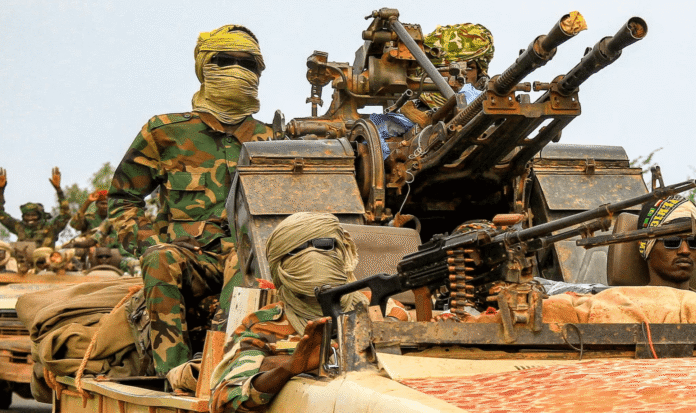
KHARTOUM – Sudan’s army-aligned authorities have pushed back against growing pressure from Washington over the country’s war, exposing deep disagreements over political legitimacy, diplomatic engagement and the international effort to secure a ceasefire in one of Africa’s most devastating conflicts.
The latest dispute comes as the United States increases pressure on the warring parties to halt fighting between the Sudanese Armed Forces, led by General Abdel Fattah al-Burhan, and the paramilitary Rapid Support Forces, commanded by Mohamed Hamdan Dagalo, widely known as Hemedti.
Sudan’s foreign ministry rejected recent US characterisations of the country’s political situation and defended the institutions aligned with the army as the internationally recognised authorities of Sudan. Washington, meanwhile, has continued to argue that Sudan’s future government should emerge through a civilian-led political process rather than military rule.
The disagreement has sharpened amid diplomatic tensions surrounding Burhan’s participation in international meetings in New York. Sudanese authorities have accused Washington of using diplomatic access as leverage over the country’s leadership, while US officials have continued to press for a cessation of hostilities and greater humanitarian access.
Behind that diplomatic confrontation lies a war that has transformed Sudan since fighting erupted in April 2023. What began as a power struggle between two military formations that had previously shared power has developed into a nationwide conflict involving territorial battles, competing political structures, allegations of atrocities and one of the world’s largest displacement crises.
Neither the SAF nor the RSF has secured a decisive national victory. The army has regained important territory, including Khartoum in 2025, and the government aligned with Burhan has sought to restore state institutions in the capital. The RSF, however, retains significant influence and territorial control elsewhere, particularly in western Sudan, leaving the country effectively divided across competing military zones.
That fragmentation has complicated international mediation because ceasefire negotiations are no longer concerned only with stopping battlefield clashes. Mediators must also confront competing claims over political authority, territorial control, humanitarian access and the structure of any post-war government.
Washington has increasingly tried to build international pressure around those issues. The United States has worked with Saudi Arabia, Egypt and the United Arab Emirates through a diplomatic grouping seeking a humanitarian truce and a pathway towards a more durable ceasefire.
Those countries bring considerable influence but also competing strategic interests. Egypt has longstanding ties with Sudan’s military establishment, while the UAE has repeatedly faced accusations of supporting the RSF, allegations Abu Dhabi denies. Saudi Arabia has previously hosted direct negotiations between the SAF and RSF in Jeddah, while Washington has attempted to coordinate the different regional powers around a common diplomatic framework.
The involvement of external powers illustrates why Sudan’s conflict has become much more than an internal struggle between two generals. Its location between the Red Sea, Sahel, Horn of Africa and North Africa gives the country significant strategic importance, while instability has consequences for neighbouring Chad, South Sudan, Egypt, Ethiopia, Eritrea, Libya and the Central African Republic.
Sudan also occupies an important position along the Red Sea, one of the world’s most strategically important maritime corridors. Prolonged instability therefore intersects with wider competition over ports, trade routes, security partnerships and political influence across northeast Africa.
Regional interests have repeatedly complicated attempts to end the war. Each diplomatic initiative must contend with the relationships that Sudan’s competing military forces have developed with governments, businesses and armed actors outside the country.
The humanitarian consequences remain far more immediate. Millions of Sudanese have been displaced within the country or forced across its borders, while communities continue to face severe shortages of food, healthcare, shelter and basic services. Aid organisations have repeatedly warned that insecurity and restrictions on access make it difficult to reach some of the populations facing the greatest need.
Famine and severe hunger have become part of the conflict’s landscape, particularly in areas where fighting has disrupted agriculture, markets and humanitarian operations. Damage to hospitals, schools, water systems, businesses and public infrastructure has further weakened the institutions civilians depend on.
Sudan’s economic losses are also mounting. Before the war, the country already faced inflation, foreign-exchange shortages, debt problems and political instability. Nearly three and a half years of conflict have destroyed businesses, disrupted trade routes, displaced workers and damaged productive capacity across agriculture, manufacturing and services.
Gold remains one of Sudan’s most valuable resources, but the conflict has intensified concerns about how mineral revenues and cross-border trading networks finance armed actors. Control over economic assets has consequently become intertwined with control over territory.
Agriculture has suffered heavily despite Sudan possessing some of Africa’s largest areas of potentially productive farmland. Conflict has displaced farming communities, interrupted planting and harvesting cycles and made transport between production areas and markets more difficult.
The damage matters beyond Sudan because the country has long been viewed as having substantial agricultural potential within the wider African and Arab food economy. Rebuilding that productive base will require security, infrastructure investment and functioning state institutions long after any ceasefire is reached.
Diplomatic pressure from Washington therefore confronts a much larger problem than persuading two military leaders to stop fighting. Previous negotiations have produced temporary commitments without delivering a lasting settlement, and repeated ceasefire announcements during the war have broken down.
Any new agreement would need mechanisms capable of monitoring compliance, protecting civilians and guaranteeing humanitarian access. It would also have to address the political question that continues to divide Sudan: who governs the country once the guns fall silent.
Civilian groups that helped lead the uprising against former president Omar al-Bashir in 2019 have repeatedly argued that Sudan should return to civilian government. Years of military intervention, political fragmentation and war have weakened that transition while creating new centres of power.
Burhan’s camp maintains that Sudan’s existing state institutions retain national legitimacy and has rejected attempts it considers interference in the country’s sovereignty. The RSF and its political allies have pursued a competing political project, deepening fears that prolonged conflict could institutionalise Sudan’s territorial and political division.
International diplomacy consequently faces two dangers. A ceasefire that ignores the underlying political conflict could collapse, while negotiations focused exclusively on designing a future government risk taking too long to stop the immediate killing, displacement and hunger.
African diplomacy will also remain important. The African Union and regional governments have a direct interest in preventing Sudan from becoming a prolonged source of instability across northeast Africa, particularly as the continent already confronts conflicts and political insecurity stretching from the Sahel to the Horn.
The latest confrontation between Sudan’s army-aligned authorities and Washington shows how difficult that diplomatic environment has become. Pressure from the United States may increase the cost of resisting negotiations, but external leverage alone cannot resolve the competing military, political and regional interests sustaining the conflict.
Nearly three and a half years after the war began, Sudan’s most urgent requirement remains a credible route towards ending the fighting and restoring humanitarian access. Whether the latest international pressure can move the SAF and RSF towards that outcome will depend not only on Washington, but also on whether regional powers can align their interests sufficiently to support an agreement that Sudan’s competing forces are prepared to observe.
Until that happens, diplomatic disputes over legitimacy will continue alongside a much more consequential reality inside Sudan: civilians are carrying the cost of a war whose political settlement remains unresolved.