


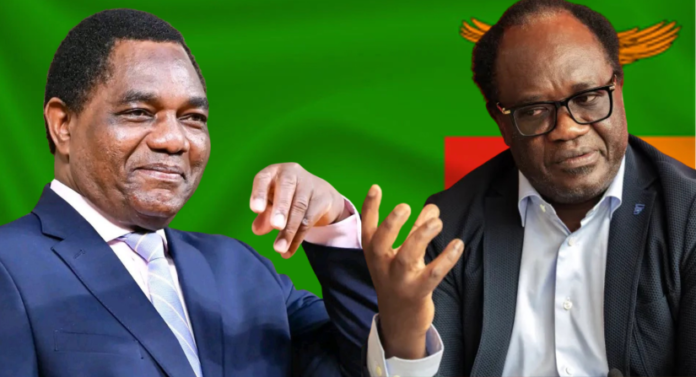
Zambia is facing fresh questions over its post-election process after the country’s highest courts were closed on the final day available to challenge President Hakainde Hichilema’s re-election.
The Constitutional Court and other senior courts in Lusaka were closed on Monday, with judicial authorities citing security concerns. The decision came as opposition leader Brian Mundubile prepared to contest the presidential result, adding another layer of tension to an election already marked by allegations of intimidation and irregularities.
Hichilema secured a second five-year term after winning 61.4% of valid votes in the 13 August election. Mundubile, his main challenger, received about 38%, according to official results announced by the Electoral Commission of Zambia.
The opposition has rejected the outcome and says it documented problems during the conduct, counting and transmission of results. Mundubile had announced plans to take those allegations to court, making Monday’s closure particularly sensitive because it coincided with the legal deadline for filing an election petition.
A judiciary memorandum instructed staff to remain at home, while police were deployed around court premises in Lusaka. Authorities said the closures were necessary because of security concerns, but the timing prompted questions among lawyers and opposition figures about access to the courts.
The dispute comes after an election that international observers described as competitive but conducted in a political environment that raised concerns about fairness.
European Union observers pointed to restrictions on fundamental freedoms, unequal campaign conditions and weaknesses in parts of the electoral process. State media coverage also favoured the incumbent, according to the mission’s preliminary assessment.
Those concerns do not by themselves establish that the presidential result was wrong. Hichilema won by a wide margin, and any attempt to overturn the outcome would require the opposition to present evidence capable of meeting Zambia’s legal threshold for an election challenge.
The controversy instead places attention on whether the country’s institutions can handle those allegations transparently and independently.
Zambia has built a strong reputation for competitive elections and peaceful transfers of power since returning to multiparty democracy in 1991. That history has often distinguished the country in a region where disputed elections have sometimes produced prolonged political crises.
Hichilema himself benefited from that democratic tradition when he defeated incumbent Edgar Lungu in 2021 after several unsuccessful attempts to win the presidency.
His re-election five years later comes under different circumstances. The president entered the campaign with the advantages of incumbency and an economic record built partly around restructuring Zambia’s debt and restoring relationships with international lenders and investors.
Copper has remained central to that recovery. Zambia is one of Africa’s largest producers of the metal and is seeking to sharply increase output as global demand grows from electricity networks, renewable energy, electric vehicles and other industries.
Economic progress has not removed domestic pressures, however. Many households continue to struggle with living costs, unemployment and poverty, giving the opposition fertile ground to challenge the government’s record.
Political tensions intensified soon after voting ended. Authorities arrested several opposition figures following a security operation that involved gunfire. Police said the operation concerned alleged threats to national security and the possession of military-grade weapons, while opposition representatives rejected the accusations.
Mundubile was later summoned by police for questioning over alleged national security threats. He has denied wrongdoing and described the allegations against his political allies as fabricated.
The United Nations human rights office has expressed concern about the arrests and called on Zambian authorities to ensure that any action against opposition figures complies with domestic law and international human rights standards.
Those developments have changed the atmosphere surrounding what began as a largely peaceful election. Attention is now shifting away from campaign rallies and ballot counting towards Zambia’s courts, police and other institutions. Their handling of the dispute could prove as important to public confidence as the election result itself.
A legal challenge does not automatically undermine an election. Courts are precisely where allegations about voting, counting or electoral procedure should be tested when political parties dispute an outcome.
Access to that process is therefore important, regardless of whether a petition ultimately succeeds.
Hichilema enters his second term with a clear electoral mandate according to the official count. His government must now balance that victory with the responsibility of maintaining confidence in the institutions that oversee political competition.
Mundubile and his allies face an equally important test. Claims of electoral wrongdoing require evidence and should be pursued through lawful institutions rather than political confrontation.
Across Africa, election credibility is increasingly judged not only by what happens on polling day but also by whether institutions remain independent when results are challenged. Courts, electoral commissions, police and political leaders all play a role in determining whether disputes are resolved through law or allowed to become wider political crises.
Zambia has spent more than three decades building a reputation for settling political change through elections. The dispute following Hichilema’s re-election now presents another test of that record, with the credibility of the process depending on whether competing claims can be heard openly and resolved through institutions trusted by both sides.