


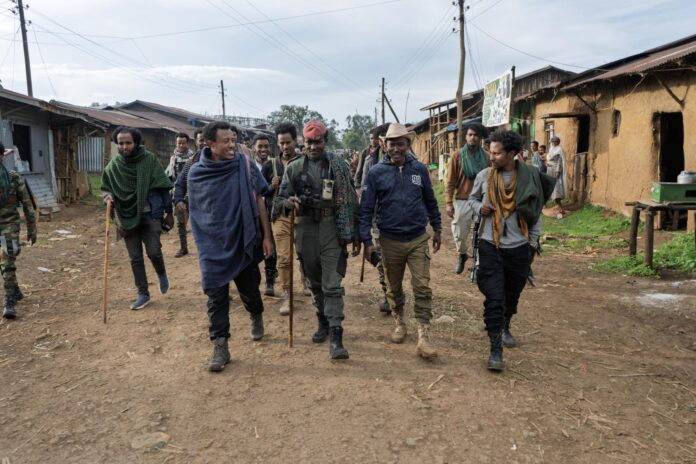
Political and military alliances are shifting across northern Ethiopia, raising concerns that unresolved disputes from the Tigray war could pull the region into another period of conflict.
The changing landscape involves the Tigray People’s Liberation Front (TPLF), factions of the Fano militia in Amhara, Ethiopia’s federal government and neighbouring Eritrea. Groups that once fought alongside each other have become rivals, while former enemies increasingly appear to share common political interests.
The realignment comes nearly four years after the Pretoria Agreement ended the devastating war between Ethiopia’s federal government and Tigrayan forces. The African Union-brokered agreement stopped large-scale fighting in November 2022, but several political and territorial disputes that fuelled the conflict remain unresolved.
Tensions have increased again in recent months. Political developments across Tigray and Amhara, alongside deteriorating relations between Ethiopia and Eritrea, have created a more unpredictable security environment across the north.
One of the most significant changes concerns the relationship between Tigrayan political actors and some Fano factions. Fano fighters from the Amhara region fought alongside the Ethiopian National Defence Force against Tigrayan forces during the 2020-2022 war.
That alliance helped federal forces challenge the TPLF, which had dominated Ethiopian national politics before Prime Minister Abiy Ahmed came to power in 2018. Relations between the federal government and its Amhara allies later deteriorated as the political landscape changed following the Tigray peace agreement.
Federal authorities moved to dismantle regional special forces after the war, triggering resistance in Amhara and contributing to an insurgency involving Fano fighters. Government forces and armed groups have since fought across parts of the region, creating another major security challenge for Addis Ababa.
The deterioration has produced an unusual political landscape in which some Fano factions and Tigrayan actors share opposition to Abiy’s government despite their bitter history. Their overlapping interests, however, should not be interpreted as evidence that the two sides have resolved the deep disagreements between them.
Territorial disputes remain one of the biggest obstacles to lasting cooperation. Western and southern areas of Tigray remain contested between Tigrayan and Amhara interests, complicating implementation of the Pretoria Agreement and efforts to resolve displacement caused by the war.
Communities across these disputed areas experienced violence and mass displacement during the conflict. Questions surrounding administration, land and the return of displaced people therefore remain highly sensitive, and any attempt to change territorial control could trigger further confrontation.
Eritrea has added another layer of uncertainty to the regional picture. Eritrean forces fought alongside Ethiopia’s federal military during the Tigray war, but relations between Addis Ababa and Asmara have since deteriorated sharply.
Ethiopia accused Eritrea earlier this year of supplying weapons to rebels operating in Amhara, an allegation Eritrean authorities rejected. Asmara has also denied accusations that it is seeking to destabilise its much larger neighbour.
The worsening relationship represents a dramatic reversal from the rapprochement between Abiy Ahmed and Eritrean President Isaias Afwerki in 2018. Their reconciliation ended two decades of hostility and contributed to Abiy receiving the Nobel Peace Prize the following year.
Cooperation between the two governments later became central to the military campaign against the TPLF. Eritrean troops entered Tigray and fought alongside Ethiopian federal forces, but the relationship between Addis Ababa and Asmara changed significantly after the Pretoria Agreement.
Eritrea was not a signatory to the peace deal and its relationship with the TPLF remains deeply hostile. Growing tensions between Asmara and Addis Ababa have since created a more complicated balance in which former wartime partnerships no longer define the region’s politics.
Relations have also come under pressure as Ethiopia renews its push to secure greater access to the Red Sea. Abiy has repeatedly argued that landlocked Ethiopia needs reliable commercial access to a seaport to support its population and growing economy.
Eritrea’s ports once played an important role in Ethiopian trade before the countries fought their 1998-2000 border war. Ethiopian officials now insist that the country seeks peaceful access to the sea, although the debate has generated concern among some of Ethiopia’s neighbours.
Eritrean authorities have watched the discussion closely, particularly when Ethiopian political figures have spoken about the strategic importance of Red Sea ports. The issue adds another source of tension to a relationship already affected by disagreements over the political settlement in northern Ethiopia.
The result is a network of relationships that looks very different from the alliances that shaped the Tigray war. Ethiopia’s federal government once counted Eritrea and Amhara forces among its most important military partners against the TPLF.
Addis Ababa now faces strained relations with Eritrea while simultaneously confronting an insurgency involving Fano forces in Amhara. Tigrayan leaders are also navigating their own internal political divisions as the region attempts to recover from the war.
Disagreements within the TPLF and Tigray’s political establishment have centred on leadership, relations with Addis Ababa and implementation of the Pretoria Agreement. These divisions have complicated efforts to establish a stable post-war political settlement.
Tigray also continues to recover from enormous human and economic damage. Reconstruction remains incomplete, displaced communities continue to wait for lasting solutions, and the demobilisation and reintegration of former combatants have proved difficult.
These unresolved challenges increase the risks associated with renewed military confrontation. The 2020-2022 war killed large numbers of people and displaced millions, creating one of Africa’s gravest humanitarian crises in recent years.
Researchers, governments and humanitarian organisations have produced widely differing estimates of the death toll. There is, however, broad agreement about the devastating impact that conflict, hunger, disease and the collapse of essential services had on communities.
Another major confrontation could place people who are still rebuilding their lives under renewed pressure, while increasing humanitarian needs across northern Ethiopia.
The risks also extend beyond Tigray and Amhara because Ethiopia sits at the centre of an increasingly fragile Horn of Africa. Sudan remains engulfed in war, Somalia continues to confront insecurity, and geopolitical competition around the Red Sea has intensified.
Any direct confrontation involving Ethiopia and Eritrea could therefore have consequences well beyond their shared border, affecting trade routes, migration, regional diplomacy and security across the Horn.
The changing alliances also demonstrate how quickly political partnerships can shift when the underlying causes of conflict remain unresolved. Groups that fought together during one phase of Ethiopia’s crisis now find themselves divided, while former enemies may discover areas of common interest.
Such convergence does not necessarily amount to lasting political or military cooperation. Historical grievances, territorial disputes and competing political objectives remain capable of breaking temporary alignments apart.
The Pretoria Agreement demonstrated that negotiations could stop a devastating war, but its longer-term success depends on resolving the disputes that survived the ceasefire. Dialogue between Addis Ababa and Tigrayan leaders remains important, alongside efforts to find a political settlement to the conflict in Amhara.
Stable relations between Ethiopia and Eritrea could also reduce the danger of domestic tensions developing into a wider regional confrontation.
Northern Ethiopia’s communities have already endured years of conflict, displacement and economic disruption. Preventing another cycle of violence will depend on whether political leaders can resolve outstanding disputes before shifting alliances turn old grievances into new battle lines.