


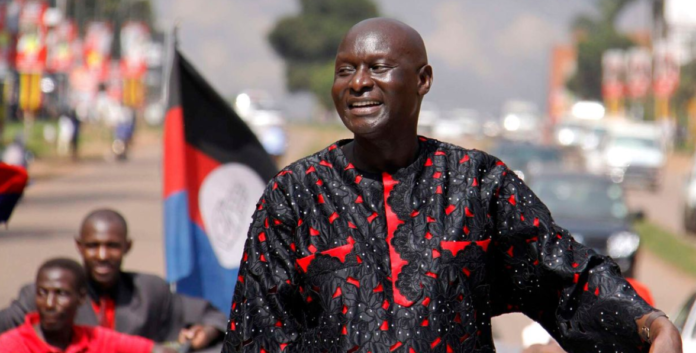
Uganda has nominated veteran diplomat Olara Otunnu to become the next Secretary-General of the United Nations, adding another African candidate to a contest that will determine who leads the world body from 2027.
The 75-year-old former UN Under-Secretary-General becomes the seventh declared candidate seeking to succeed António Guterres, whose second five-year term ends on 31 December.
Uganda formally submitted Otunnu’s nomination in a letter to the presidents of the UN General Assembly and Security Council. The move places one of the country’s most experienced international diplomats into a competitive race that is expected to gather pace this week.
Otunnu brings decades of experience across diplomacy, the United Nations, politics, academia and civil society. His candidacy also adds an East African voice to a selection process taking place at a difficult moment for the UN, with conflicts, climate change, artificial intelligence and pressure for institutional reform dominating the international agenda.
Otunnu is one of Uganda’s most internationally recognised diplomats. He previously served as the country’s ambassador and permanent representative to the United Nations between 1980 and 1985.
He later became UN Under-Secretary-General and served as the organisation’s first Special Representative for Children and Armed Conflict from 1998 to 2005.
His work in that role focused international attention on the impact of war on children. Uganda’s government says he helped establish children affected by armed conflict as a major issue on the UN Security Council’s agenda. His career has also included political activity in Uganda, where he previously led the Uganda People’s Congress.
Uganda’s Ministry of Foreign Affairs described Otunnu as a statesman with more than four decades of experience spanning international diplomacy, government, academia and civil society. Otunnu has placed conflict resolution and reform of the United Nations among the priorities of his candidacy.
In his vision for the organisation, he argues that the UN needs to strengthen its ability to respond to major international conflicts while continuing institutional reforms. His candidacy comes as the organisation faces questions about its effectiveness in responding to wars and geopolitical divisions.
The next Secretary-General will inherit an international system in which disagreements between major powers have repeatedly complicated collective action through the Security Council.
Otunnu has also identified artificial intelligence as an emerging challenge for global governance. He has proposed creating an oversight mechanism to coordinate the UN’s work on AI as the technology increasingly affects economies, security and societies.
Climate change is another priority, although he has argued that climate action must take account of economic development. Otunnu joins a diverse field of diplomats, former presidents and senior international officials competing for the position.
The current candidates include former Chilean president Michelle Bachelet and International Atomic Energy Agency Director-General Rafael Grossi of Argentina.
Former Costa Rican vice-president Rebeca Grynspan is also running, alongside former Ecuadorian foreign minister María Fernanda Espinosa and former Guyanese foreign minister Carolyn Rodrigues-Birkett.
Africa already has another prominent candidate in the race. Former Senegalese president Macky Sall is seeking the position, giving the continent at least two declared contenders. More candidates could still enter before the selection process reaches its decisive stages.
The presence of several female candidates is also significant. Since the United Nations was established in 1945, no woman has served as Secretary-General.
The selection of the UN Secretary-General is influenced by an informal tradition of geographic rotation, although the position does not automatically pass from one region to another.
There is considerable diplomatic support for the view that Latin America and the Caribbean should produce the next Secretary-General.
The region last held the position when Peru’s Javier Pérez de Cuéllar served from 1982 to 1991.
That could strengthen the position of candidates from Latin America and the Caribbean, particularly as several have extensive international experience.
However, regional considerations are only one part of a highly political selection process. The contest provides another opportunity for African diplomacy to influence the debate over the future direction of the United Nations.
The Secretary-General is formally appointed by the UN General Assembly following a recommendation from the Security Council. In practice, that gives the five permanent members of the Security Council considerable influence over who gets the job.
China, France, Russia, the United Kingdom and the United States each hold veto power. A successful candidate must therefore navigate competing geopolitical interests without attracting a veto from any of the five.
The 15-member Security Council is expected to begin informal straw polls as it works to narrow the field of candidates.
Those ballots provide an early indication of the level of support each contender has among Council members, although negotiations can continue for months before a consensus emerges.
The successful candidate will serve a five-year term beginning on 1 January 2027. Africa has produced several UN Secretaries-General, most recently Ghana’s Kofi Annan, who led the organisation from 1997 to 2006. Egypt’s Boutros Boutros-Ghali served immediately before him from 1992 to 1996.
Otunnu’s entry therefore does not rest on a claim that Africa has never led the institution. Instead, his candidacy brings questions about the continent’s role in an international system that African governments have increasingly argued requires reform.
African leaders have repeatedly called for greater representation within global institutions, particularly the UN Security Council.
The continent has 54 UN member states but no permanent seat on the Council, despite accounting for a significant share of issues considered by the body.
The Secretary-General cannot independently reform the Security Council, but the next officeholder will have considerable influence over the international debate on multilateralism, development and institutional reform.
Nominating Otunnu places the Uganda directly into that conversation. Whether he can secure enough support to progress through the Security Council remains uncertain. The field is competitive, regional considerations will matter, and the permanent members ultimately wield considerable influence.
But with the selection process gathering pace, Uganda has put forward a candidate with extensive experience inside the institution he now hopes to lead.