


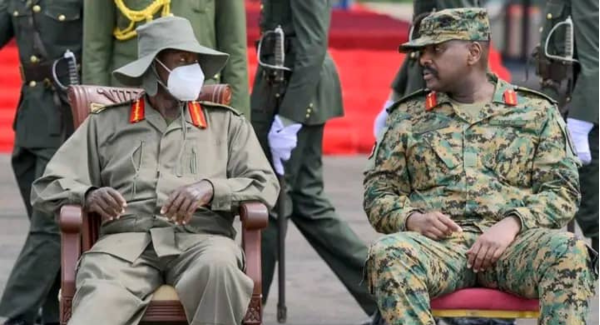
A proposal to change how Uganda selects its Leader of the Opposition has triggered a political storm, deepening divisions within Parliament after the country’s military chief publicly declared that he wants the current opposition leader removed from office.
The debate follows an announcement by Buyaga West County MP Denis Namara that he will seek leave of Parliament to introduce amendments to the Administration of Parliament Act, allowing both opposition and independent legislators to participate in the election of the Leader of the Opposition (LoP).
The proposed amendment comes days after Uganda’s Chief of Defence Forces (CDF), Gen. Muhoozi Kainerugaba, publicly called for the removal of Joel Ssenyonyi, the Leader of the Opposition and spokesperson of the National Unity Platform (NUP), Uganda’s largest opposition party.
NUP currently holds 48 seats in the 12th Parliament (2026–2031), making it the largest opposition bloc and giving it the mandate to designate the Leader of the Opposition under the existing parliamentary arrangement.
Namara argues that the proposed law would strengthen accountability within the opposition ranks.
“I am going to seek leave of Parliament to introduce a proposed amendment into the Administration of Parliament Act. We shall amend Section 8 of this Act so that both Opposition and Independent MPs elect the Leader of Opposition in Parliament,” Namara said.
He further defended the proposal by arguing that all parliamentary leaders should be subject to oversight.
“If Parliament can remove a President and all Ministers, if it can remove a Speaker of Parliament, why should it be impossible for Parliament to remove a Leader of Opposition? Because if you have leaders who can’t be checked, it breeds impunity!” he said.
Namara maintains that the proposed legislation would broaden participation in opposition leadership decisions and empower legislators outside formal party structures.
“The proposed amendment we are going to table before Parliament is actually going to empower the opposition in Parliament. They will have powers to select a Leader of Opposition of their choice. So I expect Opposition MPs to support us in this journey,” he added.
The proposal has, however, drawn criticism from legal experts, opposition politicians and civil society leaders who view it as part of a broader effort to influence the leadership of Uganda’s opposition.
The controversy intensified after Gen. Muhoozi announced on June 15 that he had instructed the Patriotic League of Uganda (PLU), a pressure group he chairs, to study ways of removing Ssenyonyi from office.
“I have instructed PLU to study how to remove Joel Ssenyonyi, who’s the current legal Leader of Opposition, from being Leader of the Opposition as soon as possible,” Muhoozi wrote on social media.
In a subsequent post, he added: “I want a new Leader of the Opposition in Parliament. And I will get him. He will be endorsed by me.”
Muhoozi also argued that no law prevented him from expressing preferences regarding the office.
“Nothing in the laws of my country stops me from appointing a Leader of the Opposition that I think is best suited for the job. Nothing at all,” he wrote.
His remarks have sparked concerns among critics who argue that the opposition leadership should remain independent of both the Executive and the military.
Uganda Law Society President Isaac Ssemakadde dismissed the proposal, saying it undermines constitutional principles governing political association.
“The suggested PLU Bill is fool’s errand. A wild-goose chase. The right to freedom of association—the basis of multiparty democracy—includes the right not to associate. Parliament has no power to direct a merger of opposition political parties and/or Independents,” Ssemakadde said.
Former MP and constitutional lawyer Samuel Odonga-Otto also criticized the initiative, linking it to what he described as growing political interference in parliamentary affairs.
“This 12th Parliament will remain the most useless Parliament in Uganda’s history. They take orders from PLU. A Speaker of Parliament is removed by PLU. The Speaker of Parliament is summoned by PLU. Ministers are summoned by PLU. The Leader of Opposition is determined by PLU,” Odonga-Otto said.
At the centre of the dispute is Ssenyonyi, who has recently emerged as one of the government’s most vocal critics. The opposition leader has accused security agencies of escalating human rights abuses and unlawful detentions, including the arrest of former Kampala Lord Mayor Erias Lukwago.
The tensions between Ssenyonyi and Muhoozi have escalated in recent weeks, with both men exchanging sharp public criticism over governance, human rights and the role of security agencies in politics.
Political analysts say the proposed amendment is likely to face intense scrutiny, not only because of its implications for parliamentary leadership but also because it comes amid broader debates about the separation of powers, opposition autonomy and the role of influential political actors outside Parliament.