


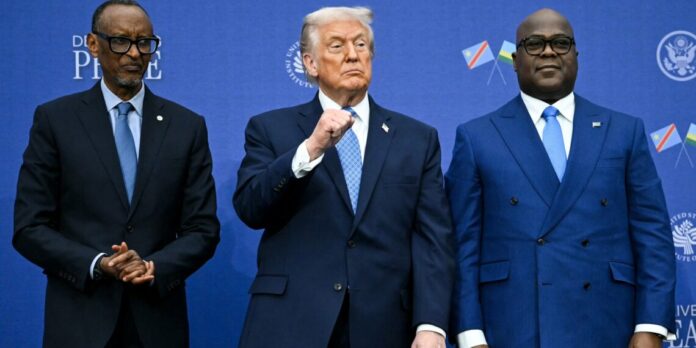
Fresh tensions have emerged between the Democratic Republic of the Congo (DRC) and Rwanda after Kinshasa announced new steps to disarm the Democratic Forces for the Liberation of Rwanda (FDLR), an armed group that has remained at the centre of insecurity in eastern Congo for decades.
Congolese authorities say the latest measures demonstrate their commitment to implementing the security provisions of the peace agreement signed with Rwanda. Kigali, however, has questioned the approach, arguing that any disarmament process must follow the framework agreed by both countries and their international mediators.
The disagreement has exposed the fragile nature of a peace process that many hoped would reduce violence in one of Africa’s most volatile regions. While both governments continue to support diplomatic engagement, differences over how to neutralise armed groups remain a significant obstacle.
The FDLR was formed by elements linked to the perpetrators of the 1994 Rwandan genocide who fled into what is now the Democratic Republic of the Congo. Rwanda considers the group a direct threat to its national security and has repeatedly called for its complete dismantling.
The conflict has become increasingly complex over the years. Kinshasa accuses Rwanda of backing the M23 rebel movement, which has captured large areas of eastern Congo. Rwanda has consistently denied those allegations, maintaining that its security concerns stem from the continued presence of the FDLR near its border.
The latest disagreement comes despite ongoing international efforts to stabilise the region. The United States, Qatar, the African Union and Togo continue to support the implementation of the Washington Peace Agreement through a Joint Security Coordination Mechanism that brings together officials from both countries. During their latest meeting in Geneva, the parties reaffirmed their commitment to accelerating the neutralisation of the FDLR while improving information sharing and establishing stronger verification mechanisms.
Congolese military officials recently launched a campaign encouraging FDLR fighters to surrender voluntarily before broader security operations begin. Reception centres have been established to receive combatants willing to disarm before they are repatriated to Rwanda under internationally supervised programmes.
Despite those efforts, security analysts caution that dismantling the FDLR will not be straightforward. The armed group has operated in eastern Congo for many years, often shifting its areas of operation and forming alliances with local militias. United Nations experts have also noted that the security environment remains highly fragmented, making sustained disarmament difficult.
The continuing instability has had severe humanitarian consequences. Millions of people have been displaced by years of fighting involving numerous armed groups. Communities across North and South Kivu continue to face violence, disrupted livelihoods and limited access to essential services.
The dispute also carries wider economic implications. Eastern Congo contains some of the world’s richest deposits of cobalt, coltan, gold and other critical minerals that are essential to global technology and clean energy industries. Prolonged insecurity has repeatedly disrupted mining operations, trade routes and investment across the Great Lakes region.
Diplomatic progress therefore remains important not only for regional security but also for economic development. International partners view lasting peace as essential for attracting investment, improving infrastructure and creating opportunities for communities that have lived with conflict for decades.
The current disagreement does not signal the collapse of the peace process. Both governments continue to participate in internationally mediated discussions and have reaffirmed their commitment to the agreement. However, the latest developments show how quickly differing interpretations of security commitments can slow implementation.
The dispute between the DRC and Rwanda reflects one of Africa’s most enduring security challenges. Lasting peace will depend on more than military operations. It will require political trust, effective regional cooperation and credible mechanisms to verify that all parties are meeting their commitments.
For the millions of people living in eastern Congo, the success of the peace process will be measured less by diplomatic statements than by safer communities, the return of displaced families and the restoration of normal economic life. Until then, every disagreement over implementation risks delaying the stability that the region has sought for decades.