


Look closely at the design of Africa’s indigenous languages, and a deeper truth about African masculinity and personhood emerges. From isiXhosa, isiZulu, Sepedi and Sesotho in the south to Kiswahili in the east and Yorùbá in the west, these languages have no grammatical gender, unlike English. There is no ‘he’ or ‘she’, only yena or yeye, a single word meaning simply ‘that person’.
In Bantu grammar, human beings are classified first under the Personhood Class (umuntu / abantu; motho / batho), placing shared humanity ahead of biological sex. Even in Kiswahili, the words for man (mwanaume) and woman (mwanamke) share the same root, mwana, meaning human offspring. Both are identified as children of the same human family before male is distinguished from female.
Africa deserves profound praise for this cultural insight. Centuries before modern sociology, African civilisations encoded a unifying truth into everyday speech. The primary division in society is never a battle between men and women, but the sacred developmental journey from child (umntwana / ngwana) to initiated, morally accountable adult (umuntu / motho). Men and women were understood as complementary pillars upholding the same kinship roof.
This raises an urgent question for our continent this November. When Africa already possesses one of the deepest, most unifying philosophies of human personhood on earth, why are we buying into a Western concept of gender that fractures our homes and turns men and women into adversaries?
Imported gender frameworks have conditioned a generation to view masculinity itself with suspicion, as though strength, protectiveness and male identity were defects requiring apology. Yet across both classical civilisation and indigenous African philosophy, serious thinkers never defined masculinity by brute dominance or aggression. By definition, masculinity is a constructive, life-giving force: strength placed under moral governance, restraint and duty to the community.
Over two thousand years ago, Aristotle defined true courage (andreia) not as reckless aggression, but as the disciplined median between cowardice and impulsiveness: strength guided by wisdom for a noble end. One of my favourite definitions comes from the Stoic emperor Marcus Aurelius, who went further. He warned that a man who cannot master his own anger is not powerful, no matter how loudly he intimidates others; he is enslaved to his impulses.
Independently of Western philosophers, African philosophy arrived at the same conclusion with even sharper moral clarity. In his landmark work on African personhood, Nigerian philosopher Ifeanyi Menkiti drew a vital distinction between biological birth and moral standing. Being born male is merely the starting point. True manhood is an earned achievement, realised through self-discipline, initiation and service to one’s family and community.
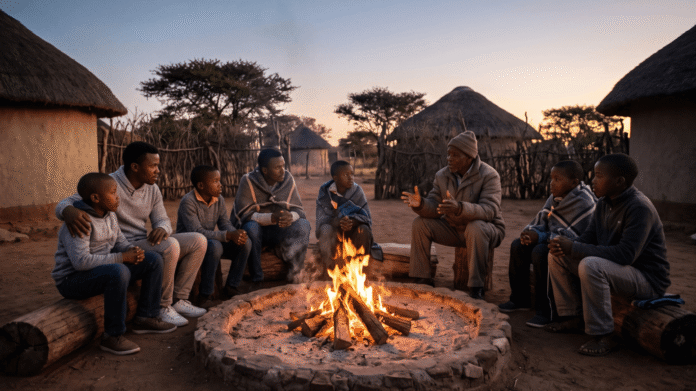
Think of masculinity as fire inside a pit. Contained within structure, purpose and conscience, fire warms the entire house, cooks the food and keeps predators at bay. Scattered outside the pit, that very same fire burns the house down.
When we examine South Africa’s crisis of violence through this lens, the numbers tell a sobering story that imported slogans fail to explain.
According to South African Police Service (SAPS) annual figures, the country recorded 23,096 murders in the 2025/26 financial year. That is a rate of 37.2 per 100,000 people, more than six times the global average of roughly 6 per 100,000 documented by the United Nations Office on Drugs and Crime (UNODC).
Broken down by sex, a stark double reality emerges. Some 85.4% of South Africa’s murder victims are men, killed predominantly on streets and outside taverns in alcohol-fuelled altercations. The other 14.6% are women, who face their greatest lethal danger inside private homes, at the hands of intimate partners or relatives. Globally, UNODC data reflects the same pattern: 80% of all homicide victims are male, yet 58% of women killed intentionally lose their lives inside the domestic sphere.
Both sides of that lethal ledger trace back to the same broken root, which I have discussed in previous articles: fatherlessness and unhealed childhood trauma.
In earlier columns for Fence Africa 24, I examined how migrant labour and modern institutional blind spots stripped fathers from African households. Today, Statistics South Africa confirms that only 31.4% of South African children live with both biological parents. This is never an indictment of single mothers, who carry extraordinary weight with remarkable resilience. Rather, it exposes a developmental vacuum. Research across two dozen countries consistently shows that boys who witness domestic conflict or endure childhood abuse without a healthy male anchor are far more likely to normalise violence as a response to stress and shame.
The late Burkinabé thinker Malidoma Patrice Somé warned relentlessly about the danger of uninitiated men. When fathers and elders are absent, young men are left without rites of passage or moral frameworks to channel their raw strength. Street culture, gangs and tavern bravado rush into that vacuum, convincing wounded boys that aggression is courage, that emotional numbness is strength and that control is leadership. The tragedy in our streets and our homes is never caused by too much masculinity. It is caused by uninitiated, unhealed boys carrying adult physical strength without an elder’s compass.
If trauma and paternal absence were destiny, South Africa would be beyond repair. It is not, and the proof lies in a public-health and community-change approach known as Positive Deviance.
Positive Deviance rests on a simple, empowering observation. In every high-poverty township, informal settlement and rural village, there are men facing the same economic pressures, historical wounds and fatherless upbringings as their neighbours. Yet they practise uncommon, constructive habits that keep their homes peaceful and their children thriving. Because these men live under the same constraints, their example cannot be dismissed as foreign or unrealistic.
Across South Africa, these ‘positive deviants’ are quietly rewriting African masculinity through three daily disciplines.
Emotional Grounding Over Reaction. Instead of letting childhood shame or workplace humiliation erupt at home, grounded men practise self-regulation. They step outside to cool down during conflict, seek counsel from trusted peers and refuse to confuse volume with authority.
Disciplined Presence. They reject the weekend binge-drinking culture that fuels so much street and domestic violence. Instead, they choose to be sober, financially transparent and actively involved in their children’s daily routines from infancy.
Social Fatherhood. Rooted in the Ubuntu ethic articulated by South African philosopher Mogobe Ramose, ‘Feta kgomo o tshware motho’ (put human dignity above material gain), and documented by South African researcher Kopano Ratele, these men step in as social fathers. Uncles, coaches, teachers, older brothers and stepfathers intentionally mentor fatherless boys, giving them a living blueprint of calm, protective manhood.
Building the Fire Pit This International Men’s Day
As the world marks International Men’s Day on 19 November, South African men do not need imported lectures or borrowed Western categories that pit husband against wife and son against daughter. We need to return to the wisdom already written into our own languages and traditions, where every human being is first umuntu, and where manhood is an honourable office earned through stewardship.
Real change begins when men decide to build the fire pit. That means healing our own childhood wounds rather than passing them on, interrupting demeaning behaviour among our peers in taverns, boardrooms and WhatsApp groups, and standing as steady mentors for boys growing up without a father at home.
When men govern their own strength with conscience, they do more than prevent violence. They make our homes, our communities and our nation truly safe to exist.
The future of Africa’s men must be a uniquely African one. We have the answers and the culture to achieve this.
You are the change we want to see. Step into your masculine mandate.