
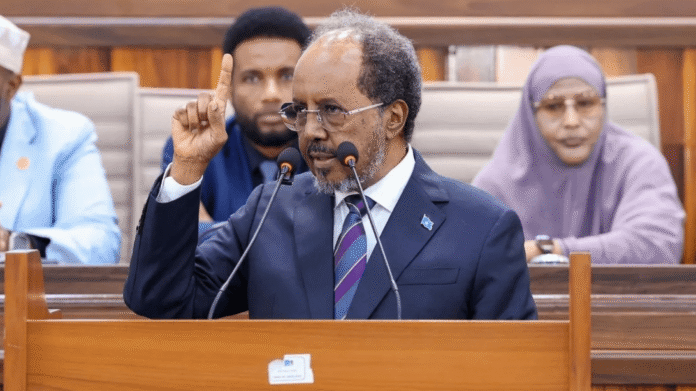
Somalia is considering new diplomatic measures against the United Arab Emirates after President Hassan Sheikh Mohamud accused Abu Dhabi of funding political divisions, backing armed groups and undermining the country’s sovereignty.
MOGADISHU, Somalia – Somalia is preparing to recall its ambassador to the United Arab Emirates and request the return of the Emirati envoy in Mogadishu for consultations, marking a fresh escalation in a diplomatic confrontation that has exposed deep divisions over foreign influence, national sovereignty and control of strategic ports in the Horn of Africa.
The reported measures follow President Hassan Sheikh Mohamud’s televised address on 17 November, in which he accused the UAE of interfering in Somalia’s internal affairs, supporting political factions and establishing security structures outside the authority of the federal government. The allegations have triggered a public exchange between officials in Mogadishu and Abu Dhabi, raising concerns about the future of relations between the two countries.
According to a report published by Goobjoog News on Thursday, 19 November, the Somali government is considering reciprocal diplomatic consultations involving both ambassadors. The proposed measures would not constitute a complete severance of diplomatic relations, with consular services expected to continue and channels for dialogue remaining open.
Somalia’s Ministry of Foreign Affairs had already issued a strongly worded statement on Wednesday, accusing the Emirati government of undermining the country’s sovereignty, territorial integrity and national unity. Mogadishu warned that it would take necessary lawful measures to protect its national interests and insisted that all foreign diplomatic and security arrangements must pass through federal institutions.
President Mohamud’s address marked one of his strongest public criticisms of Abu Dhabi since Somalia cancelled its agreements with the UAE in January 2026. He alleged that Emirati authorities had supported competing political interests and armed formations operating outside the national security framework, accusing the Gulf state of pursuing policies that threatened Somalia’s political stability.
The president compared the UAE’s alleged conduct to that of a brother who damages a family home while continuing to present himself as a friend. His remarks reflected a growing sense of frustration within the federal government over what it considers a sustained campaign to weaken its authority.
Despite the criticism, Mohamud acknowledged the UAE’s historical contribution to Somalia during decades of conflict and institutional collapse. Emirati financial institutions, trade networks and investment opportunities have provided important commercial links for Somali businesses, while Abu Dhabi has also supported humanitarian initiatives and security programmes.
The Somali leader argued that the relationship had changed, however, accusing the UAE’s leadership of pursuing divisive policies and conducting activities without the approval of Somalia’s internationally recognised federal government. He warned that the country would no longer tolerate foreign interventions that challenged its sovereignty.
The confrontation intensified when Anwar Gargash, diplomatic adviser to UAE President Sheikh Mohamed bin Zayed Al Nahyan, publicly challenged Mohamud’s accusations. Gargash criticised the Somali president’s approach, suggesting that domestic political considerations were influencing his position towards Abu Dhabi.
The exchange has brought renewed attention to the UAE’s longstanding relationships with Somalia’s regional administrations, particularly Somaliland, Puntland and Jubaland. Although these territories have different constitutional and political relationships with Mogadishu, all three have maintained significant commercial or security connections with Emirati institutions.
Relations deteriorated sharply on 12 January when Somalia’s cabinet announced the termination of agreements involving the UAE, including port operations, defence cooperation and security partnerships. The decision covered arrangements associated with the strategic ports of Berbera, Bosaso and Kismayo, which play important roles in regional trade and maritime logistics.
The Somali government argued that these arrangements undermined federal authority because they had been negotiated or maintained without its approval. The UAE’s commercial presence in the region includes major port investments, particularly the development of Berbera by Dubai-based logistics company DP World.
Regional authorities challenged Mogadishu’s decision. Somaliland, Puntland and Jubaland rejected the federal government’s attempt to terminate their Emirati agreements, illustrating the continuing struggle over the division of powers between Somalia’s federal institutions and regional administrations.
The dispute also reflects wider geopolitical competition around the Gulf of Aden and the Red Sea, where access to ports and maritime routes carries considerable commercial and strategic importance. Somalia’s coastline places it at the centre of shipping networks linking the Indian Ocean, the Middle East and the Suez Canal.
One of the most serious diplomatic flashpoints emerged in January after reports that Aidarous al-Zubaidi, a leading figure in Yemen’s Southern Transitional Council, had travelled through Somaliland on his way to the UAE. Somali authorities investigated allegations that the movement had been facilitated without federal approval.
The incident contributed to the breakdown in relations, with Mogadishu treating the alleged use of Somali territory as a challenge to its control over national borders and airspace. Somalia subsequently imposed restrictions on Emirati military and cargo aircraft while maintaining its objections to security arrangements conducted outside federal authority.
Mohamud has also criticised what he considers foreign support for Somaliland’s independence ambitions. Somaliland declared independence from Somalia in 1991 and has operated its own institutions since then, although Mogadishu continues to regard the territory as an integral part of the Somali Republic.
Israel’s recognition of Somaliland in December 2025 added another layer of tension. The Somali president has accused the UAE of helping facilitate that diplomatic development, although the allegation has not been independently substantiated.
The dispute is unfolding alongside increasingly contentious domestic politics. Somalia’s federal government faces disagreements with several regional administrations over electoral procedures, constitutional reforms and the distribution of political authority.
In South West State, political tensions and reports of armed mobilisation have raised concerns about the possibility of further instability. Allegations that foreign interests are supporting rival political factions remain disputed and have not been independently established.
Similar tensions have emerged in Hiiraan, where political figures have challenged the existing arrangements within Hirshabelle State. The disagreements centre on representation, leadership rotation and the balance of power between communities in Hiiraan and Middle Shabelle.
Former intelligence officials and regional political actors have criticised what they describe as failures to honour established power-sharing understandings. These disputes have created an environment in which allegations of outside financing and political interference are increasingly prominent, although credible independent evidence linking the UAE to specific planned rebellions remains limited.
Somalia’s national political crisis has also deepened over constitutional amendments extending presidential and parliamentary terms from four to five years. Under the previous constitutional framework, Mohamud’s term was due to expire in May 2026, but the federal government maintains that the amendments allow his administration to remain in office until 2027.
Opposition leaders have challenged the application of the amendments to sitting officeholders, arguing that the president’s mandate has expired and that the electoral process lacks sufficient political consensus. The government rejects those objections and maintains that the constitutional changes provide a legal basis for its position.
The disagreement has complicated efforts to reach a settlement over the next national elections, placing further pressure on the country’s fragile federal arrangements. Political tensions have also raised concerns about the ability of national and regional institutions to coordinate security operations against militant groups.
The UAE’s role in Somalia remains particularly sensitive because of its previous security assistance and financial support. Emirati authorities have funded military training and other security programmes, while commercial investments have strengthened the Gulf state’s influence in strategically important coastal areas.
Somalia’s latest diplomatic measures could therefore have consequences beyond the relationship between Mogadishu and Abu Dhabi. A prolonged confrontation may affect investment confidence, security coordination and relations between the federal government and regional administrations that continue to maintain their own connections with Emirati institutions.
The Somali government has nevertheless sought to distinguish its concerns about UAE government policy from its relationship with the Emirati people. In its latest statement, the Foreign Ministry reaffirmed the historical friendship between the two populations and signalled that diplomatic engagement could continue if Abu Dhabi respected Somalia’s sovereignty and constitutional authority.
Mohamud has similarly left open the possibility of dialogue, insisting that any future cooperation must proceed through recognised diplomatic channels and respect the federal government’s authority over foreign relations.
The developing crisis leaves Somalia facing a difficult diplomatic balancing act as it seeks to consolidate state authority, manage regional political disagreements and protect vital economic relationships. Whether the proposed ambassadorial consultations lead to a negotiated settlement or deeper diplomatic restrictions will depend on the decisions taken by both governments in the coming days.