
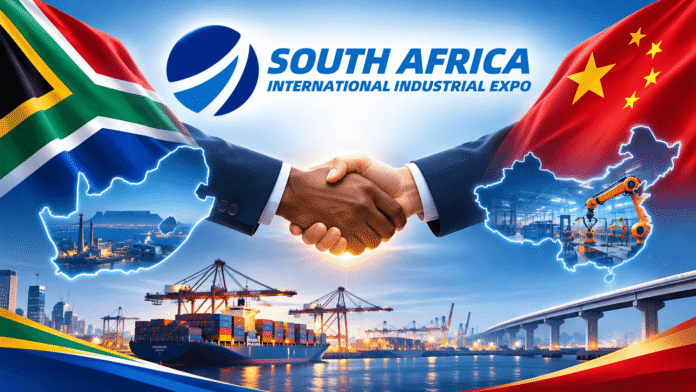
South Africa has gained a significant opportunity through China’s zero-tariff access scheme. But as SAIIE 2026 brings Chinese manufacturers and South African businesses together in Johannesburg, important questions remain about who benefits, how trade deals are measured and whether market access will translate into jobs and industrial growth.
JOHANNESBURG, South Africa – On paper, South Africa’s China zero-tariff deal represents one of the most significant trade opportunities the country has received from Beijing in decades.
Since 1 May 2026, qualifying South African products have been eligible to enter China at zero customs duties. The arrangement extends beyond a handful of agricultural products or a limited sector-specific initiative. According to Golden Bridge Expo, the private company behind the South Africa International Industrial Expo (SAIIE 2026), the scheme covers the broader tariff schedule, including agriculture, food, minerals and manufactured goods, with 47 tariff lines subject to tariff-rate quotas.
In a country seeking export growth, employment and access to new markets beyond its traditional trading partners, that should be a major economic opportunity.
But SAIIE 2026, taking place from 19 to 21 November alongside the China-Africa Economic and Trade Expo (CAETE), is not a government trade negotiation. It is a business exhibition organised by a private-sector company with roots in China.
That distinction matters. Throughout a detailed set of written responses provided to Fence Africa 24 ahead of the exhibition, Golden Bridge Expo repeatedly makes clear what falls outside its authority.
The company cannot determine which products qualify, interpret rules of origin or certify compliance with sanitary standards. It cannot provide verified figures on how many companies have used the scheme, the volumes exported or their commercial value. It does not systematically track deals signed at its exhibitions and cannot impose local-content, procurement or skills-transfer obligations on participants.
Nor can it guarantee financial or technical support for small, black-owned, women-owned and rural enterprises.
What it can do, the company says, is create a platform that connects buyers and sellers, encourages two-way trade and opens opportunities for production, employment and investment.
That is both the promise and the challenge at the heart of SAIIE 2026. The opportunity is real, but evidence showing who benefits, and by how much, remains limited. Meanwhile, the two-year window for South Africa’s zero-tariff arrangement is already narrowing.
What South Africa’s China zero-tariff deal actually means
The first distinction is understanding what zero tariffs mean in practice. Golden Bridge Expo stresses that the initiative is considerably broader than preferential access for selected agricultural goods. China has extended zero-tariff treatment across its tariff schedule for qualifying South African products, although 47 tariff lines remain subject to tariff-rate quotas.
Those products are not necessarily excluded. Instead, specified quantities may qualify for zero tariffs, after which normal duties can apply. Exporters must therefore verify their Harmonised System (HS) codes against China’s official tariff schedule.
The warning should appear on every trade brochure: zero tariffs do not mean zero paperwork, zero standards or zero risk.
Products must satisfy the applicable rules of origin, while exporters need a valid Certificate of Origin issued by the South African Revenue Service (SARS). Supporting export records must also be retained for five years.
Agricultural and food exports face additional requirements, including China’s sanitary and phytosanitary (SPS) measures, inspection procedures and product-specific import protocols. Labelling, traceability and other certification obligations may also apply.
“The important distinction: zero customs duties do not mean zero regulatory requirements,” Golden Bridge says. “We encourage businesses to establish these requirements before committing to supply contracts.”
The advice highlights a central challenge. Removing import duties does not eliminate the costs of regulatory compliance, reliable supply, cold-chain logistics, pricing, distribution or securing favourable payment terms.
Golden Bridge directs exporters to SARS and the Department of Trade, Industry and Competition (DTIC) before entering export agreements.
That is appropriate, but it leaves an information gap. Small businesses attending a major China-focused industrial exhibition may still struggle to obtain a clear answer about which products qualify and what compliance will cost.
How does South Africa’s deal compare with the rest of Africa?
China’s February 2026 announcement extended preferential market access to African countries with which it maintains diplomatic relations. South Africa is among 20 non-least-developed African countries covered by the temporary zero-tariff arrangement.
Least-developed countries had already benefited from duty-free access under earlier Chinese commitments. The new scheme extends preferential treatment to economies, including South Africa, that were not previously covered on the same basis.
Golden Bridge describes South Africa as “benefiting from a significant expansion of market access, although the precise terms and arrangements differ according to the applicable schemes.”
The wording avoids suggesting that South Africa has secured either a better or an identical arrangement to other African countries.
However, it raises important questions. How do quota volumes, product coverage and duration compare with the arrangements available to Kenya, Nigeria, Egypt or Ethiopia?
Neither Golden Bridge nor the DTIC material supplied to Fence Africa 24 included a straightforward comparative table. Greater clarity would help businesses assess the opportunities available across different African markets.
The temporary nature of China’s zero-tariff scheme
Perhaps the most important consideration is the scheme’s expiry date. The current arrangement runs from 1 May 2026 to 30 April 2028. It is a unilateral, non-reciprocal preference, meaning China grants eligible South African goods preferential treatment without requiring equivalent concessions in return.
The scheme is intended to provide interim market access while broader China-Africa Economic Partnership arrangements and the Southern African Customs Union (SACU)-China framework advance.
Trade, Industry and Competition Minister Parks Tau has indicated that negotiations are progressing towards arrangements that could preserve preferential access beyond 2028.
Golden Bridge welcomes the opportunity and hopes both governments will establish a more durable framework.
However, hope is not a trade agreement. A South African manufacturer considering new production capacity, additional workers or long-term supply contracts must account for a preference arrangement that currently expires in April 2028.
What happens if negotiations stall? Could quota conditions change? What protection would exporters have if access were withdrawn or new regulatory requirements introduced?
Golden Bridge does not speculate on the possibility of withdrawal, acknowledging that such matters fall within government authority.
The questions nevertheless remain relevant for the DTIC and the Chinese Embassy. Exporters need to know whether any guarantees or transition arrangements will protect investments made in response to the current preferences.
Without that certainty, businesses may reasonably choose to test the market with smaller shipments rather than commit to major expansion. Such caution could limit the employment and industrialisation benefits the initiative seeks to generate.
How much has South Africa exported under the scheme?
The discussion becomes more complicated when moving from opportunity to measurable results. Asked how many companies have used the preference arrangement since May, the quantities exported and the value achieved, Golden Bridge referred Fence Africa 24 to the DTIC and the Chinese Embassy.
It cited figures presented by Minister Tau on 22 October 2026. According to those figures, SARS issued 25,975 Certificates of Origin between 1 June and 31 August, while customs declarations increased by 199%.
The figures suggest growing use of the export documentation system. However, they do not establish the number of businesses benefiting or the value of qualifying exports.
“The number of certificates cannot automatically be equated with the number of individual companies or the value of exports that actually received preferential treatment,” Golden Bridge explains.
One exporter may obtain several certificates. Similarly, issuing a certificate does not confirm that the shipment cleared customs under preferential treatment, that a commercial transaction was completed or that payment was received.
The reported increase in customs declarations also requires context. What was the starting figure? Which sectors accounted for the growth? How many unique exporters participated?
Fence Africa 24 has not received verified figures establishing the number of participating exporters, qualifying export volumes or the total value cleared under the scheme.
Until SARS and the DTIC publish such data, claims that the arrangement has already transformed South African exports remain difficult to substantiate.
SAIIE 2026: Business matchmaking without measurable outcomes?
SAIIE 2026 is being promoted as its largest edition to date. Golden Bridge cites exhibitors from nine Chinese provinces, including Shandong, Henan, Fujian, Jilin, Hunan, Jiangxi, Hebei, Zhejiang and Guangdong, alongside 49 South African small, medium and micro enterprises (SMMEs).
The exhibition covers more than 6,000 square metres. Its concurrent CAETE programme expands the focus to agriculture, equipment manufacturing, financial services, green energy and speciality commodity trade. Yet the fundamental question is what this scale means commercially.
Golden Bridge identifies potential buyers and participants across several sectors, including importers, distributors, wholesalers, manufacturers, agricultural commodity buyers, food processors, retailers, machinery suppliers, mining businesses and technology investors.
However, it does not publish specific buyer mandates or minimum order volumes. Participating businesses must confirm those requirements directly with exhibitors.
Matchmaking follows a similarly flexible arrangement. Registered participants receive event information, attendance is voluntary and there is no formal booking requirement. The organiser aims to provide an environment where businesses can explore commercial opportunities.
When Fence Africa 24 asked how many export agreements had emerged from previous SAIIE exhibitions, their commercial value and how many remained active, Golden Bridge explained that participants are not required to disclose their transactions.
The company cites confidentiality and commercial privacy, while identifying exhibitor re-bookings and a growing waiting list as indicators of the exhibition’s value. It also points to business success stories reported by media organisations, including CGTN. However, the organiser does not currently provide a comprehensive, independently verified public record of deals concluded through the exhibition.
Golden Bridge says it is considering ways to strengthen post-event reporting and will share reports received from participants where possible. Such reporting remains voluntary.
This creates an accountability challenge when a private exhibition is promoted as a platform supporting national trade, investment and employment objectives.
An exhibition may generate valuable commercial relationships without publishing individual contracts. But when its broader economic contribution is used to support public-policy claims, measurable outcomes become important.
Attendance, exhibitor numbers and re-bookings cannot independently demonstrate that factories were established, jobs created or export contracts fulfilled.
A stronger measure would examine how many first-time exhibitors return, how many agreements progress into commercial transactions and how many South African SMMEs secure sustainable buyers.
Golden Bridge already considers re-bookings an important success indicator. Publishing anonymised annual figures could make that assessment more transparent.
Can the zero-tariff deal reduce South Africa’s trade deficit with China?
South Africa maintains a substantial trade deficit with China. The composition of that trade is equally important. Historically, South Africa has exported significant quantities of minerals and raw materials while importing manufactured goods.
The question is whether preferential access to China will help narrow that imbalance or whether SAIIE will primarily create additional opportunities for Chinese manufacturers to sell into South Africa.
Golden Bridge argues that the exhibition should be viewed as a two-way trade platform. It acknowledges the existing imbalance and believes the zero-tariff initiative offers opportunities for South African exporters, particularly in agriculture, agro-processing and manufacturing.
It also points to increased exports since May, referring journalists to Chinese Ambassador Wu Peng and the Chinese Embassy for further information.
However, bringing 126 Chinese manufacturers to Johannesburg also gives those businesses access to potential South African customers.
Without knowing how many exhibitors intend to buy South African products, sell Chinese goods or establish local investment partnerships, the exhibition’s contribution to balancing trade remains difficult to assess.
Asked to classify the 126 manufacturers as buyers, sellers or investors, Golden Bridge said it could not speak on behalf of individual exhibitors. “We cannot speak for the exhibitors,” the company explains, inviting journalists to engage directly with participating businesses.
That answer reflects the organiser’s limitations, but it leaves an important question unresolved. Even an anonymised breakdown of commercial intentions could help assess whether exhibitors are seeking South African suppliers, local distributors or manufacturing partnerships.
The distinction between two-way engagement and balanced trade is critical. An exhibition may facilitate meetings in both directions while the value of imports continues to exceed exports.
The real test is whether Chinese buyers begin purchasing more processed, packaged and branded South African products at prices that support local production, employment and logistics.
If the arrangement primarily increases raw-material exports while South Africa continues importing higher-value finished goods, the structure of trade may remain largely unchanged.
Investment, local production and technology transfer
One of the most significant industrial-policy questions is whether Chinese companies participating in SAIIE will eventually manufacture in South Africa.
Golden Bridge says it has encouraged a shift towards two-way commercial engagement, with greater attention to partnerships that could support investment, local production and industrial cooperation.
The company highlights two examples of previous matchmaking opportunities. The first involves African Young Entrepreneurs South Africa and Imram Makama, who was expected to provide further details at a media briefing.
The second concerns RY Agriculture in Meyerton. According to Golden Bridge, CGTN reported in 2024 that a Chinese investor who met the business during SAIIE 2023 subsequently invested in its expansion, with further activity in Botswana and Zimbabwe. Golden Bridge encouraged journalists to verify the company’s current position directly.
These examples suggest that commercial relationships can emerge from the exhibition. However, two cases do not establish the scale or durability of its broader investment impact. Questions also remain about the incentives available to companies seeking local production opportunities.
Golden Bridge refers participants to existing DTIC incentives, Industrial Development Corporation (IDC) support and Special Economic Zone opportunities. It emphasises that these benefits are not automatically granted through SAIIE participation. Businesses must meet the relevant eligibility requirements.
On local content, procurement and supplier development, the organiser acknowledges that it cannot impose binding obligations. Such commitments must be negotiated between commercial parties or incorporated into investment and regulatory frameworks. The same principle applies to technology and skills transfer.
Golden Bridge encourages partnerships involving technical training, local engineering capacity, supplier development and knowledge exchange. However, it cannot require participating companies to deliver those outcomes.
The implication for policymakers is significant. SAIIE can encourage industrial cooperation, but it cannot guarantee industrialisation.
If South Africa wants greater local production, technology transfer and supplier development, those objectives must be supported through agreements, investment conditions and appropriate regulatory measures.
Will small and women-owned businesses benefit?
The employment and inclusion questions are particularly important. Asked about the projected jobs impact if South Africa fully uses the zero-tariff opportunity, Golden Bridge referred Fence Africa 24 to the DTIC.
It acknowledged that employment outcomes will depend on whether businesses translate improved market access into higher production and sustained commercial activity.
The organiser also identified institutions involved in enterprise development, including the Small Enterprise Development and Finance Agency (SEDFA), Gauteng Growth and Development Agency (GGDA), Johannesburg Chamber of Commerce and Industry (JCCI) and Lepharo.
However, Golden Bridge made clear that SAIIE does not itself guarantee the financial, certification or export-readiness support required by small enterprises. This distinction matters for rural agro-processors and smaller manufacturers.
An introduction to a Chinese buyer has limited value if a business cannot afford food-safety certification, packaging improvements, cold-chain transportation or sufficient working capital to fulfil an order.
These barriers may determine whether the scheme creates meaningful opportunities for smaller businesses or primarily benefits established exporters.
Golden Bridge identifies three major challenges: regulatory compliance, logistics and supply-chain capacity, and commercial readiness.
It also highlights Chinese market requirements involving product registration, food safety, ingredient declarations, Chinese-language labelling, packaging, traceability and shelf life.
However, requirements differ considerably between products. A rooibos tea exporter may face different certification and labelling obligations from a macadamia producer or dried-fruit processor.
These product-specific details were not included in the material supplied to Fence Africa 24. The risk is that businesses approach SAIIE with enthusiasm but without sufficient technical preparation.
A small producer signing a memorandum of understanding without understanding SPS protocols, logistics costs or payment risk could face financial difficulties when trying to fulfil the agreement.
Golden Bridge’s advice that participants should arrive with clear commercial objectives is sensible. Yet objectives alone cannot replace export-readiness support.
Meaningful inclusion requires practical answers. Who pays for certification? Who finances the first shipment? Which institution helps protect exporters against delayed payments? Who provides affordable cold-chain logistics and assists with market-specific packaging requirements?
Without a coordinated support mechanism, established and export-ready businesses are more likely to capture the strongest opportunities.
That does not make SAIIE a failure. It reflects a broader challenge within South Africa’s export economy, where businesses with greater resources often find it easier to enter international markets.
Industrial policy: Will South Africa export raw or processed goods?
South Africa’s industrial strategy seeks to strengthen manufacturing, beneficiation and value addition.
That ambition includes existing initiatives such as the Automotive Production and Development Programme (APDP), agro-processing strategies and opportunities created through the African Continental Free Trade Area (AfCFTA).
Golden Bridge acknowledges that SAIIE is not a government industrial-policy programme. Nevertheless, it believes the exhibition can contribute by facilitating the relationships needed for trade and industrial investment.
Its ambition is to encourage exports not only of what South Africa produces, but also of what the country can process, manufacture and transform into higher-value goods.
That objective deserves support. However, achieving it will be challenging. China already imports South African minerals and agricultural products, while its domestic industries compete strongly in manufactured goods, automotive components and renewable-energy equipment.
Whether preferential access will encourage greater purchases of South African processed products remains an important question.
The relationship also raises concerns about the potential effects of lower-priced imported manufactured goods on domestic producers.
Golden Bridge refers questions about safeguards to the DTIC, noting that South Africa maintains trade relationships with numerous countries and that cheaper products are not exclusive to China.
However, protecting domestic industry requires specific policy tools, including appropriate anti-dumping measures, standards enforcement and monitoring of import surges in vulnerable sectors.Such mechanisms are beyond the organiser’s mandate.
The distinction is important. SAIIE can facilitate commercial agreements, but government policy determines whether those arrangements contribute to industrial development or deepen existing weaknesses.
China’s zero-tariff offer and South Africa’s geopolitical position
The timing of China’s trade initiative also deserves attention. South Africa is navigating uncertainty in its economic relationship with the United States, including concerns surrounding the African Growth and Opportunity Act (AGOA), tariffs and foreign-policy differences.
China, meanwhile, continues to strengthen its economic engagement across Africa, including access to agricultural products, minerals, industrial markets and green-energy supply chains.
The zero-tariff arrangement therefore carries strategic significance for both countries.
South Africa gains an opportunity to diversify export markets, while China strengthens its commercial relationships with one of the continent’s most industrialised economies. However, diversification should not simply replace dependence on one major trading partner with dependence on another.
A temporary, unilateral preference is also different from a binding, reciprocal trade agreement that includes agreed safeguards, dispute-resolution procedures and long-term commitments.
This makes negotiations involving SACU and China particularly important. If the temporary arrangement develops into a durable framework with clearer provisions on standards, investment, safeguards and industrial cooperation, SAIIE 2026 could become an important stepping stone.
If negotiations do not deliver that certainty, South Africa risks celebrating new market access without securing the long-term conditions required to use it fully.
The key question is therefore not only how many deals are signed, but also what framework governs them.
A commercial deal without an effective framework may remain an isolated transaction. Equally, a framework without meaningful commercial activity delivers little direct economic benefit. South Africa needs both.
What does CAETE add to SAIIE 2026?
The China-Africa Economic and Trade Expo provides SAIIE 2026 with additional institutional and commercial reach. Golden Bridge says the concurrent event connects South African companies with Chinese provincial governments, industry associations, manufacturers and trade organisations.
The Hunan provincial government has identified agriculture, equipment manufacturing, financial services, green energy and speciality commodity trade as key areas of focus.
Six Chinese provincial institutions named in the programme represent Shandong, Henan, Fujian, Jilin, Jiangxi and Hunan, alongside other industry partners.
However, Golden Bridge says the matchmaking process does not intentionally pair Chinese and South African provinces.
Instead, partnerships are determined by sector, commercial capability and business requirements. That is a practical approach. A Gauteng automotive-components manufacturer, for example, should connect with a suitable equipment producer because of commercial compatibility rather than geographical affiliation.
Nevertheless, it also means that provincial trade missions should not automatically be described as formal inter-provincial cooperation agreements.
Exhibition costs and the small-business access question
One practical issue remains unresolved: how much does participation cost? Asked about exhibition fees, visitor access and subsidised opportunities for smaller South African businesses, Golden Bridge referred to a rate card that was said to be attached. However, the document was not included in the material received by Fence Africa 24.
Participation costs matter because they directly influence which businesses can afford to exhibit. Beyond stand fees, enterprises may need to budget for transport, accommodation, samples, marketing materials and staffing.
These expenses can place exhibition opportunities beyond the reach of smaller producers. Although 49 South African SMMEs are expected to participate, their presence alone does not establish whether the event is financially accessible to businesses across different income levels and regions.
Visiting may offer a more affordable route, but the organiser has not provided sufficient information to establish whether visitors receive matchmaking opportunities comparable to those available to paying exhibitors.
The broader question is whether meaningful buyer engagement depends on securing an exhibition stand or whether smaller businesses can access similar opportunities without substantial costs.
How should SAIIE 2026 measure success?
Asked what lessons had been learned from previous exhibitions, Golden Bridge said it would not characterise earlier editions as failures.
Instead, it acknowledged that bringing businesses together is only the first step. Commercial introductions must lead to sustained engagement and meaningful transactions.
This year’s programme places greater emphasis on the zero-tariff opportunity and encourages businesses to attend with clear commercial objectives.
Golden Bridge says the quality of relationships, export opportunities and emerging investment partnerships will help determine success. “Exhibitors who re-book are our main indicator of this success,” the company says. “The real measure of success will be what happens in the months that follow.”
That is a reasonable principle. However, measuring success months later requires a process for collecting credible information.
If reporting remains entirely voluntary, it will be difficult to establish the exhibition’s broader economic contribution.
By May 2027, one year after the zero-tariff scheme began, Golden Bridge, the DTIC and SARS should ideally be able to provide answers to five questions.
How many unique South African companies have exported under the scheme, broken down by sector and province?
What are the value and volume of qualifying exports, and how much consists of processed rather than raw products?
How many SAIIE 2026 introductions resulted in signed commercial contracts, and what was their value?
How many partnerships led to investment, local production, joint ventures or measurable employment?
How many small, black-owned, women-owned and rural enterprises participated, and what assistance did they receive?
Publishing these figures, subject to appropriate commercial confidentiality protections, would provide a stronger basis for assessing the scheme’s impact.
Without such evidence, SAIIE may remain a valuable commercial exhibition whose contribution to national development is difficult to measure independently.
The question extends beyond organisers and government institutions.
Journalism must also move beyond ceremonial coverage of trade exhibitions. Ribbon-cuttings, visiting dignitaries and large attendance figures are relatively easy to report.
The more demanding responsibility is returning months later to establish whether an agreement produced an actual shipment, whether a buyer paid, whether investment materialised and whether employment increased.
Fence Africa 24 intends to pursue that accountability-focused coverage.
South Africa’s China trade opportunity needs more than promises
SAIIE 2026 deserves recognition for bringing Chinese manufacturers and South African businesses together at a time when access to the Chinese market has improved.
The exhibition creates opportunities for companies to establish relationships that might otherwise require costly international travel. Golden Bridge has also been relatively transparent in its written responses about the limits of its responsibilities.
However, the event is not a trade agreement, industrial policy, certification authority or development finance institution.
It cannot guarantee employment, technology transfer, local production or a reduction in South Africa’s trade deficit.
China’s zero-tariff scheme offers a genuine but temporary opportunity. Regulatory requirements remain substantial, and evidence of its economic impact is still incomplete.
South Africa must therefore invest in the systems that allow businesses to turn market access into commercial results. That includes standards, logistics, finance, skills development and effective implementation.
When SAIIE 2026 closes on 21 November, the exhibition stands will come down. The real story will emerge in the months that follow, through export records, government reports, factory orders and businesses that successfully enter the Chinese market.
The strongest evidence would be a small business in Limpopo, the Eastern Cape or KwaZulu-Natal able to demonstrate that it met a buyer at SAIIE, obtained the necessary certification, shipped its products, received payment and created employment.
Until those outcomes can be established through names, figures and verified commercial activity, the fairest assessment of SAIIE 2026 is neither triumph nor failure. It is an opportunity offered, but not yet fully proven.
Editor’s note: This article is based on written responses provided by Golden Bridge Expo to Fence Africa 24 journalist Kholekile Mnisi ahead of SAIIE 2026, alongside public statements from the Department of Trade, Industry and Competition. Where Golden Bridge referred questions to the DTIC, SARS or the Chinese Embassy, those referrals have been distinguished from substantive answers. The exhibitor rate card referenced in the responses was not included in the material provided.