


Chinese carmakers are moving deeper into African manufacturing, with South Africa emerging as an important base for companies seeking growth beyond China’s increasingly competitive domestic market.
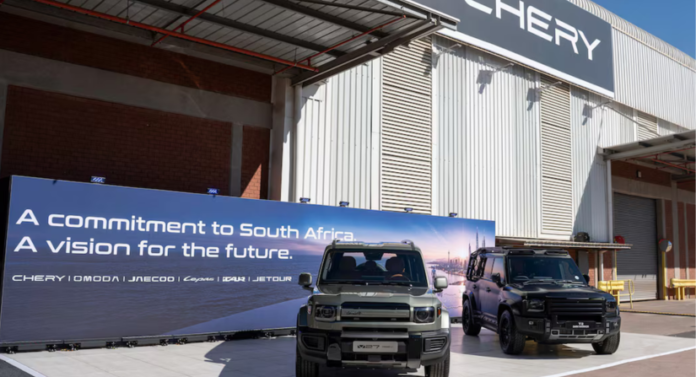
Chery’s takeover of Nissan’s former manufacturing facility in Rosslyn, Pretoria, puts that shift into sharp focus. Rather than relying only on vehicles shipped from China, the automaker is preparing to manufacture models locally for South African and wider African markets.
Production at Rosslyn is expected to include conventional and electrified vehicles as Chery expands its presence in one of Africa’s largest automotive markets. Plans include hybrid and plug-in hybrid models, while the company has also identified battery-electric vehicles as part of its longer-term manufacturing strategy.
Chery officially opened the Rosslyn facility in July after acquiring manufacturing assets from Nissan. The site has decades of automotive history and gives the Chinese manufacturer an established factory rather than requiring it to build a production facility from the ground up.
Local production is expected to begin with the Tiggo 4 range during the second half of 2027. Chery has outlined an initial production ramp-up of about 15,000 vehicles before introducing additional models as operations expand.
Moving into manufacturing marks an important change in how Chinese automotive companies approach Africa.
Affordable Chinese vehicles have gained market share across several African countries in recent years. Brands including Chery, BYD, Great Wall Motor and others are competing with established Japanese, European and American manufacturers as buyers look for competitively priced vehicles with newer technology.
Manufacturing locally takes that competition further.
South Africa already has one of the continent’s most developed automotive industries, supported by established factories, component suppliers and export infrastructure. Global manufacturers have used the country as a production base for decades, giving new entrants access to an existing industrial ecosystem.
Chinese manufacturers are increasingly recognising that advantage. Chery joins other Chinese automotive groups with manufacturing interests in South Africa, including BAIC and Great Wall Motor.
Electric mobility adds another dimension to the investment.
African demand for electric and hybrid vehicles remains relatively small compared with China, Europe and North America, but the market is expanding. Governments are introducing policies to encourage cleaner transport while manufacturers search for growth in countries where vehicle ownership is expected to rise.
South Africa has also introduced incentives aimed at encouraging manufacturers to invest in new-energy vehicle production. Such policies matter as the country tries to protect an automotive industry that supports manufacturing jobs and exports while the global market shifts towards electrification.
Chery’s investment could bring benefits beyond the vehicles produced at Rosslyn. Local manufacturing creates demand for components, logistics, engineering, maintenance and technical skills, while established factories can support wider supplier networks.
Employment will be closely watched. Chery committed to retaining hundreds of workers from the former Nissan operation and has indicated that further jobs could emerge as production increases.
Competition will remain intense, however. South African manufacturers must contend with high operating costs, electricity constraints and weak domestic economic growth, while imported vehicles continue to compete strongly on price.
Chinese companies also face the challenge of building long-term consumer confidence and developing local supply chains rather than relying heavily on imported components.
Africa’s wider automotive opportunity could make those investments worthwhile.
Rapid urbanisation and population growth are expected to increase transport demand across the continent. Countries including Morocco, Kenya, Ethiopia and Ghana are also pursuing automotive and electric mobility investments as governments seek a larger share of global manufacturing.
For South Africa, the stakes extend beyond attracting another international carmaker.
As the global automotive industry shifts towards electric and hybrid vehicles, established manufacturing countries must adapt or risk losing production to markets better prepared for new technology.
Chery’s move into Rosslyn suggests Chinese manufacturers increasingly see Africa as more than a destination for vehicle exports. They are beginning to view parts of the continent as places where cars can be built, supplied and eventually exported.
South Africa now has an opportunity to turn that interest into deeper industrial investment, local skills and manufacturing jobs.
Whether that happens will depend on how much of the emerging supply chain ultimately takes root locally. The real measure of success will not simply be how many Chinese-branded vehicles Africans buy, but how many of those vehicles Africa eventually builds.