
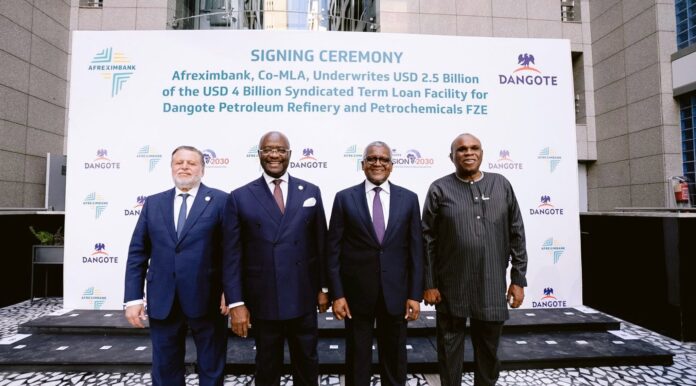
Cairo, Egypt, 31 March 2026 – Afreximbank has underwritten $2.5 billion of a $4 billion senior syndicated term loan for Dangote Petroleum Refinery and Petrochemicals. The five-year facility will help the refinery consolidate existing debt and improve its capital structure. That makes this one of the largest recent financing deals for African industrial infrastructure. It also reinforces the refinery’s place in the continent’s long push for energy security and industrial scale.
Located in Lagos, Dangote Refinery has a nameplate capacity of 650,000 barrels per day. Afreximbank describes it as Africa’s largest refinery and petrochemical complex. Afreximbank and Access Bank acted as co-mandated lead arrangers on the transaction. The bank’s $2.5 billion share is the largest in the syndicate.
For Afreximbank, the deal fits a wider strategy. The bank says the financing supports industrialisation, import substitution and stronger intra-African trade in refined petroleum products. In practical terms, the loan gives the refinery more financial flexibility. It should also strengthen the company’s position as a supplier to African and international markets.
More than a refinancing deal
This latest facility builds on earlier support from Afreximbank. Since refining operations began in February 2024, the bank says it has already provided a $1 billion working capital facility. It has also advised on the naira-for-crude initiative. That arrangement aims to let the refinery buy crude and sell refined products in local currency.
The policy, however, has not been without strain. Reuters reported in 2025 that Dangote Refinery suspended fuel sales in naira at one stage because crude purchases were made in dollars. Operational pressure has also remained visible this year. Reuters reported this week that Nigeria still faces record petrol prices even with the refinery running at full scale.
That context gives the new loan added weight. This is not just a routine refinancing package for a private company. It is also a statement of confidence in a project many see as strategically important to Africa.
George Elombi, president of Afreximbank, used the announcement to stress that point. He said the bank backs Dangote because it is an African business building African capacity. The bank also said it has invested about $15 billion in the Dangote Group since 2015. That figure underlines the scale of its long-term support.
Aliko Dangote described the facility as an important step for the refinery’s next phase of growth. His comments framed the loan as part of a broader push to build world-class industrial capacity for Nigeria and beyond.
Support from other African and international financial institutions also mattered. Their participation suggests lenders still see the refinery as a serious industrial asset despite its operating pressures. The bigger test now lies beyond the announcement. Market volatility, crude supply challenges and currency pressure will still shape how the refinery performs.
Even so, the size of this deal sends a clear signal. For African finance institutions, Dangote Refinery remains more than a corporate project. It is still being treated as a continental industrial bet with real strategic weight.