
JOHANNESBURG – Foreign direct investment into South Africa more than doubled to R49.8 billion in the second quarter of 2026, marking the country’s strongest quarterly inflow in three years. However, the figures reveal a more complicated investment picture beneath the headline increase.
South African Reserve Bank data released on Tuesday showed that FDI inflows rose from R20.3 billion in the first quarter. The increase took foreign direct investment to its highest level since the second quarter of 2023.
Much of the improvement came from debt funding received by an unnamed South African telecommunications company from its foreign parent. That detail matters because it means the R29.5 billion quarterly increase does not necessarily represent a broad surge in new foreign companies building factories, opening businesses or expanding operations across the economy.
Foreign direct investment can take several forms, including new equity investment, reinvested earnings and loans between companies and their foreign parent groups. All contribute to FDI, but their immediate effects on productive capacity can differ significantly.
South Africa’s latest figures therefore offer encouraging evidence that foreign capital continues to enter the economy, while stopping short of showing a widespread investment revival.
Other indicators released for the same quarter reinforce that distinction. Statistics South Africa reported that gross fixed capital formation declined for a second consecutive quarter as private businesses and public corporations reduced investment in infrastructure, machinery and other fixed assets.
Construction works and transport equipment were among the largest contributors to the decline. General government increased its investment during the quarter, but that was not enough to offset weaker spending elsewhere.
South Africa’s economy also contracted by 0.2% in the second quarter, adding another layer to the investment picture. An increase in foreign capital entering the country therefore occurred alongside weaker domestic output and declining fixed investment.
Portfolio flows moved in the opposite direction to FDI. Foreign investors withdrew a net R9 billion from South African portfolio assets during the quarter, reversing an inflow of the same amount in the previous three months.
Foreign investors sold R34.2 billion in South African shares while buying R25.1 billion in domestic bonds. The difference produced the overall portfolio outflow and showed contrasting attitudes towards different parts of the country’s financial markets.
These movements matter because foreign direct investment and portfolio investment behave differently. FDI usually reflects longer-term financial relationships between foreign investors and South African businesses. Portfolio investors can move money into and out of shares and bonds much more quickly as market conditions change.
South Africa has been trying to increase both domestic and foreign investment as it confronts weak economic growth, high unemployment and infrastructure constraints.
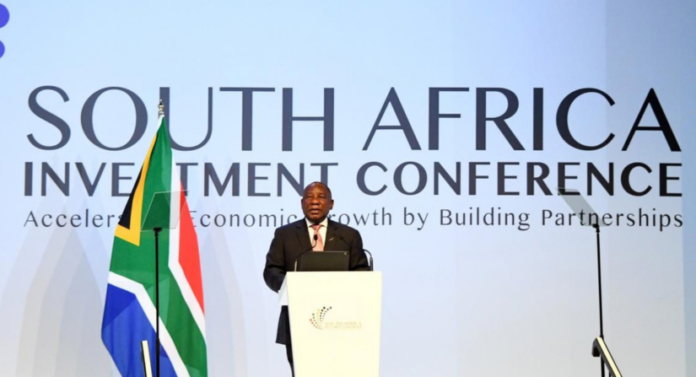
President Cyril Ramaphosa launched a second investment mobilisation drive earlier this year after the government completed its previous five-year campaign. At the South Africa Investment Conference in March, the government announced R415 billion in confirmed fixed-investment commitments alongside R474.8 billion in development finance.
Together, those announcements amounted to R889.8 billion across 81 projects, according to government figures. Authorities said the investments covered all nine provinces and involved capital from 22 source markets.
Turning commitments into operating businesses, infrastructure and jobs remains the more important economic test.
South Africa still offers several advantages to international investors. It has one of Africa’s largest and most diversified economies, deep financial markets, substantial mineral resources and established industrial sectors. Its banking and corporate systems also provide investors with access to a sophisticated financial market.
Its position within the Southern African Development Community gives companies another attraction. Businesses operating from South Africa can potentially use the country as a base for accessing markets across the wider region.
Structural constraints continue to weigh against those advantages. Businesses have repeatedly raised concerns about logistics, municipal infrastructure, regulatory uncertainty and the cost of operating in parts of the economy.
Electricity supply has improved substantially from the severe load-shedding crisis that previously disrupted production, but energy investment remains important for longer-term industrial expansion. Freight rail and port performance also remain critical for exporters and mining companies trying to move products efficiently to international markets.
Government has responded with structural reforms across electricity, logistics, water and digital infrastructure. The economic effect will increasingly depend on whether those changes translate into lower operating costs and greater confidence among companies making long-term investment decisions.
Competition for foreign capital is also intensifying across Africa. Countries including Egypt, Morocco, Kenya, Rwanda and Côte d’Ivoire are competing for investment in manufacturing, energy, logistics, technology and financial services. South Africa therefore has to compete not only with established global investment destinations but with African economies building their own industrial and investment propositions.
Africa itself continues to capture a relatively small share of global foreign direct investment. Ramaphosa said in March that the continent accounts for about 4% of global FDI, while South Africa represents an estimated 15% to 20% of Africa’s total.
Increasing that share will require more than occasional large transactions. South Africa needs investment that expands productive capacity, develops infrastructure, increases exports and creates sustainable employment. Capital entering through an intra-company loan strengthens the FDI numbers, but its wider economic significance depends on what the recipient company does with that funding.
The telecommunications sector could be particularly important in that respect. Investment in mobile networks, fibre, data centres and digital infrastructure can support activity well beyond the companies receiving the capital. Financial services, e-commerce, artificial intelligence, cloud computing and digital government increasingly depend on that infrastructure.
However, the Reserve Bank did not identify the telecommunications company behind the second-quarter increase, making it difficult to assess how the funding will ultimately translate into investment.
South Africa’s R49.8 billion FDI figure is therefore significant, particularly after the much weaker R20.3 billion recorded in the first quarter. It shows that sizeable foreign capital continues to move into the country at a time when government is trying to accelerate investment and economic reform.
The composition of that inflow is equally important. With fixed investment declining and the economy contracting during the same quarter, one large telecommunications transaction cannot by itself establish a broader investment recovery.
The stronger signal will come when rising foreign investment begins to appear alongside growing fixed capital formation, expanding productive capacity and stronger economic growth. South Africa’s latest FDI figures provide movement in that direction, but the wider economic data shows that the investment story is still being written.