


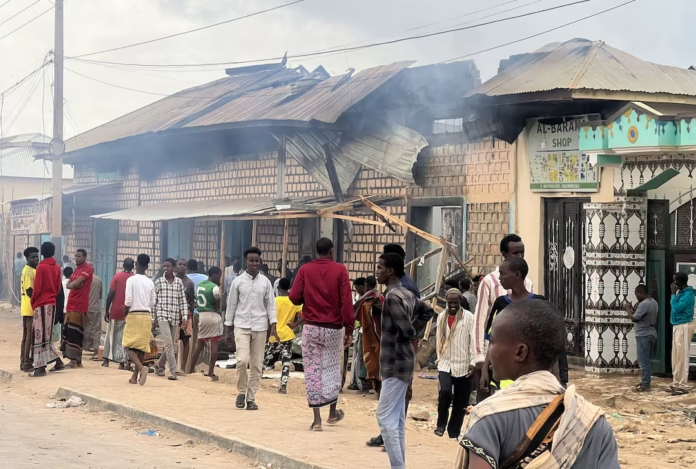
MOGADISHU, Somalia — Somali federal forces have regained control of Baidoa after fierce fighting with armed opposition groups on Monday. The clashes opened another dangerous front in a country already battling al-Shabaab and a deep humanitarian crisis.
Fighting erupted before dawn on 17 August between federal troops and forces loyal to Abdiaziz Hassan Mohamed Laftagareen. He previously led Somalia’s South West State. Government troops later pushed the opposition fighters from Baidoa after hours of clashes across parts of the city.
Residents described heavy gunfire and explosions as fighting spread through Baidoa, one of Somalia’s largest cities. The confrontation also left civilians caught between rival forces. Local witnesses reported at least 10 deaths, although the full toll remained unclear on Monday.
Somalia’s Defence Ministry said opposition fighters attacked federal positions at dawn. Officials said the attackers used vehicles carrying explosives during the assault. Federal troops responded and eventually drove them from the city. The ministry said its forces killed about 30 opposition fighters, but independent sources have not confirmed that figure.
Monday’s violence carries significance beyond control of Baidoa. A political struggle between Mogadishu and regional leaders lies at the heart of the confrontation. That dispute centres on elections, constitutional reform and the balance of power within Somalia’s federal system.
Relations between the federal government and South West State deteriorated sharply earlier this year. Laftagareen’s administration broke ties with Mogadishu before federal troops took control of Baidoa in March. Laftagareen later resigned, but the political dispute remained unresolved.
Regional leaders have resisted attempts by Mogadishu to expand federal influence over state elections. They have also challenged constitutional changes promoted by the central government. Critics argue that those reforms could concentrate too much political power in Mogadishu.
Federal authorities see the issue differently. They have pursued electoral and constitutional reforms as part of efforts to strengthen national institutions. Somalia has spent decades trying to rebuild those institutions after years of conflict and political fragmentation.
That political disagreement has now developed into a security confrontation. The shift creates a serious problem for a government already fighting a long-running insurgency.
Al-Shabaab remains one of the most powerful armed groups operating in the Horn of Africa. Somali forces have fought the group for years with support from international partners. However, the militants continue to carry out attacks and maintain influence in parts of the country.
Fighting between Somali political factions could weaken that campaign. Federal troops may have to divide their attention between al-Shabaab and armed regional opponents. Continued political conflict could also create security gaps that militants may exploit.
Baidoa’s importance extends far beyond politics and military strategy. The city has become a major humanitarian centre for people fleeing violence, drought and hunger elsewhere in Somalia. Hundreds of thousands of displaced people now live in and around the city.
Many already face severe food shortages.
Médecins Sans Frontières warned this month that Somalia’s nutrition crisis has worsened sharply during 2026. Funding for programmes tackling acute malnutrition has fallen by more than 80%. At the same time, demand for treatment has risen significantly.
Conditions around Baidoa are particularly severe. Recent screening in displacement camps found severe malnutrition among about one in four children assessed. Failed rains, conflict and shortages of food and water have placed families under growing pressure.
More than half a million people also fled their homes across Somalia during the first part of 2026. Women and children account for most of those displaced. Renewed fighting in Baidoa could force more families to move while making humanitarian operations increasingly difficult.
Aid organisations have fewer resources available to respond. Somalia’s humanitarian programme has attracted far less funding than during previous periods of extreme food insecurity. That leaves agencies with limited capacity if political violence creates another wave of displacement.
Baidoa now sits at the intersection of three major challenges facing Somalia. Political divisions remain unresolved, armed insecurity continues and hunger is worsening across vulnerable communities.
Federal forces may have regained control of the city, but military success alone cannot settle the political dispute. Mogadishu and regional leaders still disagree over how Somalia should distribute power and conduct elections.
Finding a political settlement has therefore become increasingly urgent. Further clashes could divert resources from the fight against al-Shabaab and deepen mistrust between federal and regional authorities. They could also place more civilians at risk.
Somalia has spent years rebuilding state institutions after decades of instability. Progress remains fragile, particularly as the country assumes greater responsibility for its own security. Armed disputes between political factions threaten to weaken those gains.
Events in Baidoa will also draw attention across the wider Horn of Africa. Somalia’s security challenges rarely remain confined within its borders. Militancy, displacement and disrupted trade can affect neighbouring countries, including Kenya and Ethiopia.
Monday’s battle shows how quickly unresolved political disagreements can turn into armed confrontation. Federal troops may control Baidoa again, but Somalia’s larger challenge remains. The country must find a political framework that can hold its federal system together while confronting al-Shabaab and a worsening humanitarian emergency.