


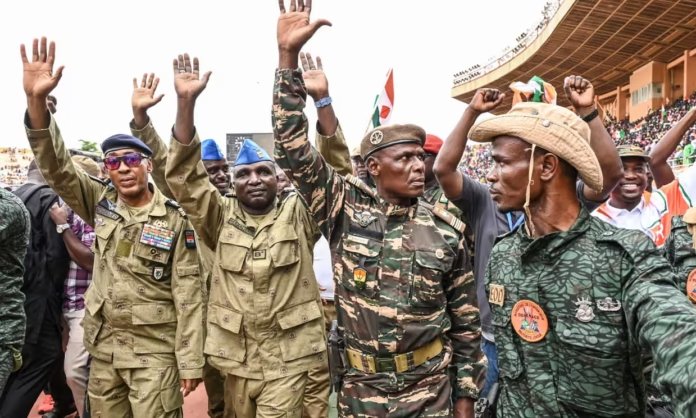
NIAMEY, NIGER — Niger’s military government has regained control of key sites in the capital after a mutiny by disgruntled soldiers triggered hours of fighting and prompted intervention by Russia’s Africa Corps, exposing tensions within an army already struggling against a persistent jihadist insurgency.
The unrest began around Base 101 at Diori Hamani International Airport before spreading towards sensitive locations in Niamey, including the presidential district and state broadcaster. Heavy gunfire and explosions were reported as loyalist forces fought to regain control.
Nigerien authorities said security forces eventually contained the mutiny. Dozens of soldiers were reportedly killed or arrested, while security remained heightened across the capital after calm returned.
Russia’s involvement has added a wider geopolitical dimension to the crisis. Russian Ambassador to Niger Viktor Voropaev confirmed that Africa Corps received a request to help Nigerien forces neutralise the mutineers.
The Russian force has become an increasingly important security partner since Niger’s military government pushed the country away from traditional Western allies following the July 2023 coup.
General Abdourahamane Tchiani seized power after soldiers removed elected President Mohamed Bazoum, citing deteriorating security among the reasons for the takeover. Niger later forced French and American troops to leave and strengthened military cooperation with Russia.
Three years later, however, armed groups linked to al-Qaeda and Islamic State remain a serious threat.
The latest mutiny appears to have involved soldiers from areas that have suffered some of the country’s heaviest losses in the fight against jihadist groups. Troops from Ouallam, Tera and Dosso were among those linked to the uprising, according to security officials and analysts cited in international reports.
That connection gives the rebellion significance beyond the immediate confrontation in Niamey. The unrest points towards frustration among soldiers fighting on some of Niger’s most dangerous front lines, rather than solely reflecting a struggle for political power in the capital.
Military casualties, equipment shortages, troop welfare and the government’s ability to contain armed groups have increasingly placed pressure on Niger’s security forces.
Base 101 itself holds considerable strategic importance. The facility forms part of the international airport complex and hosts military aircraft, drones and counter-terrorism operations. Russian personnel are also based there, alongside forces connected to the Alliance of Sahel States.
Niger formed the regional alliance with neighbouring Mali and Burkina Faso after the three military-led governments broke with the Economic Community of West African States and strengthened their own security cooperation.
The alliance backed Niger’s leadership following the mutiny and condemned what it described as an attempt to destabilise the country.
Niger’s security problems have nevertheless persisted despite the country’s political and military realignment.
Armed groups have repeatedly attacked military positions, particularly in western Niger near the borders with Mali and Burkina Faso. The airport military complex in Niamey has also faced attacks this year.
The unrest now raises questions about whether pressure on the battlefield is beginning to deepen divisions within Niger’s armed forces. It also places renewed attention on Niamey’s increasingly important security relationship with Moscow.
Russia has expanded its footprint across parts of the Sahel as military governments in Niger, Mali and Burkina Faso have reduced cooperation with France and other Western partners. Africa Corps, controlled by Russia’s defence establishment, has increasingly taken over roles previously associated with the Wagner Group.
Its intervention in Niger demonstrates how far that security relationship has developed. Russian personnel are no longer supporting only counter-terrorism operations. They have now helped the government confront a direct internal challenge involving members of its own military.
The attempted uprising presents a difficult test for Tchiani’s government. Niger’s military leaders came to power partly on the argument that the previous civilian administration had failed to protect the country from worsening insecurity.
The government has since reshaped Niger’s foreign alliances and security strategy, but the jihadist threat remains entrenched.
The immediate confrontation in Niamey may have ended, but the mutiny has exposed a deeper challenge. Niger’s military government must now confront the security failures and discontent within its armed forces that appear to have contributed to the uprising.