


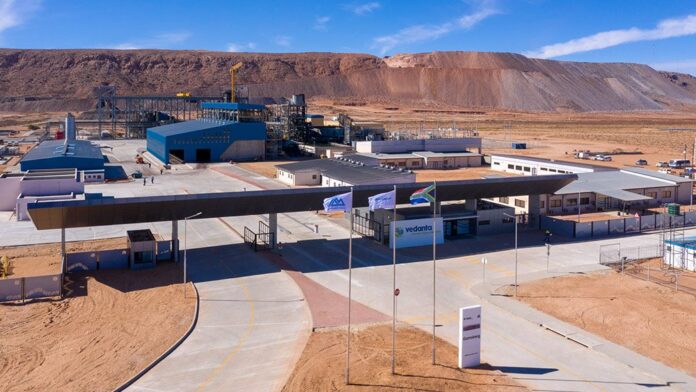
NORTHERN CAPE, South Africa – South Africa’s Gamsberg zinc mine expansion has doubled its annual zinc-in-concentrate production capacity to approximately 500,000 tonnes. The nearly US$600 million (R10 billion) investment by Vedanta strengthens the country’s mining industry and creates opportunities for manufacturing, employment and local mineral processing.
President Cyril Ramaphosa inaugurated the Gamsberg Phase II concentrator plant near Aggeneys on 16 October. The expansion increases annual ore-processing capacity from four million to approximately eight million tonnes. It also introduces additional infrastructure to support higher production as the mine develops.
Vedanta Zinc International operates Gamsberg as part of the wider Vedanta group. The expansion builds on the mine’s first phase, which began operations in 2019. It also supports the company’s plans to increase zinc production across Southern Africa.
Zinc plays an important role in construction, transport and manufacturing. Industries use the metal to protect steel against corrosion through a process known as galvanisation. Consequently, demand for zinc is closely linked to infrastructure development and industrial growth.
However, the economic benefits of mining depend on how much value countries retain from their mineral resources. South Africa exports significant quantities of raw and partially processed materials. Meanwhile, manufacturers in other countries often generate additional value through refining and industrial production.
Speaking at the inauguration, Ramaphosa called for greater investment in local mineral processing.
“Why should the mineral wealth beneath our soil create more industrial opportunities elsewhere than it creates here at home?” he asked.
The president argued that South Africa must expand beyond mineral extraction. He wants the country to develop stronger refining, manufacturing and technology-based industries. The Gamsberg zinc mine expansion could support these ambitions by strengthening connections between mining and industrial production.
Vedanta has also proposed developing a zinc smelter in the Northern Cape. Such a facility could convert zinc concentrate into refined metal within South Africa. This would support local manufacturing and reduce dependence on overseas processing.
However, the proposed smelter is not part of the completed Phase II expansion. Its development will depend on reliable electricity, competitive energy prices, infrastructure and financing. Zinc smelting requires substantial power, making electricity costs an important consideration for investors.
“We recognise that an investment of this magnitude requires commercially viable electricity, reliable infrastructure and other enabling conditions,” Ramaphosa said.
The expansion also creates economic opportunities in the Northern Cape, where many communities face limited employment prospects. More than 1,500 people worked on the project during construction. Meanwhile, the expanded operation is expected to sustain between 800 and 1,000 jobs during production.
Mining operations require engineers, electricians, technicians, equipment specialists and contractors. As a result, increased production could support local businesses and create demand for specialised skills.
The investment also supports the development of the Namakwa Special Economic Zone. South Africa designated the zone in 2024 to encourage mineral processing and industrial growth. Its objective is to attract manufacturers that can convert regional mineral resources into higher-value products.
The Department of Trade, Industry and Competition welcomed the expansion. It reported that the R10 billion investment had created more than 400 direct jobs. This figure differs from the broader employment estimates associated with construction and future mining operations.
Gamsberg’s growth also strengthens Vedanta’s Southern African zinc business. The company operates Black Mountain Mining in South Africa, while its Skorpion Zinc operation in Namibia remains under care and maintenance.
Vedanta aims to increase regional zinc production to approximately one million tonnes annually. However, achieving this target will require further investment beyond the completed Gamsberg expansion.
The development comes as African governments increasingly promote mineral beneficiation. This involves processing extracted resources into higher-value materials and manufactured products.
Countries across the continent are seeking greater economic returns from copper, cobalt, lithium, iron ore and other minerals. These resources support manufacturing, infrastructure development and emerging technologies.
Although mineral exports generate revenue and foreign exchange, limited domestic processing can restrict industrial growth. Expanding processing capacity could help African economies create skilled jobs, strengthen manufacturing and retain more value from their natural resources.
The Gamsberg zinc mine expansion illustrates both the opportunities and limitations of this approach. Its new concentrator increases the value of extracted ore. However, the operation still produces zinc concentrate rather than refined metal.
A future smelter could therefore represent another important step towards developing South Africa’s domestic zinc industry.
The investment also reflects growing commercial relations between India and Africa. Indian companies have expanded their involvement in African mining, infrastructure and manufacturing. These partnerships create opportunities for investment, technology transfer and industrial development.
Nevertheless, attracting foreign capital alone will not guarantee long-term economic benefits. Governments must also strengthen local supply chains, invest in technical training and improve industrial infrastructure.
The completion of Gamsberg Phase II provides a foundation for further growth. South Africa’s next challenge is to attract downstream processing facilities and increase local participation in the mineral value chain.
Across Africa, governments are seeking ways to ensure mineral wealth supports industrialisation rather than commodity exports alone. The Gamsberg investment demonstrates the scale of capital African mining can attract. Its lasting significance will depend on the manufacturing opportunities, skilled employment and economic value it creates.