


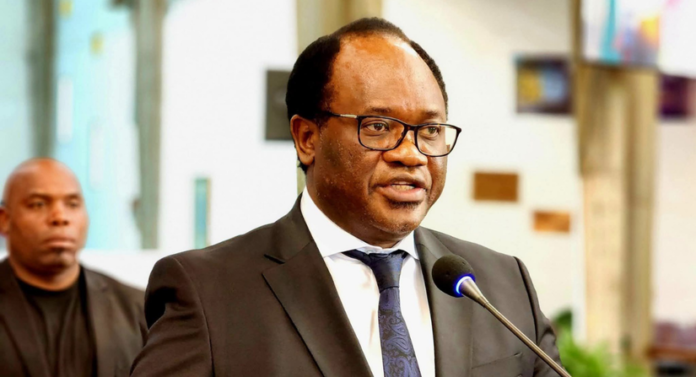
LUSAKA, ZAMBIA — Zambia’s opposition leader Brian Mundubile, his running mate Makebi Zulu and 16 others face treason charges as political tensions deepen following the country’s disputed presidential election.
Police formally charged Mundubile and Zulu after they surrendered for questioning last week. Businessman Harry Findlay is also among the 18 accused.
Police allege that the group conspired to overthrow the government by unlawful means between 1 and 16 August in Lusaka. The case has yet to reach trial, and Mundubile has denied claims that opposition figures planned an insurgency.
Authorities have since transferred Mundubile, Zulu and Findlay to Mukobeko Maximum Security Facility in Kabwe, according to their lawyer. The transfer marks another escalation in the political fallout from Zambia’s 13 August presidential election.
President Hakainde Hichilema secured about 60% of the vote, according to official results, while Mundubile finished second with about 38%. Mundubile rejected the outcome and alleged irregularities in the electoral process.
Independent election monitoring later raised questions about the accuracy of the official presidential figures. However, monitors concluded that the discrepancies did not change the overall winner.
The Christian Churches Monitoring Group (CCMG), a non-partisan coalition of faith-based organisations, deployed 1,500 observers across Zambia. It used a nationally representative sample of polling stations to independently assess the presidential results.
CCMG estimated Hichilema’s support at 56%, with a margin of error of 1.7 percentage points. It estimated Mundubile’s support at 42.3%, with the same margin of error.
The official results for both candidates fell outside CCMG’s projected ranges. However, its assessment found that Hichilema still received the most votes and crossed the 50% threshold needed to avoid a runoff.
CCMG also identified 30 constituencies where official turnout differed significantly from figures recorded by its observers. The organisation said votes had been added in those constituencies, artificially increasing turnout and undermining the integrity of the process.
It called on the Electoral Commission of Zambia to publish detailed polling and constituency records. CCMG said greater transparency would help address the discrepancies and rebuild public confidence in the electoral process.
Political tensions had already intensified before police formally charged Mundubile and Zulu. Security forces raided a property linked to Mundubile a day after the election and arrested 11 people.
Authorities said officers recovered AK-47 rifles and other military equipment during the operation. Police linked those arrested to an alleged national security threat.
Former cabinet minister Mutotwe Kafwaya died after security forces shot him during the raid. Authorities said officers came under fire and responded, while Mundubile disputed that account. He maintained that opposition members at the property carried no weapons.
Mundubile subsequently went into hiding and later sought refuge at a United Nations building in Lusaka. He and Zulu eventually surrendered to police after discussions involving their lawyers.
The United Nations said Zambia’s government had given assurances that authorities would respect their rights to due process and a fair trial. The UN also said it would continue to monitor developments.
Questions surrounding Zambia’s electoral process intensified when the country’s judiciary closed on 24 August. The closure came on the final day available to file a presidential election petition.
Judicial authorities cited security concerns, while police described the restrictions as a preventive measure based on intelligence. No evidence has established that Hichilema personally ordered the closure to prevent an election challenge.
The timing nevertheless attracted criticism because Mundubile had announced plans to challenge the presidential result. Zambia’s Constitution gives candidates seven days after the declaration of a winner to file a presidential election petition.
The Constitutional Court later said it had no presidential petition before it, clearing the way for Hichilema’s inauguration for a second five-year term.
The political confrontation has placed renewed attention on Zambia’s democratic institutions. The country has a history of competitive elections and peaceful transfers of presidential power, including Hichilema’s victory over Edgar Lungu in 2021.
Prosecutors will now have to substantiate the treason allegations against Mundubile and the other accused through the courts. Treason remains a non-bailable offence in Zambia, and the High Court handles such cases.
Zambia’s electoral institutions face a separate challenge over the discrepancies identified by independent monitors. CCMG’s assessment indicates that Hichilema received enough votes to retain the presidency without a runoff, but it also identified problems that require further scrutiny.
Both findings can stand at the same time. Independent monitoring supports Hichilema’s overall victory while raising serious questions about the accuracy and transparency of parts of the official count.
Zambia’s post-election crisis will therefore test more than the political rivalry between Hichilema and Mundubile. The country’s institutions now face pressure to handle the treason proceedings fairly while addressing unresolved questions about the election with transparency and independence.