


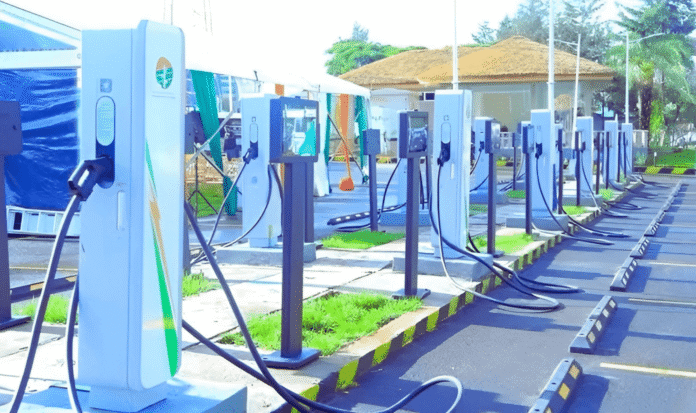
Ethiopia has opened a new ultra-fast electric vehicle charging centre in Addis Ababa, in what officials say is a major step in the country’s effort to expand electric mobility and reduce dependence on imported fuel. The facility, launched at the Ethiopian Electric Utility site in Kotebe, is being presented as part of a broader national push to electrify transport and strengthen the country’s green growth agenda.
The launch comes at a time when Ethiopia is moving more aggressively than many African countries on electric transport. In recent months, the government has continued to link EV adoption not only to environmental goals, but also to economic strategy, foreign exchange pressures and energy security.
Officials argue that shifting from fuel-powered vehicles to electric mobility offers Ethiopia a way to make greater use of domestically produced electricity while easing the burden of fuel imports.
According to details shared by State Minister of Transport and Logistics Bareo Hassen, the Kotebe site includes a 250 kilowatt ultra-fast charging system capable of serving 24 vehicles at the same time. The project cost 170 million birr. It also introduces off-peak pricing intended to encourage more cost-effective charging and help manage pressure on the national grid.
A policy shift now taking physical shape
The significance of the new charging centre lies not only in its technical capacity, but in what it represents. Ethiopia has already taken a strong policy position on electric mobility, including restricting the import of internal combustion engine vehicles. That decision attracted scepticism when it was first announced, but the government has continued to defend it as part of a longer-term plan to reduce fuel dependence and build a transport system powered more by local energy than imported petroleum.
The government’s ambitions are substantial. Hassen said Ethiopia plans to integrate 500,000 electric vehicles into its transport system over the next five years and construct 2,230 charging stations nationwide. Of those, 1,176 are planned for Addis Ababa. He also pointed to plans for heavy-duty charging stations and battery-swapping infrastructure along the Ethio-Djibouti corridor, a route that remains central to the country’s trade and logistics network.
That wider infrastructure push suggests Ethiopia wants to move beyond symbolic pilot projects. The focus is increasingly on building a system that can support real adoption at scale. Ethiopian Electric Utility, according to Hassen, plans to roll out 40 initial charging stations, with 32 in Addis Ababa and eight in regional cities.
The urgency behind the transition is not difficult to understand. Ethiopia spends heavily on imported fuel and remains exposed to international price shocks. EV24 Africa reported that the government sees electric mobility as a way to cut those costs, protect foreign currency reserves and use the country’s renewable energy base more effectively. The same report noted that Ethiopia has already emerged as one of the continent’s fastest-moving EV markets, driven by strong policy support and a clearer sense of direction than many of its regional peers.
Still, infrastructure alone will not determine whether the transition succeeds. Affordability, grid reliability, regulation, maintenance systems and consumer confidence will all shape how quickly electric mobility takes root. Yet the opening of the Kotebe centre gives visible form to a policy that until recently could still feel aspirational.
For Ethiopia, that matters. Governments often speak in the language of transformation. What gives those promises weight is the infrastructure that follows. In Kotebe, Ethiopia is trying to show that its EV ambitions are no longer only a policy statement. They are beginning to take shape on the ground.