


African women’s rights movements are calling on the Pan-African Parliament to pause the push for ratification of the AU Convention on Ending Violence Against Women and Girls. They want greater scrutiny, consultation and legal safeguards before African Union Member States adopt it.
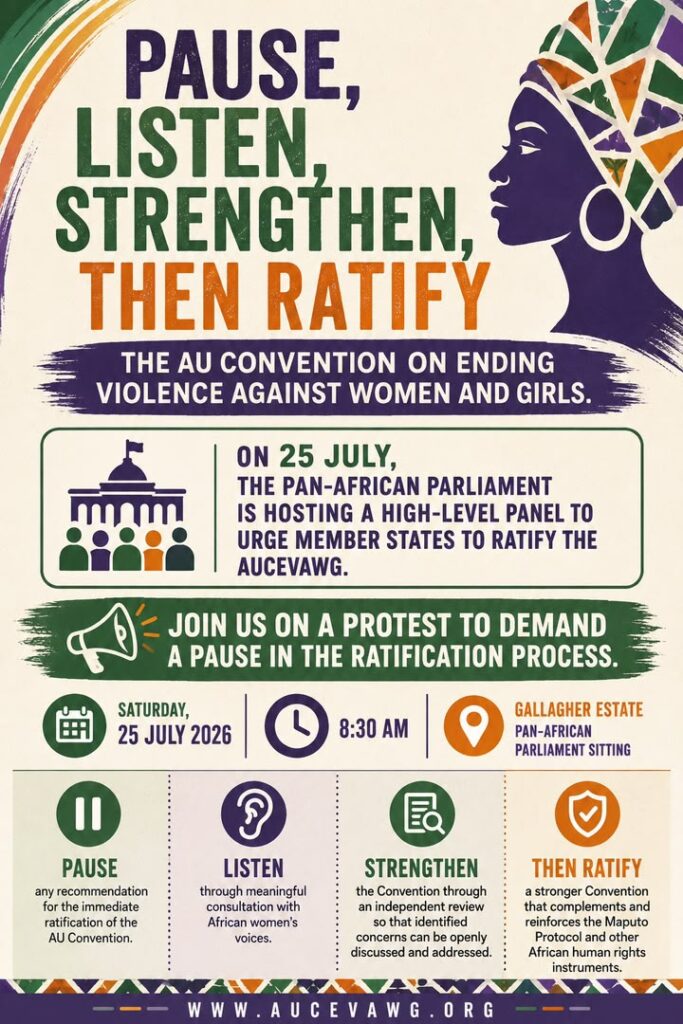
African feminists and women’s rights organisations will gather outside the Pan-African Parliament on 25 July 2026. Survivors, legal advocates, human rights defenders and civil society movements will also join the protest. They will demand meaningful scrutiny of the African Union Convention on Ending Violence Against Women and Girls (AU CEVAWG).
They want Parliament to examine the Convention more closely before encouraging African Union Member States to ratify it. Their message is simple: Pause. Listen. Revise. Strengthen. Then Ratify.
The protest does not reject efforts to end violence against women and girls. African feminist movements have spent decades fighting for stronger protections and institutions. They have also pushed for greater accountability for violations against women and girls.
Their concern centres on the legal protections already secured across Africa. Campaigners argue that the continent cannot afford new legal instruments that create uncertainty or weaken existing protections. They also fear that poorly defined provisions could open the door to future erosion of rights.
Pan-African Parliament Urged to Listen The Pan-African Parliament has a responsibility that goes beyond endorsing legal instruments. Campaigners argue that Parliament must ensure such instruments remain robust and rights-based. They must also advance the dignity, equality and freedom of African women and girls.
Parliament cannot fulfil that mandate without listening to African women’s rights organisations and feminist movements. Legal experts and civil society actors must also have an opportunity to raise their concerns.
For many years, women across Africa faced a persistent gap between progressive laws and weak implementation. Today, campaigners say they face another deeply troubling reality. Organised anti-rights actors increasingly challenge hard-won gains for women’s rights across Africa and elsewhere. These groups contest established human rights standards and gender equality protections.
They also seek to restrict the rights and autonomy of women and girls. Campaigners say the threat no longer comes only from governments failing to implement good laws. They warn that actors can increasingly use the law itself as a tool of regression.
Every new legal instrument affecting women and girls therefore requires rigorous scrutiny. Africa cannot afford ambiguity where clarity is required. We cannot afford legal regressions disguised as progress.
We cannot afford frameworks that create opportunities to dilute existing rights. Generations of African women fought tirelessly to secure those protections. This is why African feminists are speaking out. This is why they are protesting. And this is why States must listen.
Many women’s rights organisations and legal experts have raised serious concerns about the AU CEVAWG in its current form. They point to potential inconsistencies with existing African human rights standards. They also question whether the Convention contains strong enough accountability mechanisms.
Some provisions, they argue, may create legal uncertainty. Campaigners also question whether the Convention improves protections already contained in the Maputo Protocol and other regional frameworks.
The Maputo Protocol remains Africa’s most comprehensive and progressive instrument for protecting women’s rights. Any new Convention must strengthen this foundation. It should not create uncertainty around it. African women deserve legal frameworks that move their rights forward.
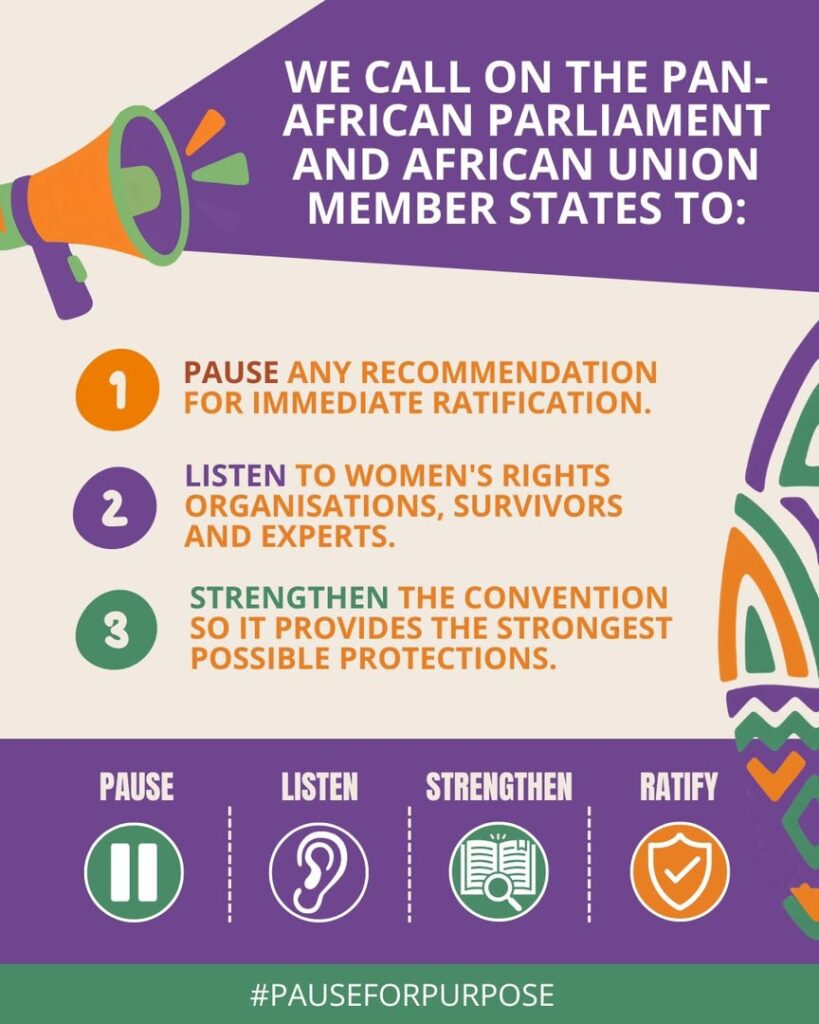
The Pan-African Parliament is being urged by campaigners to halt any recommendation for the immediate ratification of the AU CEVAWG until robust consultations take place with African feminist movements, women’s rights organisations, survivors, legal scholars, and civil society organisations.
In addition to this pause, an independent and transparent review of the Convention is necessary to address concerns about legal coherence, accountability, and the protection of existing rights standards.
Campaigners emphasise that the Convention should complement and reinforce the Maputo Protocol while strengthening Africa’s broader human rights architecture. They insist the ratification process must be transparent, evidence-based, and inclusive before Member States are encouraged to adopt the Convention.
‘Political Momentum Is No Substitute for Effective Legal Instruments’ Sibongile Ndashe of the Initiative for Strategic Litigation in Africa said:
“This convention is not only substantively weak, conceptually flawed, and structurally incoherent; more seriously, it risks dismantling hard-won gains achieved over the past four decades by displacing well-established legal frameworks for combating violence against women and girls. Member States must clearly understand the obligations they assume in protecting women and girls from violence. It is misleading to suggest that, by ratifying this treaty, they are helping countries with weaker protections: a treaty binds the states that ratify it. Political momentum and misplaced solidarity are no substitute for coherent, effective legal instruments.”
Their message to the Pan-African Parliament remains clear: African women are speaking. Parliament must listen. Pause. Listen. Revise. Strengthen. Then Ratify.