
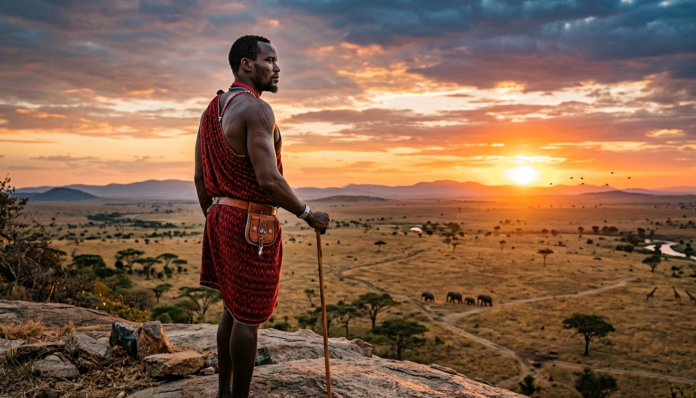
No more beautiful, diverse continent exists than Africa. From the sun-scorched deserts of
from the North to the lush equatorial heartlands and down to our rugged southern coastlines, we live
atop a goldmine of wildlife, mountains, and, most importantly, staggering, untapped wealth.
Africa is arguably the wealthiest continent on earth.
In the Democratic Republic of Congo, you can shove a spade into the dirt and hit the minerals the world’s technology depends on. The DRC produces 3,300 tons of copper annually; Angola, Nigeria, and Libya pump 10 million barrels of oil daily; and 70% of the world’s chocolate, that global “essential,” comes from our
Western Bulge, yet the Swiss are seen as the kings of chocolate.
Africa is seen as poor. Why? It is not a lack of resources; it is a lack of pride.
African nations are constantly turning to larger, foreign economies seeking validation. We act
like the quintessential traumatised child, looking for a “well done” from a Western parent who
has only ever wanted to exploit us.
This trauma begins with the very maps in our schools. The standard world map is a deceit, a
visual lie called the Mercator Projection. It depicts Africa as smaller than it truly is, roughly the
same size as Greenland. In reality, Africa is a giant that could swallow the United States, China,
India, Japan, and almost all of Europe combined.
When you shrink a continent on paper, you shrink the aspirations of the boys standing upon it.
We have been taught to see ourselves as small while standing on the biggest stage on earth.
This is not just bad geography; it is psychological warfare designed to make the African mind
feel peripheral to the world’s “important” centres.
The Architecture of the Mirror
When a boy only sees a “thug” or a “victim” reflected in the eyes of a police officer or a foreign
headline, he eventually adopts that mask. We must hold up a new mirror, one that reflects the
Architect, the Philosopher, and the Protector. We must “speak the man” into the boy long before
the world tries to shout him down.
The Lion in the Suit
For centuries, the African child has been told they are less valuable than the Western child. The
African man has lost his identity, trying to wear the suits of Western businessmen, imagining he
isn’t worthy unless he holds a Western university degree.
The West sneers at African-qualified Doctors, Pilots, and Engineers. Yet, I have seen African
doctors perform miracles in field hospitals under the flickering light of a generator, doctors who
are magicians of medicine compared to their Western “technicians.” We have tried to fit the
African Lion into a three-piece suit, and all we have achieved is a lion that is too
restricted to hunt and too ashamed to roar. We are trading our indigenous brilliance for a
paper trail that the “powers that be” still use to exclude us.
The Educational Cage
Language is the blueprint of reality. When we accept the label “Black,” we accept a term that, in
the Western dictionary, is synonymous with mourning, fear, and the “void.” Look at the soil of the
Congo, the dust of the Karoo, the mud of the Nile. It isn’t “black.” It is a rich, deep mahogany; it
is burnt sienna; it is a shimmering bronze.
My brothers and sisters are Ebony, Coffee, Bronze, and Chocolate. When we teach a boy to
identify with the Colours of the Soil, we link him directly to the source of its wealth. He isn’t a
“minority” in a white world; he is the majority of a vibrant, colourful planet. The term “black,” with
its Western baggage, is sadly not a source of pride; instead, these negative connotations scar a
young boy’s mind before he even develops his masculine identity.
Healing the Red-Stained Parliament
We cannot heal until we deal with our trauma. Look at South Africa. A friend of mine recently
offered a chillingly accurate insight into our leadership: “The leaders in our Parliament are the ones who fought for freedom; they were the children in the streets of Soweto in the ’76 uprising. They haven’t dealt with that trauma,
and now they are bleeding all over the people of this country.”
These men fought the war, but they never healed from it. This is the Initiation Gap. A boy does
not become a man simply by ageing; he becomes a man when the elders of his community “call
him out.” Because our leaders went from traumatised child soldiers to powerful politicians
without the middle step of healing, they lead from a place of survival and scarcity.
We need the restoration of the Council of Elders, men who have healed their own wounds so
they can stand at the gate and tell the next generation: “Your war is over. Your era of the Sharp
Mind has begun.”
The New Battlefield: Sharp Minds over War Machines
How do we take our seats at the head of the table? It will not be done through military might. We
don’t need more tanks; we need more thinkers. Our strength lies in Sharp Minds. We must stop
trying to out-gun the world and start trying to out-think them.
This requires building educational facilities that empower our boys to think outside the Western
box. We need to cultivate a generation of innovators who don’t just follow the manual but rather
write a completely new one. Our boys must be raised to realise that their greatest weapon is
their intellect, and their greatest armour is their unshamed African identity.
The Colours of the Soil
Language is the blueprint of reality. When we accept the label “Black,” we accept a term that, i
the Western dictionary, is synonymous with mourning, fear, and the “void.” Look at the soil of the
Congo, the dust of the Karoo, the mud of the Nile. It isn’t “black.” It is a rich, deep mahogany; it
is burnt sienna; it is a shimmering bronze.
My brothers and sisters are Ebony, Coffee, Bronze, and Chocolate. When we teach a boy to
identify with the Colours of the Soil, we link him directly to the source of its wealth. He isn’t a
“minority” in a white world; he is the majority of a vibrant, colourful planet. The term “black,” with
its Western baggage, is sadly not a source of pride; instead, these negative connotations scar a
young boy’s mind before he even develops his masculine identity.
Unity is another discipline we must put into practice. It is time to break down the artificial borders
established by colonial masters and open Africa to all its children. Let us bring back the
traditional African justice systems that we were brainwashed into believing were “heathen.”
Former President Thabo Mbeki had a profound dream of an African Renaissance and a united
continent; I dream of one too.
If we pool our vast resources and leverage our minerals as true
currency, we will transform into an economic powerhouse, one that supplies food and
resources to a struggling West, rather than the other way around. We possess the wealth of the
world, yet we behave like beggars waiting for handouts from Europe, America, or China. This
submissive practice must end. Let us learn from global systems, but let us stop taking crumbs
from their tables.
Arise, Africa, arise and take your seat at the head of the table. We don’t need an invitation to a table we already own. We own the minerals in the phones they hold and the cocoa in the mouths of their children. We must learn to be proud of ourselves and stop buying into the lie that we are only good enough to be slaves.
We need to break the shackles of self-hate that have been bludgeoned into us by history books
written by the people who wanted our land. Those days are over. The world needs the African
Lion to step out of the suit, reclaim his roar, and lead with a mind that no fence can contain.