


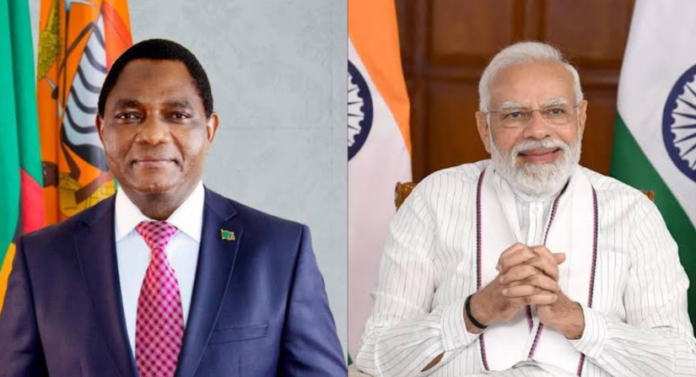
LUSAKA, ZAMBIA – India has revived talks with Zambia over investment in copper and other critical minerals, adding another major global economy to the intensifying competition for Africa’s resources as demand rises for metals needed in energy, technology and manufacturing.
Officials from India’s Ministry of Mines held preliminary discussions with Zambian counterparts on August 26. New Delhi is exploring investment opportunities as it looks overseas for reliable supplies of raw materials to support its rapidly expanding economy.
The renewed engagement places Zambia at the centre of a critical minerals race that has increasingly involved China, the United States, Europe and Gulf investors. India’s return broadens that competition and gives Lusaka another potential partner as it seeks billions of dollars in mining investment.
Copper sits at the heart of those ambitions. Electric vehicles, renewable energy, electricity grids, data centres and advanced manufacturing require large quantities of the metal. Global electrification is expected to keep demand strong as countries expand power networks and build cleaner energy systems.
India faces its own supply challenge. The country ranks among the world’s largest importers of refined copper and is expanding domestic smelting capacity. However, its mines cannot supply enough copper concentrate to feed that growth, increasing the importance of overseas resources.
That gap explains why Zambia has become strategically important. The Southern African country produced about 890,000 tonnes of copper in 2025 and holds substantial undeveloped mineral resources. Its government wants annual production to reach three million tonnes by 2031.
Meeting that target will require major investment in mines, exploration, processing, electricity and transport infrastructure. Zambia has therefore opened discussions with investors from several countries rather than relying on a single source of capital.
India previously secured rights linked to a roughly 9,000-square-kilometre exploration area in Zambia. Those discussions later stalled after New Delhi sought stronger assurances over mining rights and the commercial framework surrounding future discoveries.
The latest talks suggest both countries see value in reopening negotiations. India’s state-backed Khanij Bidesh India Ltd, known as KABIL, has a mandate to secure critical mineral supplies overseas and is assessing opportunities in several resource-rich countries.
Zambia offers something particularly valuable because copper production can support India’s growing industrial economy. India, in turn, offers Zambia another source of capital, technology and long-term demand.
The relationship could become more significant if investment moves beyond extraction. Zambia has made mineral processing and local value creation central to its strategy as it tries to capture more economic benefits from its copper industry.
That distinction matters because Africa has supplied raw minerals to industrial economies for generations while capturing a smaller share of the value created when those resources become finished products.
Zambia now has an opportunity to negotiate from a stronger position. Competition among international investors could allow Lusaka to push for commitments around processing, local procurement, skills development, infrastructure and employment alongside access to mineral deposits.
The country has already attracted more than US$10 billion in mining investment commitments in recent years. Major producers are expanding existing operations, while new projects could increase output if developers secure sufficient electricity and financing.
Power remains one of the biggest constraints. Zambia’s mining industry requires large amounts of reliable electricity, while drought and pressure on hydropower generation have exposed weaknesses in the country’s energy system.
The government will therefore need to expand electricity supply alongside copper production. Without sufficient power, ambitious mining targets could struggle to translate into actual output.
India’s renewed interest also changes the geopolitical picture around Zambia’s minerals. China already holds a substantial position across the country’s mining sector, while the United States has sought stronger critical-mineral partnerships in Central and Southern Africa.
Washington has also backed the Lobito Corridor, which aims to improve transport connections between mineral-producing regions in Zambia and DR Congo and Angola’s Atlantic coast. The project could create another export route for copper and cobalt while reducing dependence on existing logistics networks.
India enters that landscape with different strengths. Its rapidly growing manufacturing sector needs raw materials, while Indian companies have decades of experience investing across Africa in pharmaceuticals, telecommunications, agriculture, energy and other industries.
The revived Zambia talks show how quickly the global critical-minerals landscape is becoming more competitive. African governments increasingly have several potential partners seeking access to the same resources.
The challenge is turning that competition into lasting economic value.
Zambia’s three-million-tonne copper ambition will require foreign capital, but the scale of international interest gives the country an opportunity to negotiate investment that builds more than mines.
If Zambia can connect new mineral investment with processing, infrastructure, energy, skills and local businesses, the global race for copper could support a much broader industrial transformation.
India may be looking to Zambia for the resources needed to power its next phase of growth. Zambia’s opportunity is to ensure that the same partnership helps power its own.