


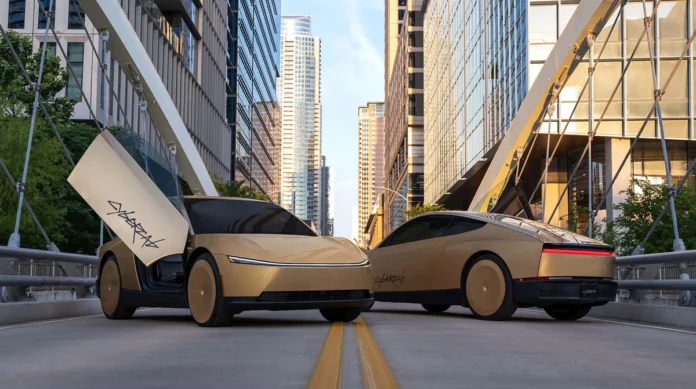
Tesla has launched its purpose-built Cybercab into limited commercial service in Austin, Texas, pushing the global race for fully autonomous transport into a new phase.
The two-seat electric robotaxi has no steering wheel, pedals or traditional driver’s position. Instead, artificial intelligence controls the vehicle, placing Tesla’s latest development at the intersection of the automotive and rapidly expanding physical AI industries.
Cybercab began carrying passengers in limited areas of Austin on 3 September. Only 45 Cybercabs were among 420 autonomous Tesla vehicles registered in Texas around the launch. The deployment remains small, but its significance extends beyond the number of vehicles on the road.
Tesla is attempting to prove that an autonomous vehicle can operate commercially without being designed around a human driver. The company began its Austin Robotaxi service with Model Y vehicles in June 2025. Cybercab changes that model because it was built from the outset for autonomous operation.
The launch has already attracted regulatory scrutiny. The US National Highway Traffic Safety Administration has opened an investigation into Tesla’s self-certification of nearly 1,000 Cybercabs. Regulators are examining how vehicles without traditional controls comply with federal safety standards developed largely around human-driven cars.
The investigation does not mean Cybercab has been declared unsafe. However, it exposes a growing challenge facing governments as autonomous technology develops faster than many existing transport regulations.
Tesla’s technology also differs from several major competitors. Waymo and Amazon-owned Zoox use combinations of cameras, radar and lidar to help autonomous vehicles understand their surroundings. Tesla has placed a much bigger bet on cameras, neural networks and onboard computing.
Cameras around the vehicle capture roads, pedestrians, traffic lights, other vehicles and obstacles. AI models interpret that information before deciding how Cybercab should respond. The system must not only recognise objects but predict movement and make decisions within fractions of a second.
That makes Cybercab an important development in the evolution of artificial intelligence. Generative AI has shown that machines can interpret language and produce text, images and software. Autonomous vehicles take AI into the physical world, where algorithms must interpret their surroundings and make decisions in real time.
Tesla believes its approach could also reduce the cost of autonomous transport. Avoiding expensive lidar systems could make driverless vehicles cheaper to manufacture if camera-led autonomy proves reliable at scale.
That remains one of the biggest questions surrounding Cybercab. Real roads contain unpredictable drivers, pedestrians, cyclists, emergency vehicles, construction zones and changing weather conditions. Tesla must demonstrate that its AI can manage those situations consistently while meeting safety requirements.
Competition is also accelerating. Alphabet-owned Waymo has built extensive experience operating commercial driverless services, while Zoox is developing its own purpose-built robotaxi. Chinese companies, including Baidu’s Apollo Go, Pony.ai and WeRide, are also expanding autonomous driving technology.
The race is therefore becoming bigger than the car industry. Autonomous mobility increasingly brings together AI, semiconductors, computing, telecommunications, mapping, energy infrastructure and regulation.
That transformation matters to Africa even if Cybercab itself remains thousands of kilometres away.
African cities have different transport environments from those where many autonomous systems are being developed. Roads can bring conventional vehicles together with minibuses, motorcycles, pedestrians, bicycles and informal trading activity, while infrastructure and road markings vary considerably.
Autonomous systems operating successfully in these environments would need relevant local data, testing and engineering expertise. This could create opportunities for African AI developers, universities, telecommunications companies and mobility start-ups as the technology matures.
The continent’s earliest autonomous applications may not even be robotaxis. Mines, ports, industrial sites, farms and defined freight corridors offer more controlled environments where autonomous vehicles and machinery could deliver productivity gains sooner.
Automation will also bring difficult employment questions. Transport supports millions of livelihoods across Africa, including taxi, minibus, trucking, delivery and ride-hailing services. Driverless technology could eventually disrupt some of those jobs while creating new opportunities in software, cybersecurity, fleet management, vehicle maintenance and digital infrastructure.
Cybercab is still far from proving that human drivers are becoming obsolete. Tesla’s deployment remains limited, regulators are scrutinising the vehicle and competitors have already accumulated significant autonomous driving experience.
Yet its arrival on public roads marks an important shift. The automobile has spent more than a century being designed around a person behind the wheel. Cybercab is designed around the assumption that AI can take that person’s place.
Africa does not need to wait until driverless taxis appear in Lagos, Johannesburg, Nairobi or Cairo to engage with that transformation. Investment in AI, robotics, data, connectivity and autonomous systems today could determine where the continent sits in tomorrow’s mobility economy.
Cybercab may have begun its commercial journey in Texas, but the technological race behind it has no borders.