


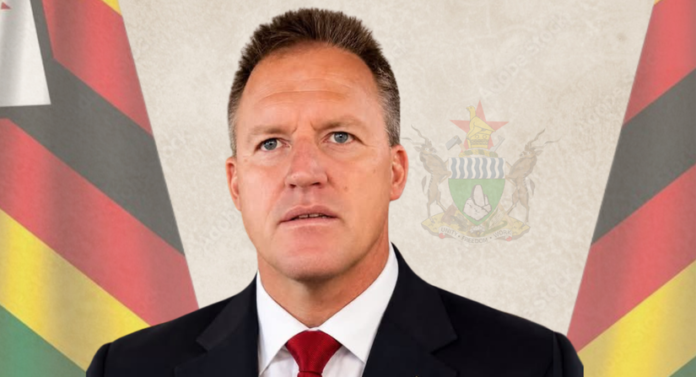
HARARE, ZIMBABWE — Zimbabwean businessman and political commentator Brett “Muvet” Holley is building a new political movement that aims to mobilise citizens at home and across the diaspora, adding an unconventional voice to the country’s fragmented opposition landscape.
The movement, Varanda VeZimbabwe (VVZ), translates as Servants of Zimbabwe and is developing its structures ahead of a planned formal launch. Holley has positioned public service, economic opportunity and improved living conditions at the centre of its emerging political message.
VVZ says it wants to challenge a political culture in which leaders enjoy privileges while many citizens struggle to access reliable water, healthcare, education, roads and employment. Holley argues that political leadership should focus on serving citizens rather than personal status.
The movement’s most ambitious proposal involves establishing what Holley describes as a “government in exile”. He wants Zimbabweans living abroad to help develop policies, organisational structures and potential leadership for a future administration.
However, the proposed structure has no recognised governmental authority or electoral mandate. VVZ remains an emerging political initiative and has yet to demonstrate the domestic support or institutional capacity needed to become a significant political force.
Holley argues that organising outside Zimbabwe would give supporters greater space to coordinate political activity. His strategy places particular emphasis on Zimbabwe’s large diaspora, including communities in South Africa, the United Kingdom, the United States, Australia and Botswana.
Diaspora participation could give VVZ access to skills, funding and international networks, but turning that influence into political support inside Zimbabwe presents a much bigger challenge. Remittances from Zimbabweans abroad already play an important role in supporting households and the national economy, and VVZ’s strategy seeks to extend that influence into political organisation and advocacy.
The movement is also developing around what it calls “servant leadership”. Holley has focused his message on the gap between the lifestyles of political leaders and the everyday difficulties experienced by ordinary Zimbabweans.
He has criticised shortages of medicines, unreliable access to clean water, deteriorating infrastructure and limited employment opportunities. Holley says his political project seeks to improve those basic conditions rather than pursue personal wealth or status.
VVZ has also indicated that it intends to establish representative structures outside Zimbabwe and raise money to support offices, administration, research and political organisation. Those plans will bring greater scrutiny of the movement’s governance and funding.
Transparency over who finances VVZ, how it chooses its leadership and how it makes decisions will become increasingly important as the organisation develops.
Its emergence comes at a sensitive moment in Zimbabwean politics. President Emmerson Mnangagwa and ZANU-PF continue to dominate the political system, while opposition politics has undergone considerable fragmentation since the 2023 elections.
Debate over Zimbabwe’s political succession and future constitutional arrangements has added another layer of uncertainty. VVZ will therefore have to demonstrate whether it can build structures capable of operating beyond social media and diaspora communities.
Zimbabwe has seen numerous opposition parties and movements emerge over the decades. Building a national political organisation requires local structures, candidates, funding, polling agents and sustained support across cities and rural communities.
Holley’s background will also attract attention. As a white Zimbabwean seeking to build a movement with national ambitions, he enters a political environment where race remains closely connected to the country’s colonial history, liberation struggle and land reform programme.
Race, however, does not define VVZ’s stated political platform. The movement presents itself as a national organisation centred on citizenship and public service, and its ability to attract support will depend on whether Zimbabweans believe it can offer credible policies and effective leadership.
VVZ will eventually need detailed positions on the economy, currency stability, investment, agriculture, mining, land, healthcare, education and Zimbabwe’s international relations. Its approach to elections will also require clarification after the movement argued that elections alone would not remove the political system it opposes.
That position makes the proposed government-in-exile strategy particularly significant. Any movement seeking political authority will face questions about democratic legitimacy, constitutional processes and how it intends to secure a mandate from Zimbabwean citizens.
Holley has succeeded in attracting attention to VVZ at an early stage, but building a credible national political force will require considerably more. The next six to eight months could show whether Varanda VeZimbabwe can develop from an emerging diaspora-linked movement into an organised political alternative with meaningful support inside Zimbabwe.
Zimbabwe does not lack political parties. The bigger test for VVZ will be whether it can build the structures, policies and public trust required to convince Zimbabweans that it offers something genuinely different.