


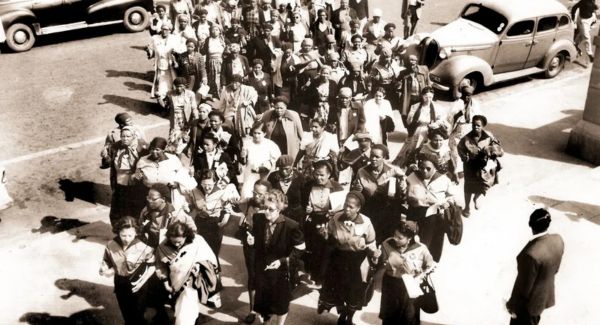
South Africa is marking 70 years since more than 20,000 women marched against apartheid pass laws, with this year’s Women’s Day placing renewed attention on gender-based violence, economic inequality and the unfinished struggle for equality.
President Cyril Ramaphosa led the national commemoration at the Union Buildings in Pretoria on Sunday, returning the anniversary to the place where thousands of women confronted the apartheid government on 9 August 1956. Their protest became one of the defining moments of women’s resistance in South African history.
The historic march brought together women across racial and social backgrounds to oppose plans to extend pass laws to Black women. The apartheid system used these documents to control where Black South Africans could live, work and travel, making the protest a direct challenge to the state’s control over their freedom and movement.
Seventy years later, South Africa has transformed politically and constitutionally. Women have rights and freedoms that the marchers of 1956 could only demand under apartheid, yet the anniversary has also prompted a more difficult conversation about how those constitutional freedoms translate into everyday life.
Many women still face economic exclusion, unemployment and unequal access to opportunities. Gender-based violence also remains one of the country’s most serious social challenges, with domestic abuse, sexual violence and femicide continuing to affect communities across South Africa.
The anniversary therefore carries two important messages. South Africa is celebrating the extraordinary courage of the women who marched in 1956 while confronting inequalities that remain seven decades later.
The government is commemorating the anniversary under the theme “Empowered Women Empower The Nation.” Ramaphosa described the 1956 march as one of the country’s most important historical events, while the government says this year’s programme should connect the courage of that generation with efforts to advance gender equality today.
One of the surviving leaders of the march has also returned to the centre of the national conversation.
Sophia Williams-De Bruyn was only 18 when she joined Lilian Ngoyi, Rahima Moosa and Helen Joseph in leading the march to the Union Buildings. Now in her late 80s, Williams-De Bruyn returned to the same site during the 70th anniversary commemorations, providing a direct connection between the generation that confronted apartheid and women facing different forms of inequality today.
The protesters carried thousands of petitions to the offices of then Prime Minister J.G. Strijdom. When officials refused to receive them, the women stood silently outside the Union Buildings before singing protest songs.
Their words, “Wathint’ Abafazi, Wathint’ Imbokodo”, became one of South Africa’s most enduring expressions of women’s resistance. Commonly translated as “You strike a woman, you strike a rock,” the phrase has remained part of the country’s political and cultural vocabulary.
The march challenged more than pass laws. It confronted the belief that women should remain outside political life at a time when they were already playing important roles in resistance movements, trade unions and community organisations. The scale of the demonstration made that political power impossible to ignore.
South Africa now commemorates that moment every 9 August through National Women’s Day. Introduced as a public holiday after the transition to democracy, the day has become an opportunity to celebrate women’s achievements while examining the barriers that continue to limit equality. Those barriers have changed considerably since 1956.
South African women no longer confront apartheid pass books, but many navigate unemployment, poverty, unequal pay, violence and limited economic opportunities. Younger women also face an economy struggling to create enough jobs, particularly among the country’s youth.
These challenges do not affect all women in the same way. Income, geography, disability, race and access to education can shape opportunities, while women in rural communities often encounter different obstacles from those living in major cities.
Women with disabilities can face additional barriers in employment, sport and public life. Paralympic tennis champion Kgothatso Montjane told the Associated Press that sacrifices made by earlier generations helped create opportunities available to women today, with her career reflecting some of that progress.
Sport, however, also demonstrates where inequalities remain. Female athletes continue to confront disparities in funding, recognition and professional opportunities despite growing international success.
Gender-based violence presents an even more urgent challenge.
South Africa has strengthened laws and institutions aimed at protecting women, while civil society organisations have pushed the issue higher on the national agenda. Yet legislation has not ended the violence, leaving many activists questioning what freedom means when women remain unsafe in their homes and communities.
That reality has changed how many South Africans view Women’s Day. The anniversary remains a celebration, but it has also become a measure of the country’s progress towards the equality promised by its Constitution.
The women who marched in 1956 challenged laws that controlled their movement and dignity. Today’s struggle includes the right to participate fully in the economy, walk safely through communities, receive equal opportunities and live without violence.
Their legacy also reaches beyond South Africa.
Women played central roles in liberation movements across the African continent and later emerged as political leaders, entrepreneurs, academics, activists and community organisers. Despite that progress, gender inequality continues to limit opportunities across many African societies.
The 1956 march therefore forms part of a wider African history of women organising against systems that restricted their rights, dignity and economic independence.
Seventy years have changed South Africa profoundly. Apartheid has ended, the pass laws have disappeared and the Constitution guarantees equality. Women now occupy positions of influence across government, business, academia, sport, media and civil society.
Those achievements deserve recognition, but the anniversary also raises a harder question. What does freedom mean when women continue to fear violence, struggle to access economic opportunities or remain excluded from positions of power?
The women who walked to the Union Buildings in 1956 demanded that the state recognise their dignity, freedom and agency. Seven decades later, their march remains both a celebration of what South Africa has achieved and a reminder of how much remains unfinished.