


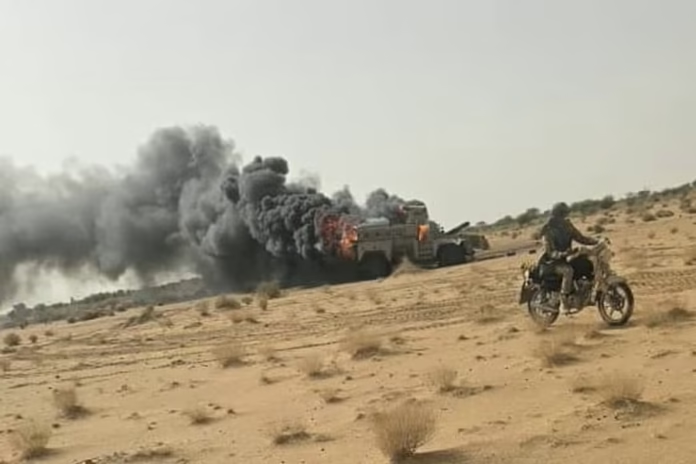
A deadly ambush on a military convoy in northern Mali has renewed concerns over the country’s worsening security crisis, despite years of military operations aimed at containing armed groups.
The attack took place near the town of Anéfis in the Gao region, where militants targeted a convoy carrying Malian soldiers and Russian Africa Corps personnel travelling towards Gao.
A source close to the rebels said more than 50 Malian soldiers and allied Russian fighters were killed, while others were captured. The figures have not been independently verified, and Mali’s military has not released official casualty numbers.
The assault is the latest indication that armed groups remain capable of launching coordinated attacks across the Sahel, posing a continued challenge to the military government’s efforts to restore stability.
Tactical Cooperation Between Armed Groups
Responsibility for the ambush was claimed by the Azawad Liberation Front (FLA), a Tuareg-led separatist movement, alongside Jama’at Nusrat al-Islam wal-Muslimin (JNIM), an al-Qaeda-linked extremist group.
The attack highlighted continued operational cooperation between the FLA and JNIM, despite their different political objectives. Security analysts describe the relationship as a tactical partnership driven by a shared opposition to Mali’s military government rather than a formal alliance.
According to statements released by the armed groups, several military vehicles were destroyed or seized during the fighting.
The Malian military said it launched a counteroffensive, including what it described as precision strikes against the attackers. Those claims, like the casualty figures released by rebel sources, have not been independently verified.
Violence Continues to Grip the Sahel
The latest attack follows a series of assaults on military positions across northern and central Mali, highlighting the persistent threat posed by insurgent groups operating across the Sahel.
Security experts say the geographical spread of recent attacks demonstrates that armed groups retain significant operational capability despite sustained military campaigns.
The conflict also reflects broader instability affecting neighbouring Burkina Faso and Niger, where extremist organisations continue to exploit weak state control in remote regions.
A military administration has governed Mali since successive coups in 2020 and 2021. The country’s leaders pledged to restore security after taking power, but attacks targeting soldiers, civilians and government infrastructure have continued.
Following the withdrawal of French forces, Mali deepened its security cooperation with Russia’s Africa Corps. The government says the partnership has strengthened counterinsurgency operations, although attacks by armed groups have continued across northern and central parts of the country.
Beyond the military confrontation, civilians continue to pay the highest price.
Thousands of people have been displaced by years of violence, while insecurity has disrupted farming, trade, healthcare and education across large parts of northern and central Mali.
Humanitarian organisations warn that continued fighting is worsening food insecurity and making it increasingly difficult to reach vulnerable communities with essential assistance.
For many families, daily life remains shaped by uncertainty as government forces and armed groups compete for control of key towns and transport routes.
While military operations remain central to Mali’s security strategy, many regional and international observers argue that force alone is unlikely to resolve the conflict.
They point to the need for stronger governance, economic development, political dialogue and closer regional cooperation to address the underlying causes of instability, including poverty, limited state presence and youth unemployment.
Analysts say sustainable peace will ultimately depend on combining security operations with long-term investment in communities affected by years of conflict.
The ambush near Anéfis is another reminder that Mali’s security crisis remains unresolved.
Although government forces continue to pursue insurgent groups across the country, the ability of militants to organise complex attacks underscores the challenges facing authorities.
Mali’s lasting peace will require not only improved security but also political reconciliation, stronger institutions and sustained regional cooperation.