


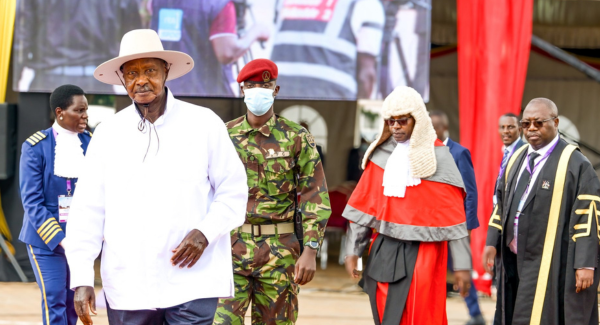
Uganda is sharpening its focus on industrialisation and digital transformation. President Yoweri Kaguta Museveni says the country’s future growth will rest on four sectors: agriculture, manufacturing, services and ICT.
Speaking during the 2026 State of the Nation Address, Museveni said the strategy will move more households from subsistence production into the money economy. It will also connect rural activity to industrial value chains and digital platforms.
He said Uganda’s GDP has grown from USD 3.9 billion in 1986 to about USD 69.3 billion today. The government projects GDP to reach USD 80 billion in the next financial period.
Museveni added that GDP per capita now stands at about USD 1,278. This sits above the lower-middle-income threshold of USD 1,136. He also said household participation in the money economy has risen to 67 percent, compared to 9 percent in 1962.
Museveni described agriculture as the backbone of Uganda’s transformation agenda. He said the sector must now become fully commercialised.
He cited dairy production, which has grown from 200 million litres in 1986 to 5.4 billion litres annually. Coffee exports have also increased to 9.3 million 60-kilogram bags. He added that maize, bananas and sugar production continue to show steady gains.
Turning to industry, Museveni said manufacturing is reshaping Uganda’s economy. Cement production has risen from 4,900 metric tonnes in 1986 to about 7 million metric tonnes today.
He also pointed to investments in agro-processing, steel, pharmaceuticals and ICT-linked services. He said these investments reduce dependence on raw material exports and strengthen domestic value chains.
Museveni linked services and ICT to job creation, especially among young people. He said transport, trade, entertainment and digital platforms now support employment and economic diversification.
He added that infrastructure expansion has played a key role. Electricity generation has grown from 60MW in 1986 to over 2,098MW today. Uganda has also expanded road networks and industrial parks.
Museveni said programmes such as the Parish Development Model and Emyooga support the four-sector economy. They improve access to affordable capital and support enterprise development. He stressed that peace and stability remain vital for continued growth.
The Ministry of Finance, Planning and Economic Development also reported stronger economic momentum. Permanent Secretary and Secretary to the Treasury Ramathan Ggoobi said: “The average economic growth for the first half of FY 2025/26 increased to 6.7 percent from 5.8 percent in the same period last year.”
Ggoobi linked the improvement to stronger output in industry, services and agriculture. He added that Uganda has maintained macroeconomic stability despite global uncertainty.
The Uganda Investment Authority also backed the industrialisation agenda. It said agro-processing, manufacturing diversification and ICT innovation will drive future growth. It added that Uganda must move away from relying on raw commodity exports.
The authority said these shifts strengthen Uganda’s production base. They also improve the country’s competitiveness in regional and global markets.
The International Monetary Fund also gave Uganda a positive outlook. It stated: “Uganda’s post-pandemic economic performance has been robust, supported by broad-based growth and contained inflation.”
The IMF said Uganda still has enough capacity to maintain macroeconomic stability. It also urged continued reforms in productivity, fiscal management and export diversification.
Museveni said deeper regional integration will support Uganda’s long-term growth. He said the East African Community and the African Continental Free Trade Area will expand markets, absorb rising output and support Uganda’s industrial and ICT-driven agenda.