
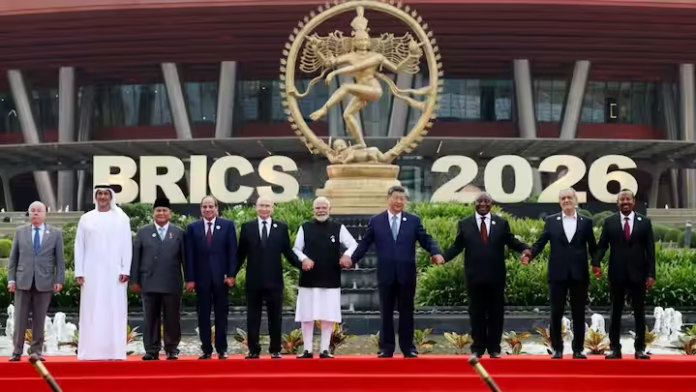
NEW DELHI, INDIA – South African President Cyril Ramaphosa has called for stronger global institutions and deeper economic cooperation as BRICS leaders meet in New Delhi, placing Africa’s demand for greater influence at the centre of a summit testing whether the expanded bloc can turn its growing economic weight into meaningful global power.
The 18th BRICS Summit brings together an organisation that has changed dramatically since South Africa joined Brazil, Russia, India and China in 2011. Expansion has brought Egypt, Ethiopia, Indonesia, Iran and the United Arab Emirates into the grouping, increasing its population, economic reach and geopolitical influence.
Ramaphosa has used the summit to argue that international institutions must better reflect the realities of the modern world. He called for reform of the United Nations Security Council and international financial institutions, where African countries continue to have limited influence despite the continent accounting for more than a quarter of UN member states.
That message reflects one of Pretoria’s long-standing foreign policy priorities. South Africa has consistently argued that institutions created after the Second World War no longer adequately represent developing economies or the changing balance of global power. BRICS expansion gives that argument greater weight, but it also creates a more complicated organisation with increasingly diverse national interests.
Those differences became particularly visible over the conflict in the Middle East. Iran and the United Arab Emirates now sit within BRICS as geopolitical tensions across the region test whether the expanded grouping can maintain common positions on major international crises.
Leaders ultimately adopted the New Delhi Declaration, calling for maximum restraint, dialogue and diplomacy while emphasising civilian protection, national sovereignty and stability in global trade. Reaching agreement despite internal differences gives BRICS a measure of diplomatic credibility at a time when its members want the organisation to exercise greater influence over international affairs.
Ramaphosa has also pushed discussions towards economic delivery, arguing at the BRICS Business Forum that cooperation between governments and businesses must produce tangible growth. South Africa wants stronger trade and investment flows, more resilient supply chains and greater cooperation across agriculture, infrastructure, technology and innovation.
The economic opportunity has grown alongside the organisation. BRICS members now represent more than 40% of the global population and roughly a quarter of world economic output, giving the grouping considerable collective weight even though trade and investment between individual members remain uneven.
South Africa wants to use those relationships to attract capital into infrastructure, manufacturing, energy and technology while expanding access to some of the world’s largest emerging markets. Achieving that ambition would give BRICS greater practical relevance to businesses and citizens beyond the political declarations produced at annual summits.
The New Development Bank remains one of the organisation’s most tangible institutions. It has approved almost US$43 billion in financing since its creation and offers developing economies another source of capital for infrastructure and development projects.
BRICS countries are also exploring ways to make cross-border payments faster and cheaper while increasing the use of national currencies in trade. Those discussions do not amount to the creation of a common BRICS currency, despite recurring speculation, but they reflect a wider effort to reduce transaction costs and deepen commerce between member economies.
Africa’s position inside the organisation has also changed significantly. South Africa once occupied a unique role as BRICS’ only African member, giving Pretoria an informal responsibility to bring continental priorities into discussions dominated by much larger economies.
Egypt and Ethiopia now sit alongside South Africa, broadening African representation while ending Pretoria’s position as the continent’s sole member. A larger African presence could strengthen the continent’s influence if the three countries can build common positions around development finance, infrastructure, trade and reform of international institutions.
Greater representation alone will not guarantee greater influence. African BRICS members have different economies, diplomatic priorities and relationships with major powers, making coordination essential if the continent wants additional seats at the table to translate into stronger negotiating power.
Reform of the UN Security Council provides one area where those interests converge. Africa remains the only continent without permanent representation on the council despite accounting for 54 UN member states and more than 1.4 billion people.
Access to development finance provides another common interest. African economies face an enormous infrastructure financing gap while many governments struggle with expensive borrowing and limited access to affordable long-term capital. A larger role for institutions such as the New Development Bank could provide alternatives if financing expands across commercially viable African projects.
Trade could become equally important. The African Continental Free Trade Area is gradually creating a larger integrated African market, while BRICS membership connects several African economies with major markets across Asia, Latin America and the Middle East.
The opportunity carries a familiar risk. Africa has spent decades exporting minerals, agricultural commodities and other raw materials while importing higher-value manufactured products. Redirecting those commodities towards different international partners would change trade routes without fundamentally changing Africa’s position in global value chains.
South Africa’s emphasis on industrialisation, investment and resilient supply chains therefore carries significance beyond its own economy. BRICS will offer greater value to African members if partnerships help build manufacturing capacity, infrastructure, technology and skills rather than simply increasing demand for raw materials.
The summit is unfolding as global economic and political power becomes increasingly fragmented. Trade tensions, conflicts and competition between major economies have weakened confidence in institutions that shaped much of the post-war international system, creating space for alternative groupings to demand greater influence.
BRICS increasingly presents itself as a platform through which emerging economies and the wider Global South can shape that changing order. Expansion has strengthened its numerical and economic weight, but a larger membership also makes consensus more difficult as countries bring competing strategic interests into the same organisation.
The New Delhi Declaration demonstrates that compromise remains possible. The more important test will be whether political agreement produces measurable economic outcomes in investment, infrastructure, trade and development finance.
South Africa helped transform BRIC into BRICS when it joined the grouping 15 years ago. Pretoria now operates within a considerably larger organisation where African representation has expanded and expectations about the bloc’s global role have risen.
Ramaphosa’s push in New Delhi reflects the opportunity created by that transformation. Africa has more voices inside BRICS than ever before, but influence will ultimately depend on what those countries achieve with their membership.
South Africa and the wider continent will judge the value of an expanded BRICS by whether it delivers greater investment, stronger trade, productive infrastructure and meaningful influence over the institutions shaping the global economy. Without those outcomes, a bigger BRICS may carry greater geopolitical weight without fundamentally changing Africa’s economic position within the world.