
Nigeria and Germany have signed a major cooperation agreement worth about $428 million. The deal aims to strengthen investment, trade, energy, agriculture and economic development between both countries.
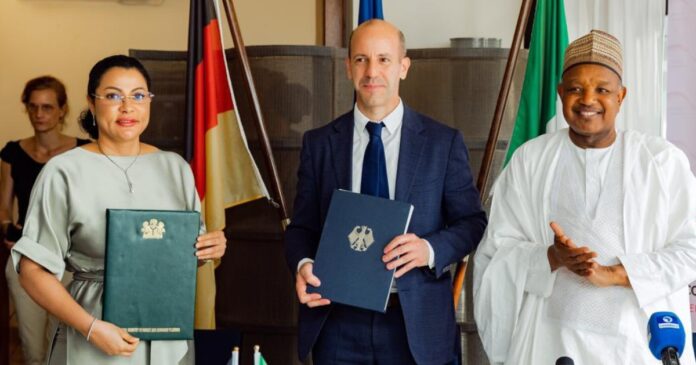
The agreement was signed in Abuja on Thursday. It includes a €65 million commitment for financial and technical cooperation. It also includes a €300 million export credit guarantee framework to support long-term investment and trade projects in Nigeria. Using the current Forbes currency converter rate of €1 to $1.17, the full package is worth roughly $428 million.
Nigeria’s Federal Ministry of Budget and Economic Planning confirmed the signing. Minister of Budget and Economic Planning Senator Abubakar Bagudu signed the agreement alongside Minister of State for Budget and Economic Planning Doris Uzoka-Anite and senior German officials. The signing took place at the German Embassy in Abuja.
Both governments said the deal will support cooperation in agriculture, renewable energy, climate transition, skills development, healthcare and economic reforms.
German Ambassador to Nigeria Annett Günther said the agreement followed months of bilateral talks. These discussions involved Nigerian ministries, German development agencies and European Union representatives. Günther said the talks focused on building stronger economic ties between Nigeria and Germany.
Philip Knill, Deputy Director General at Germany’s Federal Ministry for Economic Cooperation and Development, described Nigeria as a strategic partner in Africa. He said Germany sees Nigeria as important to regional integration, trade and security cooperation.
Uzoka-Anite said the partnership comes at an important time for Nigeria. She said the agreement will help attract investment and unlock sustainable financing as the country continues its economic reform agenda under President Bola Tinubu.
Knill said the German delegation also met Nigerian and German businesses during the visit. The meetings focused on power, agriculture, industrialisation and the digital economy. He added that major German companies are exploring opportunities in Nigeria. These include Siemens, SAP, Bayer and STIHL.
The announcement comes as Nigeria works to attract more foreign capital. The government has introduced reforms in foreign exchange, tax policy and food security.
Knill said Germany views these reforms as important steps towards improving investor confidence. He said the reforms could also encourage long-term financing into Africa’s largest economy.
He also highlighted the impact of existing Nigeria-Germany programmes. According to him, more than 16,000 small businesses have increased their income through joint initiatives. He said about 600,000 smallholder farming households have also benefited from agricultural training programmes.
Germany also reaffirmed its support for Nigeria’s Presidential Power Initiative. The project, which Nigeria is implementing with Siemens, aims to expand the country’s electricity grid capacity to 25 gigawatts.
Both countries said the next phase will focus on results. They want the investment commitments to produce measurable economic outcomes through stronger institutions and deeper private sector participation.