


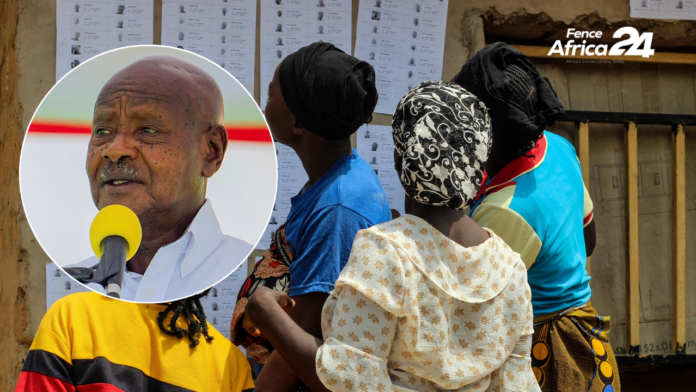
President Yoweri Museveni has taken oath for a seventh consecutive presidential term after the January 2026 election, extending his rule that began in 1986. The ceremony at Kololo Independence Grounds in Kampala formally opened Uganda’s new five-year political cycle, attended by regional heads of state, diplomats, and senior government officials.
The Electoral Commission Chairperson, Simon Byabakama, declared Museveni the winner with 71.6% of valid votes. He stated that the election followed constitutional timelines and statutory procedures, with results announced within 48 hours after polling.
Byabakama said voting was conducted on January 15, 2026, across more than 50,000 polling stations nationwide. He confirmed Museveni crossed the constitutional threshold of 50% plus one vote. “The Commission complied with all legal requirements from polling station tallying to national declaration,” he said, noting that the presidential term had expired before the oath was administered.
He also pointed to voter turnout, saying citizens exercised their franchise across the country in a largely calm process.
The inauguration drew at least 35 heads of state and government representatives. Attendees included Tanzania’s President Samia Suluhu Hassan, DR Congo’s Félix Tshisekedi, South Sudan’s Salva Kiir, Somalia’s Hassan Sheikh Mohamud, and Togo’s Faure Gnassingbé. Their presence signaled regional alignment around Uganda’s political transition.
In his address, Museveni structured his message around what he called the “seven bricks” of national development.
He named them as peace, infrastructure, wealth creation, job generation, public services, market access, and regional federation.
“Peace came first because without it nothing else survives,” Museveni said. “We rejected politics built on tribe and religion because Uganda has no dominant group. Unity is what allowed stability.”
He argued that employment depends on wealth formation. “Jobs do not come by declaration. They come from wealth,” he said, urging citizens to participate in commercial agriculture, manufacturing, services, and ICT.
Museveni pointed to household enterprises that have scaled from smallholdings to commercial production, especially in poultry, dairy, and agribusiness. He said such cases show how small capital accumulation shifts families into income-generating activity.
He devoted part of his speech to value addition, warning against export of raw materials. “A kilogram of raw gold may fetch about 60,000 dollars. Refined gold reaches 168,000 dollars,” he said. He argued that processing minerals locally retains revenue and employment within Africa.
He also called for expanded regional and continental markets, saying production growth requires larger trade zones beyond national borders.
The African Union Chairperson and Burundi President, Évariste Ndayishimiye, praised Uganda’s stability and continuity of governance. He said Museveni’s re-election reflects institutional consolidation and regional confidence.
He highlighted Uganda’s role in supporting peace processes in the Great Lakes region and called for deeper cooperation among African states in trade and security.
Separately, preparations are ongoing for the swearing-in of Members of Parliament elected to the 12th Parliament, scheduled for May 13–15, 2026, at Parliament House in Kampala. The Constitution requires MPs to take the oath of allegiance before occupying seats or participating in proceedings.
The inauguration closed a political cycle defined by continuity in leadership, expanded regional diplomacy, and renewed emphasis on production-led economic policy.