


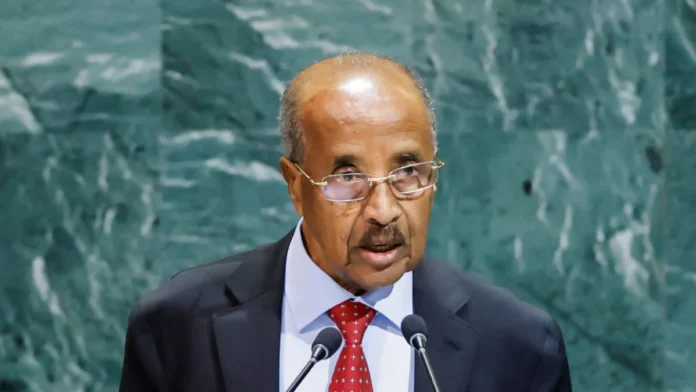
The Eritrean government has accused the United Arab Emirates (UAE) of pursuing “port imperialism,” raising eyebrows over the increasing presence of Emirati-managed ports along the Red Sea, the Gulf of Aden, and the Horn of Africa.
In an exclusive interview with the Middle East Eye (MEE) news site, the Eritrean Foreign Minister stated that the UAE’s presence in numerous regional ports is not purely business.
“The UAE has port facilities everywhere in the region, and African countries have to ask why,” Eritrean Foreign Minister Osman Saleh told MEE. “Is it just for economics? No.”
The UAE’s two main port groups, DP World and AD Ports, have stakes in or manage facilities in Egypt, Tanzania, and Somalia.
On January 12, the Somali government canceled all agreements with the UAE, including DP World’s port management of Berbera in the self-declared republic of Somaliland and the semi-autonomous region of Puntland. The Somali government accused the UAE of undermining Somali sovereignty by secretly smuggling a Yemeni separatist leader without Mogadishu’s approval. That move angered Mogadishu and prompted the cancellation of the agreements.
In a statement carried by Reuters, DP World rejected the decision of the Somali federal government, stating that DP World is there for business. The Somali State Minister for Foreign Affairs said in an interview with Universal TV that the government may consider legal action against DP World. While Mogadishu has not yet initiated the process, relations remain frosty, with the regional administrations in Puntland and the breakaway Republic of Somaliland refusing to acknowledge Mogadishu’s authority.
The decision did not come overnight. It has been in the making since reports emerged that the UAE was using Bosaso airport as a logistics hub to facilitate weapons and mercenaries to fuel the war in Sudan. A recent UN humanitarian report on Sudan exposes the UAE’s role in fueling the conflict by facilitating the transportation of mercenaries and weapons using Somali territory.
While many African countries welcome foreign investment and petrodollars, the UAE’s attempts to acquire shares in numerous strategic ports do not always yield good returns.
In 2018, Djibouti canceled its agreement with DP World. Meanwhile, Sudan invalidated an agreement with Emirati port operator AD Ports regarding the proposed building of a new $6 billion port along the Red Sea.
Eritrea’s 700 miles of coastline along the Red Sea attract many regional and international powers. Despite this, the Eritrean government under President Isaias Afwerki keeps foreign powers out of the country, as the foreign minister told MEE. He emphasized that Eritrea does not want to host a foreign hub within its territory. In 2016, the UAE established a military base in Assab as part of the campaign against the Houthis, but relations between the two countries subsequently worsened.
A senior Eritrean official told MEE that Eritrea rejected a request from the UAE around 2016 to establish a military base on one of the islands in the Dahlak Archipelago. The proposed base would have been shared between the UAE and Israel, roughly five years before the two nations signed the US-backed Abraham Accords, which made their close ties public.
Governments across Africa have grown increasingly suspicious of the UAE’s role on the continent. Algeria cut diplomatic ties with the UAE, citing violations of sovereignty and warning that wherever the UAE goes, conflict follows. Additionally, Niger implicated the UAE in a recently attempted coup, alongside France.
Observers are left wondering whether the UAE is pursuing genuine economic interests or acting as a petrodollar state with an imperialistic agenda that undermines sovereignty and destabilizes the region.