


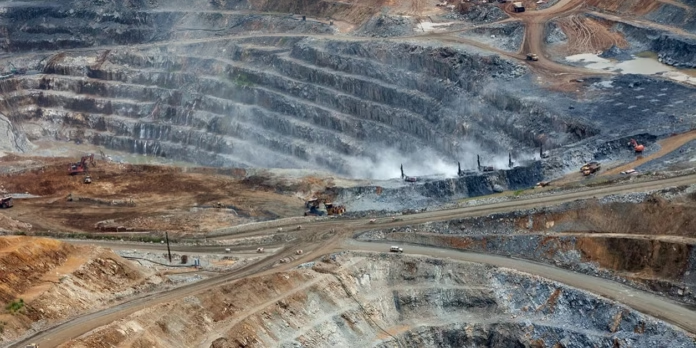
KINSHASA, DR CONGO – The Democratic Republic of Congo is tightening state control over geological data on its vast mineral resources, giving Kinshasa a potentially powerful new tool as global competition for African copper, cobalt and other critical minerals intensifies.
The government is accelerating geological mapping, airborne surveys and the digitisation of historical records. It plans to bring the information together in a national geological databank that should become fully operational by the end of 2026.
The strategy represents an important shift in how DR Congo manages its mineral wealth. Instead of focusing only on controlling what leaves the ground, the government increasingly wants greater authority over the information that determines where companies explore and what they may discover next.
That information carries considerable commercial value. Geological data can guide exploration companies towards promising deposits, reduce the cost of finding minerals and influence where investors commit billions of dollars in future mining projects.
DR Congo already dominates global cobalt production and ranks as the world’s second-largest copper supplier. Yet the National Geological Survey of Congo estimates that systematic exploration has covered only about 20% of the country.
That leaves enormous areas with limited modern geological information despite known deposits of copper, cobalt, lithium, tantalum, gold and other minerals.
A US$180 million contract with Spanish geodata specialist Xcalibur forms a major part of the government’s mapping programme. Work began in January and will survey more than 700,000 square kilometres using airborne geophysics, digitised information and advanced analysis.
DR Congo plans to keep control of the resulting national databank rather than adopting a fully open-access model. Basic geological information will remain available free of charge, while companies will pay to access more sensitive datasets.
Authorities say requests will balance investor needs with the country’s strategic interests. Revenue from some geological information could also help finance continued mapping and exploration.
The approach could strengthen DR Congo’s position when negotiating with mining companies. Governments with detailed knowledge of their mineral resources can enter licensing and investment discussions with a clearer understanding of what lies beneath their territory and what those deposits could be worth.
It could also reduce the informational advantage held by companies already operating in the country. New investors may gain access to geological intelligence that would otherwise require years of exploration and considerable capital to develop independently.
DR Congo’s push comes as the United States and China compete for access to critical minerals that underpin electric vehicles, batteries, electricity networks, defence technologies and advanced manufacturing.
Both powers have pursued agreements with Kinshasa as they seek more secure mineral supply chains. China already holds a powerful position in Congo’s mining industry, while Washington has increased efforts to develop alternative partnerships across Africa.
Congolese officials insist the geological databank will not favour either side. The government instead wants to diversify its investor base and apply the same access rules regardless of where companies originate.
That position gives the project wider significance. Control over geological intelligence could allow African mineral producers to influence not only today’s exports but also where tomorrow’s mines emerge.
DR Congo has already demonstrated its ability to influence international mineral markets. A cobalt export ban introduced in 2025, followed by a quota system, helped tighten supply after prices had fallen sharply. Cobalt prices subsequently recovered.
Geological data could provide a different form of leverage because it acts much earlier in the mining cycle. Export restrictions influence minerals already produced, while geological intelligence can shape which deposits investors discover, finance and develop years before production begins.
DR Congo is not alone in treating mineral information as strategic infrastructure. Other resource-rich countries are strengthening national geological databases as governments recognise the economic value of controlling high-quality information about their natural resources.
The model nevertheless carries risks. Mining investors often favour open geological databases because easy access can reduce exploration costs and encourage competition. A tightly controlled system could discourage investment if companies view access rules as expensive, unpredictable or vulnerable to political influence.
Transparency will therefore become critical. The value of the new system will depend on whether DR Congo applies access rules consistently and prevents established operators or politically connected interests from gaining privileged information.
If implemented effectively, the national databank could help Kinshasa negotiate from a stronger position while attracting a wider range of investors into areas that remain largely unexplored.
The bigger shift lies in what DR Congo now considers valuable. Copper and cobalt remain among its most important resources, but the knowledge of where future deposits may lie is becoming an asset in its own right.
As global powers compete for Africa’s critical minerals, controlling that knowledge could give DR Congo greater influence over who explores its resources, where investment flows and how the next generation of mines develops.