


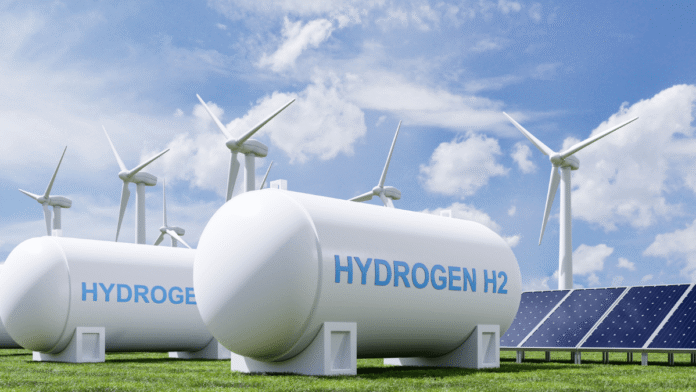
Namibia is positioning itself at the forefront of Africa’s green hydrogen industry with an operational facility at Walvis Bay that combines solar generation, hydrogen production and battery storage in a single off-grid energy system.
The CMB.TECH Namibia facility at Farm 58 uses a 5-megawatt-peak solar park to power a 5MW electrolyser, supported by a 5.9MWh battery storage system. Developers describe it as Africa’s first fully integrated green hydrogen facility, designed to demonstrate how renewable power can produce clean fuel for transport and industrial applications.
Unlike many of the large green hydrogen projects proposed across Africa, the Walvis Bay development is already producing hydrogen. CMB.TECH says it launched the facility in September 2025 as the first stage of a wider plan to develop hydrogen and ammonia production around Namibia’s Atlantic coast.
The project is relatively small compared with the multi-billion-dollar hydrogen developments proposed elsewhere in Namibia. Its significance lies instead in bringing several parts of the hydrogen value chain together at one operating site.
About 7,000 solar panels generate electricity across a 6.5-hectare solar park. That power feeds the electrolyser, which uses electricity to separate water into hydrogen and oxygen, while battery storage helps manage fluctuations in solar generation.
Because the electricity comes from renewable energy, the resulting hydrogen can be produced without the carbon emissions associated with conventional hydrogen made from fossil fuels.
CMB.TECH plans to use the fuel in transport and industrial applications, including dual-fuel trucks, generators and railway operations. The wider programme includes work with TransNamib and Africa Global Logistics on a hydrogen-powered freight locomotive intended for the Walvis Bay-Windhoek corridor.
Heavy transport is emerging as one of the sectors where green hydrogen could have particular value. Trucks, locomotives, ships and some industrial processes can be difficult to decarbonise entirely through battery electrification because of their energy requirements and operating distances.
Walvis Bay gives the project another strategic advantage. The port sits on major Atlantic shipping routes and provides Namibia with a potential gateway for supplying cleaner fuels to maritime customers while eventually exporting hydrogen-derived products.
CMB.TECH’s broader plan includes an ammonia storage and bunkering facility at Walvis Bay’s North Port. Green hydrogen can be combined with nitrogen to produce green ammonia, which is increasingly being considered as a lower-carbon fuel for shipping and as a way to transport renewable energy internationally.
The company also plans a much larger solar-powered hydrogen and ammonia development at Arandis, inland from Walvis Bay, where strong solar conditions could support production on a substantially larger scale.
Namibia’s natural conditions have made it one of Africa’s most closely watched emerging green hydrogen markets. The country has extensive land, strong solar irradiation and access to Atlantic ports, creating favourable conditions for producing renewable energy at scale.
CMB.TECH estimates that Namibia receives about 300 sunny days and more than 3,000 hours of sunshine annually. Solar irradiation can reach between 2,200 and 2,400 kilowatt-hours per square metre each year, giving developers access to some of the strongest solar resources available globally.
Those advantages have attracted international interest as governments and companies search for locations capable of producing green hydrogen and ammonia competitively.
Namibia has made the sector part of its longer-term economic development strategy. The government wants green hydrogen investment to support industrialisation, infrastructure development, exports and employment while reducing dependence on imported fossil fuels.
Turning that ambition into a commercially viable industry will be more difficult than attracting project announcements.
Green hydrogen remains expensive to produce in many markets, while major projects require substantial renewable electricity generation, water, transport infrastructure and guaranteed customers. Several proposed developments around the world have faced delays as developers struggle to secure financing and long-term buyers.
The Walvis Bay project attempts to address part of that challenge by linking production directly with potential uses.
CMB.TECH is itself an important prospective customer for low-carbon fuels. The Belgian-headquartered maritime group operates a fleet of about 250 vessels and is investing in hydrogen and ammonia technologies as it seeks to reduce emissions across shipping and heavy transport.
Producing fuel close to potential users creates an opportunity to test the technology before attempting much larger export-oriented developments.
CMB.TECH chief technology officer Roy Campe has described the Walvis Bay facility as a living laboratory for an integrated hydrogen economy. The company wants to use the site to develop technical knowledge, test applications and establish the infrastructure required for future expansion.
Skills development forms another part of that strategy.
The site includes a Hydrogen Academy intended to build local expertise in hydrogen production and applications. Training Namibian technicians and engineers could become increasingly important if the country succeeds in attracting the larger projects currently under development.
Recent local reporting says 24 of the facility’s 25 employees are Namibian, strengthening the project’s local employment component as the industry develops.
Technology group Siemens supplied electrical, automation and safety systems used to integrate the solar generation, battery storage, electrolyser and other components. Bringing those technologies together is critical because the facility must manage variable solar generation while maintaining reliable hydrogen production.
Expansion plans could eventually take the Walvis Bay operation far beyond its current 5MW scale. CMB.TECH has outlined ambitions to increase capacity to 250MW and later 500MW as demand develops.
Those targets remain future plans rather than operating capacity, making the performance of the existing facility an important early test.
The project also sits within a much larger Namibian hydrogen landscape. Several developments have been proposed as the country seeks to become a producer and exporter of green hydrogen and ammonia, potentially supplying markets in Europe and elsewhere.
Success would give Namibia an opportunity to convert its renewable energy resources into an export industry while building domestic infrastructure and technical expertise.
However, the economic benefits will depend on more than the volume of hydrogen produced. Local employment, skills transfer, infrastructure investment and participation by Namibian businesses will help determine how much value remains within the domestic economy.
Large-scale hydrogen production also requires careful management of water, land and electricity resources. Those considerations will become more important as projects move from demonstration facilities towards industrial production.
Walvis Bay therefore represents an early but tangible step in Namibia’s larger energy strategy. Rather than existing only as an investment proposal, the facility provides an operating example of how solar power, battery storage, hydrogen production and transport applications can work together.
Africa’s green hydrogen ambitions have often been defined by enormous projects promising future production. Namibia’s smaller Walvis Bay facility offers a different test: whether an operating project can build the technology, skills, customers and infrastructure required to support a much larger hydrogen industry.
If that model can scale commercially, Namibia could move beyond being a promising location for renewable energy and become an important production and logistics hub for the low-carbon fuels expected to reshape parts of global transport and industry.