


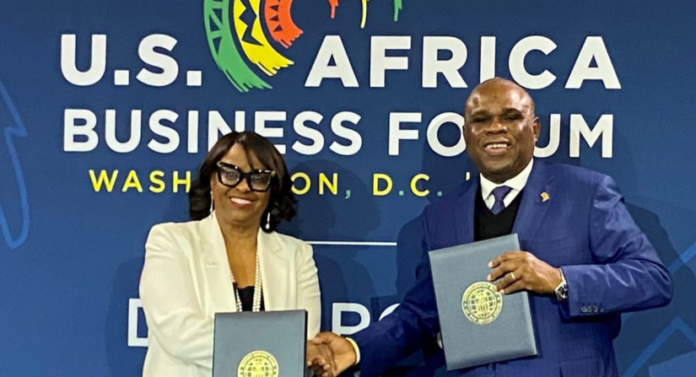
WASHINGTON — African governments and businesses will present about $4 billion in investment opportunities to global investors in Washington next week, with organisers targeting $500 million in signed agreements across strategic sectors.
The Africa Business Investment Summit will take place on 27 and 28 August at MGM National Harbor in the Washington, D.C. metropolitan area. It will bring African projects before institutional investors, development finance institutions, private equity firms and other sources of global capital.
Opportunities span infrastructure, energy, mining, agriculture, manufacturing and technology. Organisers want the summit to focus on projects seeking capital rather than broad discussions about Africa’s investment potential.
Crucially, the $4 billion represents an investment pipeline rather than committed funding. Organisers say it includes projects seeking finance and transactions already under negotiation.
The $500 million target also requires distinction. It refers to Memoranda of Understanding and Letters of Intent that organisers hope to secure around the summit. These agreements can advance negotiations but do not necessarily represent capital already invested.
That distinction places execution at the centre of the gathering. African economies have significant infrastructure and industrial investment needs, but turning project pipelines into finance remains a persistent challenge.
Investors often require stronger project preparation, predictable regulation and clearer risk structures before committing long-term capital. Currency volatility and political risk can also affect investment decisions across individual African markets.
The Washington summit will use sector-focused deal rooms and direct meetings to connect project owners with potential financiers. Organisers hope this approach will move projects closer to transactions rather than ending with investment pledges alone.
Diaspora capital will also feature prominently. The programme is expected to explore how African economies can move beyond remittances and attract more diaspora wealth into businesses, infrastructure and other productive investments.
That conversation comes as African governments search for wider sources of private capital. High debt-servicing costs and pressure on public finances have made it increasingly difficult for governments to finance major development projects alone.
Critical minerals are another important part of the investment landscape. Global demand for copper, lithium, cobalt and other resources has intensified competition around African mineral supply chains.
African governments increasingly want that interest to generate more domestic value through processing and manufacturing rather than relying mainly on raw commodity exports. Investment in electricity, transport and logistics will be essential if countries want to build those industries competitively.
Technology also presents opportunities as fintech, cloud computing and digital services expand across the continent. Growth in those sectors is creating demand for data centres, connectivity, payment infrastructure and other digital systems.
Several senior African political and financial figures are expected in Washington. They include Ghana’s Vice-President Jane Naana Opoku-Agyemang, Finance Minister Cassiel Ato Forson and Bank of Ghana Governor Johnson Asiama. Lagos State Governor Babajide Sanwo-Olu is also expected to participate.
The summit is being held under the royal patronage of Asantehene Otumfuo Osei Tutu II, King of Asante, who is scheduled to deliver the Royal Keynote Address. His involvement forms part of a wider effort to connect African leadership with investors and the global African diaspora.
Private-sector participants are also expected to contribute to discussions around investment and entrepreneurship, giving businesses direct access to financiers looking for opportunities across African markets.
Yet the summit’s significance will ultimately depend on what happens after Washington. Memoranda and Letters of Intent can signal investor interest, but projects still need to reach financing, construction and commercial operation before they deliver economic value.
That makes the $500 million target an important first measure rather than the final measure of success.
Africa does not lack investment opportunities. Across the continent, governments need capital for electricity, transport, industrial development, technology and businesses capable of creating employment.
The harder task is turning those needs into projects investors consider financially viable.
Washington will provide another opportunity to bridge that gap. If organisers can move a meaningful share of the $4 billion pipeline towards financing, the summit could demonstrate a more transaction-focused model for attracting global capital into African development.