


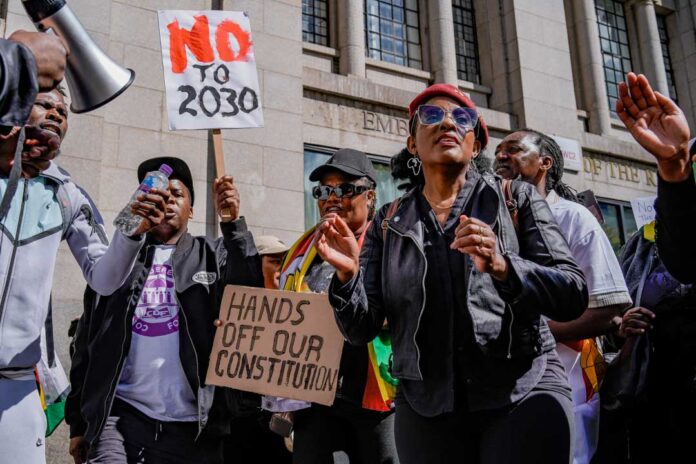
Zimbabwe’s planned nationwide protest on 31 July ended without the large street demonstrations organisers had anticipated, despite weeks of online mobilisation against the country’s latest constitutional reforms.
Police maintained a visible presence in Harare, Bulawayo and other major centres throughout the day. Most businesses remained open, although some traders delayed opening or closed early because of uncertainty over possible unrest. Public transport continued operating, and authorities reported no widespread disturbances.
The protest call centred on Constitution Amendment Act No. 3, which has become one of Zimbabwe’s most debated pieces of legislation this year. Supporters describe it as a lawful constitutional reform passed through Parliament. Critics argue that the changes alter fundamental democratic processes and should have been decided through a national referendum.
Although the streets remained largely calm, the political and legal debate surrounding the amendment continues. The demonstrations focused on Constitution Amendment Act No. 3, which Parliament approved before President Emmerson Mnangagwa signed it into law in July.
The amendment extends parliamentary and presidential terms from five years to seven years. It also postpones the next harmonised elections from 2028 to 2030. Another provision changes how future presidents will be chosen by allowing Parliament to elect the head of state instead of a direct national vote.
Government officials say the reforms followed the constitutional amendment process. They argue that longer terms will improve policy continuity, reduce election costs and provide greater institutional stability.
Opposition politicians, constitutional lawyers and several civil society organisations disagree. They argue that changes affecting presidential elections and the length of elected terms require direct public approval through a referendum.
Lawyers have already filed legal challenges, and the courts are expected to consider several aspects of the amendment in the coming months.
Police increased patrols before dawn on Friday and established checkpoints on several roads leading into Harare’s city centre.
Security officers also maintained a visible presence near government buildings, transport hubs and key commercial districts. Authorities had urged citizens to avoid unlawful gatherings and warned that police would enforce public order where necessary.
Despite the heightened security, there were no reports of sustained clashes between demonstrators and law enforcement.
Activity varied across the country. Some businesses chose to open later than usual, while others operated normally. Schools in some areas remained closed as a precaution, but many workplaces continued trading.
The contrast between the extensive preparations and the limited public demonstrations became one of the defining features of the day.
The absence of large crowds does not necessarily reveal how Zimbabweans view the constitutional changes. Some people may have agreed with the protest call but decided not to participate. Others may have stayed at home because they feared violence or arrest. Many informal traders and self-employed workers also rely on daily income, making it difficult to miss work even when they support a political cause.
Without independent data on workplace attendance, public transport usage or business activity, it is impossible to measure how many people deliberately observed the shutdown. The day’s events therefore offer only a partial picture of public opinion.
Zimbabwe has experienced several waves of public demonstrations over the past two decades. Some protests attracted thousands of participants and reshaped the country’s political conversation. Others generated significant attention on social media but produced only limited activity on the ground.
Political researchers have linked this shift to several factors. Economic hardship has increased the cost of missing work. Repeated arrests of activists have also raised concerns about personal safety. At the same time, divisions within opposition politics have made sustained national mobilisation more difficult.
These factors help explain why online campaigns often attract widespread attention but struggle to generate large public gatherings.
Digital platforms remain powerful tools for communication. They do not automatically translate into coordinated national action.
Friday’s events did not settle the dispute surrounding Constitution Amendment Act No. 3. The legal challenges continue, and constitutional experts remain divided over whether Parliament had the authority to approve reforms that significantly change Zimbabwe’s electoral system without seeking direct public approval.
The debate extends beyond Zimbabwe. Across Africa, governments have introduced constitutional amendments affecting presidential terms, electoral systems and governance structures. Those reforms have often sparked wider discussions about democratic accountability, constitutional stability and public participation.
Regional organisations, governance experts and election observers have consistently argued that constitutional reforms gain greater legitimacy when governments engage citizens through transparent consultation and broad political consensus.
The limited public demonstrations should not be interpreted as the end of opposition to the amendment. Political disputes do not unfold only in the streets. They also develop through court proceedings, parliamentary debate, public consultation and civic engagement.
Zimbabwe’s constitutional changes are now likely to face their most significant tests in those institutions rather than through mass demonstrations.
How the courts interpret the amendment, how Parliament responds to future legal challenges and how citizens continue to engage with the issue may ultimately shape its long-term impact.
The events of 31 July illustrate a broader trend visible across several African democracies. Constitutional reform has become one of the continent’s most contested political issues, particularly where changes affect electoral systems or the length of elected terms.
Zimbabwe now joins a growing list of countries where debates over constitutional change extend well beyond the passage of legislation. The immediate protest may have passed quietly, but the wider discussion about democratic governance, constitutional legitimacy and public participation is unlikely to disappear.
The streets remained calm. The constitutional debate did not. That conversation now moves to the courts, Parliament and the broader public arena, where its consequences may shape Zimbabwe’s political future for years to come.