


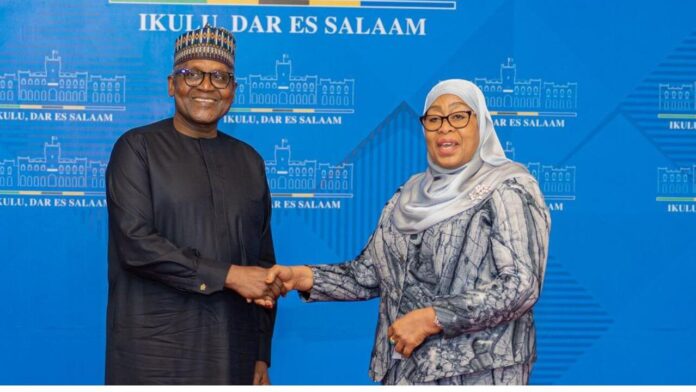
DAR ES SALAAM: Tanzania has taken steps to maintain its role in a key East African energy initiative following President Samia Suluhu Hassan’s meeting with Nigerian billionaire Aliko Dangote in Dar es Salaam.
The meeting at State House on May 16, 2026, occurred as East Africa considers the location for a proposed oil refinery valued at $15–17 billion, with a planned capacity of 650,000 barrels per day.
The initial regional industrialisation proposal has become a strategic competition between Tanzania’s Tanga and Kenya’s Mombasa. For Tanzania, meeting with Dangote signals its intent to remain influential in a project that could transform fuel supply, port operations and industrial growth in East Africa.
Kenyan President William Ruto first placed Tanga at the centre of the plan when he said East African countries were discussing a joint refinery at the Tanzanian port. Reuters reported that the plan involved Kenya, Tanzania and neighbouring countries, with Dangote saying he could replicate his 650,000-barrel-per-day Nigerian refinery in East Africa if governments supported the project.
However, Dangote later indicated a preference for Mombasa. In interviews with the Financial Times and Reuters, he cited Mombasa’s larger, deeper port, a bigger economy, and higher fuel demand compared to Tanga. He also noted that the final decision depends on President Ruto’s support. For Kenya, Mombasa offers established petroleum infrastructure, a major port and access to regional markets.
Kenya Ports Authority data shows Kipevu Oil Terminal II can accommodate vessels up to 120,000 deadweight tonnes with a 14.5-metre draft. For Tanzania, Tanga remains strategically significant. The port is near the East African Crude Oil Pipeline, which connects Uganda’s Hoima oil fields to Chongoleani in Tanga. The Citizen reported that Hoima could produce about 230,000 barrels per day once commercial production begins, while EACOP is jointly owned by TotalEnergies, Tanzania Petroleum Development Corporation, Uganda National Oil Company and CNOOC.
The selected site must provide crude supply routes, land, financing, storage, export access, political stability and assured demand. It must also demonstrate regional benefits rather than serving only national interests.
The refinery is significant because East Africa currently imports all refined petroleum products, mainly from the Middle East. This reliance exposes the region to supply disruptions, shipping challenges and price volatility. A regional refinery could reduce dependence and enhance fuel security for East African economies.
President Samia’s meeting with Dangote appears to be more than a courtesy call. It allows Tanzania to re-engage in discussions after concerns that the Tanga proposal was made public before proper consultation with Dodoma. The East African reported that President Samia challenged Ruto over the announcement, prompting clarification during his visit to Tanzania.
Tanzania is also interested in expanding the discussion beyond oil refining. The Citizen reported that President Samia welcomed Dangote’s initiative and encouraged the Dangote Group to consider additional investments in Tanzania, including fertiliser production to meet growing domestic demand.
This is significant because Dangote’s industrial model extends beyond oil. His business interests include cement, fertiliser, energy, logistics and large-scale manufacturing. For Tanzania, continued engagement with Dangote could advance broader industrial goals, particularly in construction, agriculture, gas utilisation and export-oriented manufacturing.
However, Tanzania faces a challenge. Dangote’s stated preference for Mombasa strengthens Kenya’s position. Mombasa has an established role in regional petroleum, a larger consumer market and greater logistics capacity. Tanzania must now demonstrate that Tanga is commercially competitive, not just politically viable.
The Dar es Salaam meeting does not guarantee Tanzania the refinery. Instead, it signals that Tanzania has rejoined high-level discussions. The project still depends on investor confidence, government guarantees, regional equity, land allocation, crude supply agreements and long-term safeguards against low-cost imported fuel.
If completed, the refinery could become one of East Africa’s largest industrial investments. It will also test whether African governments can collaborate on shared infrastructure rather than turning regional opportunities into bilateral competition.
Currently, the competition between Tanga and Mombasa highlights a broader issue for Africa: whether the continent will develop integrated industrial assets for regional markets or pursue infrastructure projects that are only effective through regional cooperation.