


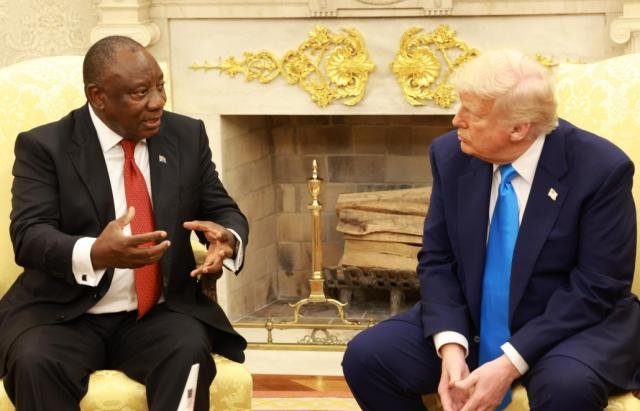
What began as a routine diplomatic engagement quickly became confrontational when former US President Donald Trump confronted South African President Cyril Ramaphosa with unfounded claims of a so-called “white genocide” in South Africa.
The meeting opened on a light note, with Trump joking about golf and his friendships with South African sports figures. The mood shifted abruptly when Ramaphosa rejected Trump’s long-standing assertion that white South Africans face systematic persecution.
In a move that stunned attendees, Trump instructed staff to dim the lights and play a video intended to support his claims.
The footage showed former South African president Jacob Zuma and opposition leader Julius Malema singing “Kill the Boer”, an apartheid-era protest song. It also included unverified images of graves marked with white crosses, which Trump claimed belonged to murdered white farmers.
Ramaphosa responded calmly. He explained that the images did not reflect government policy and acknowledged South Africa’s serious problem with violent crime across all communities.
Debunked white genocide Claims Versus Statistical Reality
Trump continued to press the narrative, a conspiracy theory popular among far-right groups, insisting that white farmers were being targeted. “They’re being executed and they happen to be white,” he said.
Crime statistics paint a different picture. South Africa experiences high levels of violent crime, but the majority of victims are Black South Africans. White citizens, who make up about 7 per cent of the population, still control roughly half of the country’s land and retain disproportionate economic privilege.
DON’T MISS THIS: South Africa Defends Naval Drills With Russia, China and Iran
Ramaphosa drew on his experience as a negotiator during South Africa’s transition from apartheid. He avoided direct confrontation while reaffirming constitutional protections for all citizens.
His restrained response highlighted the difficulty of addressing complex racial and economic issues in a global political climate shaped by polarisation and misinformation.
Strained US–South Africa Relations in the Background
The exchange occurred against the backdrop of worsening diplomatic ties. The Trump administration previously cut aid to South Africa, imposed steep tariffs, and expelled a South African diplomat.
Relations deteriorated further after South Africa filed a genocide case against Israel at the International Court of Justice, a move that drew sharp criticism from Washington.
Elon Musk and Economic Undercurrents
Tech billionaire Elon Musk attended the meeting, adding another layer to the discussion. Musk has publicly echoed similar claims about South Africa and has faced licensing challenges for Starlink due to Black economic empowerment requirements.
His presence underscored how race, investment, and economic policy continue to intersect in debates about South Africa’s future.
After the meeting, Ramaphosa downplayed the confrontation while standing firm on the facts. He suggested Trump appeared unconvinced by his own genocide claims and may have been performing for political audiences.
The incident raises broader questions about how racial dynamics in developing countries are framed in Western political discourse. As South Africa continues grappling with land reform and economic transformation, the Oval Office clash shows how easily complex national realities can become distorted on the international stage.
For policymakers and observers, the episode serves as a cautionary case study in how misinformation can derail diplomacy and overshadow substantive discussions about race, justice, and economic inequality.