
In March 2026, a wave of anti-American and anti-Israeli protests swept through Bauchi, Kano, Lagos, Sokoto, and several other Nigerian cities. The demonstrations followed the death of Ayatollah Khamenei during the Iran war and were led by the Islamic Movement of Nigeria (IMN), a Shi’a network banned by the Nigerian government in 2019 but still active.
The unrest prompted the US Mission in Abuja to halt visa issuance between March 4 and 8. At the centre of the story are the IMN and its leader, Sheikh Ibrahim Zakzaky, Iran’s Islamic Revolutionary Guard Corps Quds Force (IRGC-QF), Lebanese Hezbollah, and Nigerian security forces.
IMN mirrors Iran’s “resistance” rhetoric and frames the war as a Muslim cause; Iran-Hezbollah financing and media (Hausa TV, Al‑Manar) nurture the link. Money, training, and social‑welfare models from Lebanon give IMN protest capacity; Nigerian security responses and the state’s 2019 ban create a governance loop in which African civilians bear the risk of escalation.
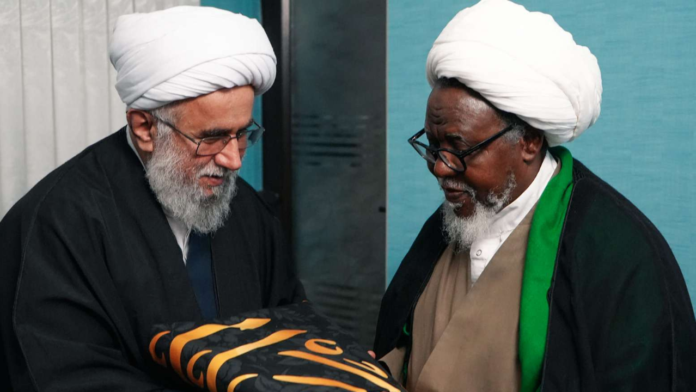
IMN rallies serve as the African channel for Tehran’s anti‑US messaging. Demonstrations in 10 states, “Death to America” chants, and a US Mission warning highlight the IMN’s reach and impact. Zakzaky, as IMN leader, has visited Khamenei in Iran and appeared on Iranian TV, further amplifying Iranian regime narratives. Protests provide Iran with deniable pressure in Africa, but Nigerian authorities, tasked with maintaining public order, focus on the law enforcement aspect rather than foreign influence, leaving intelligence gaps.
Nigeria’s crackdown in 2015 killed 300 people, and the group was banned in 2019. These actions fuel grievance but do not resolve Iran ties. IMN claims 5‑10 million members, vs about 4 million Shi’a nationally. Smaller killings keep happening. Without transparent trials, dissent and proxy risk get mixed. This weakens the rule‑of‑law accountability and avoids the AU non-interference protocols.
IMN receives $120k per year from Iran. Its members get Hezbollah training in Lebanon, access Hausa‑language media, and work with IRGC‑QF cells. Nigerian arrests in 2010/2013 and again from 2019-2022 set a precedent, as do plots in South Africa, Ethiopia, and Ghana. Money and media help IMN copy Hezbollah’s welfare‑recruitment model. Security forces focus on protests, not finance, so governance misses the leverage. ECOWAS still lacks a reporting line for foreign‑state movements.
Some argue IMN is a homegrown revival, not an Iranian cell. Zakzaky’s 1980s roots came before recent cash flows. However, Iranian funds, Al‑Manar interviews, and Hausa TV keep IMN’s scale and messaging alive. Others say the protests are peaceful. Still, IRGC‑QF African plots between 2019 and 2022 show rallies can hide attack planning. Embassies, not African parliaments, weigh the associated risk.
African accountability must tackle finance and norms, not just violence. The US Treasury’s 2015 Hezbollah sanctions, IMN’s ban, and Zakzaky’s Mashhad office show the interconnected web. Nigeria could force religious‑political groups to reveal foreign funding.
The AU could review platforms like Hausa TV. ECOWAS could link policing to non‑violent assembly standards rather than blanket bans. These steps will not end Tehran’s influence, but they shift risk from the streets to policy frameworks.