


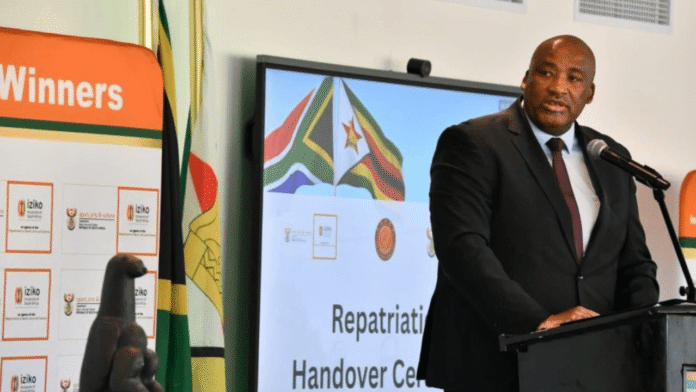
South Africa has returned eight sets of ancestral human remains and the last Zimbabwe Bird in its possession to Zimbabwe, in a gesture that reaches far beyond museum practice. The handover took place in Cape Town and brought home people and objects that colonial power had turned into specimens, trophies and possessions.
The remains had been taken from graves during the colonial period and later kept in museum collections. Officials said they were removed without consent and absorbed into a system that treated African bodies as material for study rather than as people who belonged to families, communities and histories.
That is what made the ceremony so heavy with meaning. Coffins draped in the Zimbabwean flag stood in the museum space where the repatriation was marked. What had once been stripped of dignity was being named, claimed and restored.
South African Sports, Arts and Culture Minister Gayton McKenzie made the wider point plainly. “We must return what doesn’t belong to us, because we cannot ask Europe, Asia, the West, all the different countries in the world to return our remains of our ancestors, to return our artefacts whilst keeping stolen artefacts… We are an ethical state. The government of national unity wants to do things in the right way,” he said.
That statement matters because it cuts to an uncomfortable truth. Africa has long asked former colonial powers to return what they looted. But that demand also carries responsibility inside the continent itself. If African states hold what was taken from other African peoples, the same moral principle applies.
Zimbabwe’s delegation framed the return in equally powerful terms. Reverend Paul Bayethe Damasane, Deputy Chief Secretary to the President and Cabinet, described it as an act of repair. “As I called it, it is a remembering of what we were dismembered before, and to us it’s very significant. It’s an identity marker,” he said. The return of the Zimbabwe Bird added another layer of significance to the moment.
This was not just an old carving coming home. The Zimbabwe Bird is one of the country’s most important national symbols. It appears on the flag, the coat of arms, coins and banknotes. The soapstone figures come from Great Zimbabwe, the centre of a powerful pre-colonial civilisation. Colonial removal turned one of Africa’s clearest symbols of history and statehood into an object for possession. Returning it helps restore more than heritage. It restores meaning.
Restitution is often discussed in legal terms, or in the language of diplomacy and heritage policy. But its deepest force is human. It asks whether the dead can be honoured, whether stolen memory can be acknowledged and whether states are willing to do what is right even when the theft took place generations ago.
South Africa’s decision does not erase the violence that removed these remains and artefacts in the first place. Nothing can do that. But it does show that history can be answered with something other than silence.
Zimbabwe will now take the remains home for burial with dignity. That matters because closure cannot happen while ancestors remain trapped inside institutions built on conquest. This is why the handover deserves to be seen for what it is: not a ceremonial exchange, but an act of justice long delayed.