


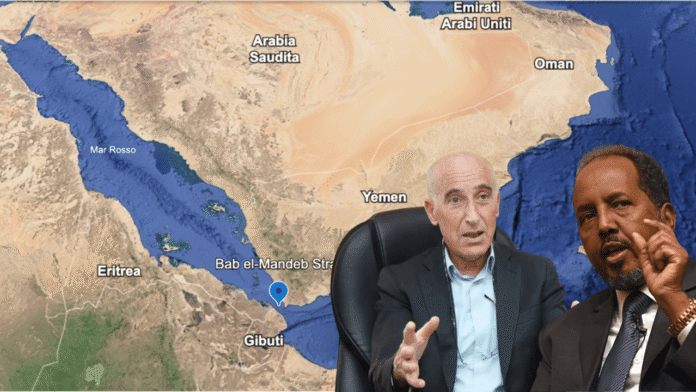
Mogadishu — Somalia has threatened to review access to the strategic Bab al-Mandab Strait following Israel’s appointment of an ambassador to the breakaway region of Somaliland, a move Mogadishu condemns as a direct violation of its sovereignty and territorial integrity.
The warning came from Somalia’s ambassador to Ethiopia and the African Union, Abdullahi Warfaa, who took to his X account to issue what analysts describe as one of the strongest diplomatic responses yet from Somali officials. “Any country interfering in Somalia’s internal affairs and compromising its territorial integrity and sovereignty will face repercussions, including potential restrictions on access to the Bab-el-Mandeb Strait,” Warfaa wrote.
The Bab al-Mandab Strait, located between Djibouti and Yemen, serves as a critical maritime chokepoint connecting the Red Sea to the Gulf of Aden. It is one of the world’s busiest shipping lanes, carrying significant volumes of global trade and energy supplies en route to the Suez Canal. Any disruption to access would have immediate and far-reaching consequences for international commerce.
The diplomatic crisis erupted after Israel appointed Michael Lotem as its first ambassador to Somaliland on April 15, following Israel’s December 2025 announcement of mutual recognition with the self-declared republic. Somalia’s Ministry of Foreign Affairs immediately condemned the move, calling it “a direct breach of Somalia’s sovereignty, unity and territorial integrity” that contravenes international law, including the United Nations Charter and African Union principles.
Somalia’s statement emphasised that Somaliland remains “an integral part of the Federal Republic of Somalia” and that any effort to portray it as a separate state lacks legal standing under international law. The government urged Israel to reconsider and reverse its decision, warning that the action could undermine efforts to consolidate national institutions and pose risks to regional stability.
Speaking at the Anatly Diplomacy Forum, Somalia’s State Minister for Foreign Affairs, Ali Omar, warned that Israel’s recognition of Somaliland would plunge the region into turmoil. He said it would invite more radical groups and turn the region into a new global theatre.
Somaliland swiftly rejected Somalia’s condemnation, asserting its status as a sovereign state with historical and legal standing independent of Mogadishu’s authority. “The Republic of Somaliland is a sovereign state. It attained independence on 26 June 1960 and was recognised by the international community in its own right. This sovereignty neither originated from, nor is contingent upon, any authority in Mogadishu,” Somaliland said in an official statement.
Somaliland’s Foreign Ministry described its diplomatic engagements as an exercise of sovereign prerogatives not subject to approval by Somalia’s federal government. It reaffirmed its commitment to peaceful coexistence and regional stability while declaring its sovereignty non-negotiable.
In a subsequent statement responding to international condemnation, Somaliland noted that its “engagement with international partners reflects evolving diplomatic practice and does not constitute a violation of any state’s sovereignty”. Somaliland officials have also signalled confidence that more countries will extend recognition in the coming days or months, though no specific timeline or additional nations have been named.
More than 100 countries have condemned Israel’s move, according to diplomatic sources. The most prominent response came in a joint statement issued on April 18 by the foreign ministers of 12 nations: Saudi Arabia, Egypt, Somalia, Sudan, Libya, Bangladesh, Algeria, Palestine, Türkiye, Indonesia, Pakistan, and Kuwait. The statement expressed the “strongest condemnation” of Israel’s appointment, terming it a “flagrant violation of the sovereignty, unity and territorial integrity” of Somalia.
The ministers emphasised that such actions constitute “a blatant violation of the principles of international law, the United Nations Charter and the Constitutive Act of the African Union” and warned that the move “sets a dangerous precedent that risks undermining stability in the Horn of Africa, which reflects negatively on regional peace and security as a whole”.
The Arab League also strongly condemned the appointment, calling it a “serious escalation” and a clear violation of Somalia’s sovereignty. The League warned that such actions pose “a direct threat to Arab national security and stability in the Red Sea, Gulf of Aden, and the Horn of Africa,” and could impact international navigation and trade.
The African Union expressed “deep concern and strongly condemns reports of Israel’s decision to appoint a diplomatic envoy to the so-called ‘Somaliland,’” warning that any attempt to undermine Somalia’s sovereignty risks peace and stability on the continent. The Organisation of Islamic Cooperation similarly reaffirmed its full support for Somalia’s unity and legitimate institutions.
Iran joined the chorus of condemnation on April 20, with Foreign Ministry spokesman Esmaeil Baghaei describing the move as “in blatant contravention of the UN Charter and international law” and accusing Israel of seeking to destabilise Muslim countries.
Through the Port of Berbera on the Gulf of Aden, Ethiopia imports goods, and any closure of this vital maritime strait will impact livelihoods and plunge the country into an economic crisis.
The Yemeni armed group threatened that any military presence in Somaliland or otherwise would be a legitimate target. Previously, the Houthis have attacked vessels on the Bab el Mandeb, causing disruptions to oil shipments along the vital strait, where 12% of world energy passes through.
Analysts contend that Somalia does not currently possess the military might to implement such restrictions, but other groups, like the Houthis, with the capability, might throw themselves into the ring.
Speaking at the Antalya Diplomacy Forum, Somalia’s President Hassan Sheikh Mohamud called the Israeli move “dangerous,” saying it threatens Somalia’s sovereignty and regional stability. He also pointed to strong international support, with over 100 countries opposing Israel’s recognition of Somaliland.
Whether this support leads to action or Somalia follows through on its warning over the Bab al-Mandeb Strait remains unclear. For now, Mogadishu continues to rely on diplomacy amid rising tensions.