


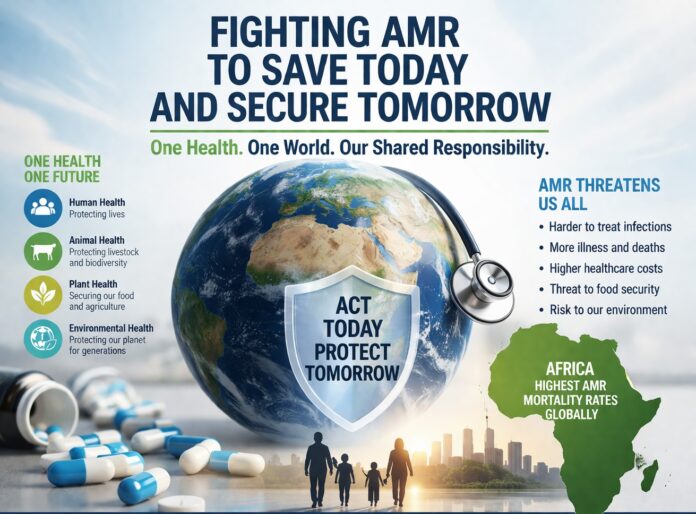
The 5th High-Level Ministerial Meeting on antimicrobial resistance (AMR) will take place in Africa for the first time. Nigeria will host the event from June 28 to 30, 2026, in Abuja.
Held under the theme “One Health, Advancing Global AMR Commitments through Local Action,” the meeting is expected to draw senior delegations from more than 100 countries, including heads of state such as Bola Ahmed Tinubu, who will officiate the opening.
AMR, also known as drug resistance, is a major global health threat. It affects humans, animal populations, food systems, and the environment. Misuse and overuse of antimicrobials drive this challenge, making medicines less effective against infections.
Addressing a global media briefing organised by the Global AMR Media Alliance, Jean Pierre Nyemazi warned, “AMR is a big threat and continues to kill many people, especially in low- and middle-income countries and the Global South.”
The upcoming meeting follows previous editions held in high-income nations such as the Netherlands, Oman, and Saudi Arabia, reflecting a growing shift toward broader global participation, particularly from low- and middle-income countries.
Ayoade Alakija, Ministerial Global Envoy on AMR, said the summit will focus on actionable solutions and funding. “AMR is not just about human health or medicines. Prevention also protects our animals, plants, and environment,” she added.
The conference also aims to accelerate the implementation of the the national AMR action plan. It builds on commitments from the 2024 United Nations General Assembly High-Level Meeting on AMR.
Dr Nyemazi explained the importance of a multi-sectoral approach aligned with the One Health framework, stating, “When we talk about AMR prevention, we are talking about preventing AMR across all sectors.”
Meanwhile, Shobha Shukla, Chairperson of the Global AMR Media Alliance, emphasised the human impact of the crisis, saying, “All of us are at risk of AMR. But in the absence of strong public systems, those in low- and middle-income countries, and especially those who are underserved, are at a much heightened risk of AMR.”
The World Health Organisation reports that AMR caused about 1.27 million deaths in 2019. Around 4.95 million deaths were linked to drug-resistant infections. The Institute for Health Metrics and Evaluation shows AMR now causes about 1.14 million annual deaths. Projections say deaths could reach 39 million by 2050 without major action.
Africa’s AMR burden is even higher. The WHO Regional Office for Africa says Africa has the highest AMR mortality rates worldwide. Over 25% of infection-related deaths are due to drug resistance. Some studies report that more than 70% of common bacterial infections are resistant to first-line antibiotics. This shows the crisis is severe in the region.
Key health groups supporting the meeting include WHO, FAO, UNEP, and the World Organisation for Animal Health. Observers expect stronger political commitment and better financing as outcomes. The event aims to boost global action against antimicrobial resistance and protect public health systems.