
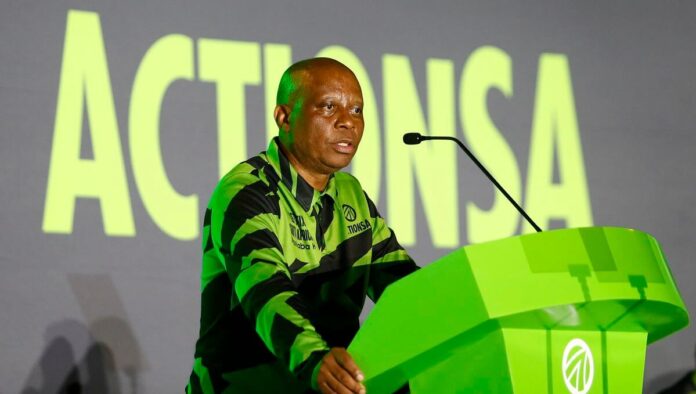
JOHANNESBURG, South Africa – ActionSA has rejected the Democratic Alliance’s (DA) final coalition proposal for Gauteng’s three major metropolitan municipalities, bringing the African National Congress (ANC) and its prospective partners closer to securing control of Johannesburg. The decision follows negotiations involving several political parties after South Africa’s November local government elections produced no outright winner in the country’s economic capital.
ActionSA national chairperson Michael Beaumont said negotiations with the ANC, Economic Freedom Fighters (EFF) and uMkhonto weSizwe (MK) Party were between 90% and 95% complete. The proposed agreement could return ActionSA leader Herman Mashaba to the Johannesburg mayoralty while allowing Nasiphi Moya to continue leading Tshwane.
However, Beaumont confirmed that the parties had not yet signed a final agreement. ActionSA’s national leadership must also approve the proposed arrangement before it becomes binding. Newsday
The latest developments followed a final offer from DA leader Geordin Hill-Lewis on Saturday, 21 November. His proposal would have allowed ActionSA to govern Tshwane under Moya while the DA took control of Johannesburg and Ekurhuleni.
Under the arrangement, Helen Zille would become Johannesburg mayor, while Khathutshelo Rasilingwane would lead Ekurhuleni. The parties would support each other’s mayoral candidates and protect their administrations against motions of no confidence.
ActionSA rejected the terms, arguing that the agreement would exclude it from meaningful executive participation in Johannesburg and Ekurhuleni. BusinessTech
The dispute has centred partly on the political future of Zille and former Tshwane mayor Cilliers Brink. ActionSA had previously proposed an alternative arrangement that would allow the DA to lead Johannesburg and Ekurhuleni, provided both figures stepped aside from their respective mayoral ambitions.
Beaumont said the proposal would also require Mashaba to withdraw from the Johannesburg mayoral contest. ActionSA wanted representation in the executive structures of the two municipalities while retaining Moya as Tshwane mayor.
The DA did not accept those terms. Its subsequent counterproposal deepened disagreements between the parties and increased the likelihood of an alternative coalition involving the ANC.
The political negotiations follow a municipal election in which the DA emerged as the largest party across Johannesburg, Tshwane and Ekurhuleni. In Johannesburg, the party secured approximately 35% of the vote, compared with 20% for the ANC and 16% for ActionSA.
However, the DA fell short of the majority needed to govern independently. The fragmented results have given smaller parties considerable influence over the formation of municipal administrations.
The ANC, ActionSA, EFF and MK Party hold a combined 138 seats in Johannesburg’s 270-member council, exceeding the 136 required for a majority. Their combined representation could allow them to establish a government without the DA if negotiations succeed and councillors support the arrangement. Mail & Guardian
The emerging alliance could also influence municipal leadership across Gauteng. Negotiators have discussed arrangements under which ActionSA would lead Johannesburg and Tshwane, while the ANC would control Ekurhuleni.
These proposals remain subject to final negotiations, internal party approvals and formal council votes.
The coalition battle has wider implications for relations between the ANC and DA, which remain partners in South Africa’s national government of unity. Although municipal arrangements operate independently, growing disagreements could place additional pressure on their national cooperation.
The outcome also carries significant economic consequences. Johannesburg is South Africa’s leading financial centre and a major destination for domestic and international investment.
Successive changes in political leadership have complicated efforts to address deteriorating infrastructure, unreliable municipal services and financial management challenges. Residents and businesses continue to demand improvements in electricity distribution, water supply, roads and public administration.
Political parties entering the next administration will face pressure to demonstrate that coalition agreements can produce stable leadership and measurable improvements in service delivery.
The immediate focus now turns to the finalisation of coalition agreements and the election of municipal leaders. Tshwane’s inaugural council meeting has been postponed to 26 November, while municipalities across the country face a 27 November deadline to convene their new councils. Daily Maverick
ActionSA’s rejection of the DA proposal has strengthened the prospects of an ANC-backed administration in Johannesburg. However, the final outcome will depend on the remaining negotiations, internal approvals and voting in the municipal council.
The result will determine not only who governs Africa’s important financial centre, but also whether South Africa’s increasingly fragmented political system can deliver stable municipal leadership.